
“If you were a Colombian, you would have your version of an empanada. If you are an Argentinean, you might find a dough that’s baked and has a butter sheen on it. And then in Ecuador, you’ll find more crispy-fried empanadas. So, yeah, every culture has their own version of empanadas.” Jose Garces
Derived from the Spanish verb “empanar” which translates to “wrap in bread”, these fried or baked pastries stuffed with sweet or savoury filling, known as empanadas have enjoyed widespread global popularity. Across the Caribbean, Latin America, Portugal, Spain, Italy to as far as Philippines; this dish has its’ own local blends that make it delectable and adaptable to every local cuisine.
“You are the olive in my empanada.” Brazilian Saying
Originally believed to be from Galicia, Spain; the empanadas of today may have been the brainchild of the Moors who had occupied Spain for hundreds of years. The idea of wrapping a hardy filling in pastry dough had led to this little delight. Fillings including seafood have been documented in a cookbook published in Catalan, Spain (1520). With the spread of civilization, trade as well as colonization, this savoury delight had travelled around the world. In fact the first empanadas in Western Hemisphere are credited to Argentina with the US celebrating the National Empanada Day on April 8th. While empanadas are a traditional Christmas treat in New Mexico, they’re known as creoles(southwest and south) or as fried pies (southeast) depending on the locality.


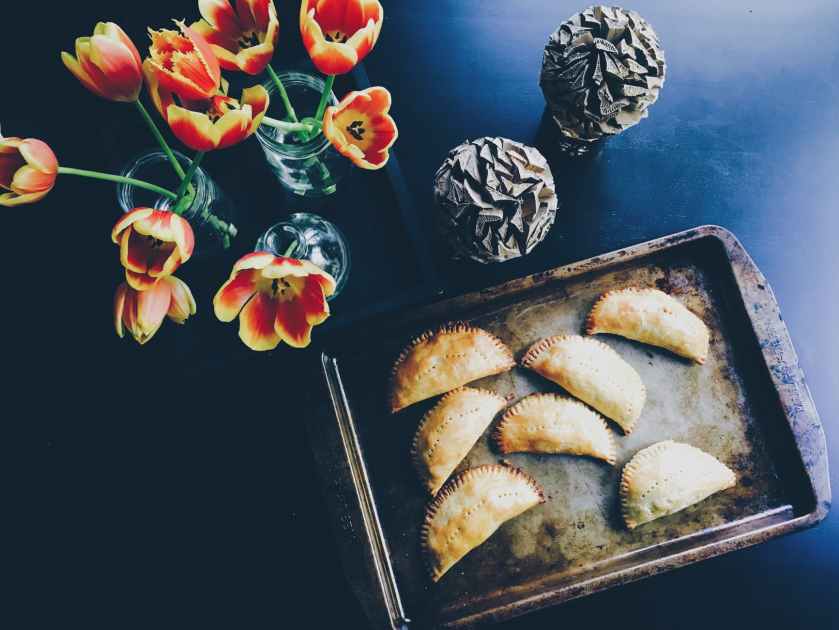
Similar to cut-up pies, empanadas are typically savoury often filled with cod fish or chicken. They are made by folding a disc of thinly rolled dough over the filling into a semicircle and then crimping the edges to seal it. The dough is often made with wheat flour, but can be substituted by corn flour, cornmenal, plantain or potato base, depending on the locally available ingredients. The content of the dough varies on whether the empanadas are to be baked or fried. The art of to make a perfect empanada is to hold the dough spread open, in one hand; while using the other hand to fill it and to crimp the edges. Homemade sweet varients of the empanadas are present in many local cuisines. For instance, the Gujiya is a traditional Indian crescent shaped dessert, similar like a sweet empanada.
There have been various variations similar to empanadas. Catibías, similar to empanadas are made with cassava flour dough with common fillings include ground beef, chicken, guava, and cheese. Pastelitos are similar to empanadas, too, but they’re made with a lighter pastry dough and they can be either baked or fried.


Travelling across the various countries, the ‘Mpanatigghi of Modica (half moon-shaped panzarotti filled with a mixture of almonds, walnuts, chocolate, sugar, cinnamon, cloves and minced beef), meat empanadas (“de pino”) of Chile , panades of Belize and so on, have been the varied presentations of the empanadas. Certain eateries in order to distinguish the varieties, develop a pattern on the pastry fold, crimping style of the edges or burn a letter(an abbreviated indication of the filling) into the dough.
Either way, one of the most easiest delights to be made for a novice cook, are empanadas which serve as quick bites, starters, breakfast, desserts or even for brunches to lunches.
“Don’t be afraid to adapt new ingredients into your own techniques, and traditional ingredients into new recipes.” Jose Garces


 Sugar And Spice... Among Other Things