Posted in Daily, Food, Stories Around the World

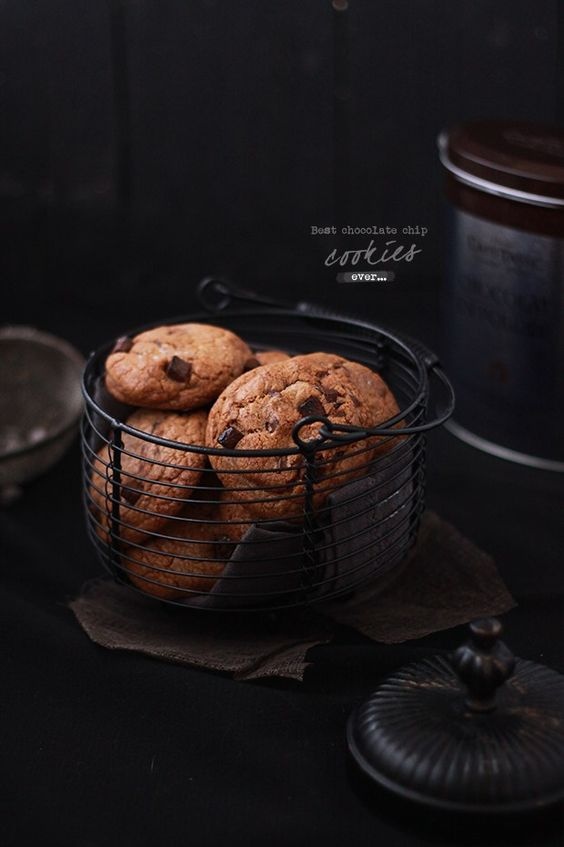
Chip it In, Bake It

Whitman, Massachusetts, 1938

“We had been serving a thin butterscotch nut cookie with ice cream. Everybody seemed to love it, but I was trying to give them something different. So I came up with Toll House cookie. Add up chopped up bits from from a Nestlé semi-sweet chocolate bar into a cookie. The original recipe is called “Toll House Chocolate Crunch Cookies.”
– American Chef Ruth Graves Wakefield, Toll House Inn
(Wakefield, Ruth Graves (1942). Ruth Wakefield’s Toll House Tried and True Recipes. M. Barrows & Company, Inc.)

One of the famous drop cookies, “the chocolate chip cookie” had its’ origins in the early 1900s; wherein chocolate chips or choclate morsels were added to the regular cookie dough as the distinguishing ingredient. With a dough composed of butter, both brown and white sugar, semi-sweet chocolate chips and vanilla; the traditional recipe had evolved. Originally invented by the American chef Ruth Graves Wakefield and chef Sue Brides (1938) when the former owned the Toll House Inn (Whitman, Massachusetts); a popular restaurant that featured home cooking. Wakefield credited Brides with helping her make the famous chocolate chip cookie.

Over the years, variations with different varieties of chocolate, change of ingredients like nuts, oatmeal, raisins and the like paved way. Variations on the original recipe may add other types of chocolate, vegan substitutes as well as additional ingredients such as nuts or oatmeal. The ‘double’ or ‘triple’ chocolate chip cookies are so called when dough flavored with chocolate or cocoa powder are used before chocolate chips are mixed in. These variations of the recipe are often referred to as , depending on the combination of dough and chocolate types.

“If you can’t change the world with chocolate chip cookies, how can you change the world?” Pat Murphy

As the popularity grew, especially during WWII, soldiers from Massachusetts who were stationed overseas shared the cookies they received in care packages from back home with soldiers from other parts of the United States. Soon hundreds of soldiers asked their families to send them some Toll House cookies. Thus began the craze for the chocolate chip cookie with Wakefield receiving letters around the world requesting her recipe.

In proportion to the increased popularity of the choclate chip cookie, the sales of Nestlé’s semi-sweet chocolate used rose. Andrew Nestlé offered Ruth a deal to buy the rights to her recipe, as well as the rights to use her and the Toll House name when advertising his acquisition. The business proposal was accepted by Ruth for one whole dollar and a lifetime supply of Nestlé chocolate. Nestlé quickly launched a new marketing campaign that advertised the chocolate chips primarily as main ingredients for cookies, engraving the recipe for the Toll House Cookie on the package print.

“ One of the best things in life- warm chocolate chip cookies.” Anonymous

In an interview (2017), Sue Brides’ daughter, Peg shared the original recipe that was passed down to her.  The original Toll House cookie recipe, according to Peg:

1 1/2 cups of shortening
1 1/8 cups of sugar
1 1/8 cups of brown sugar
3 eggs
1 1/2 teaspoon of salt
3 1/8 cups of flour (Peg prefers King Arthur all purpose)
1 1/2 teaspoon of hot water
1 1/2 teaspoon of baking soda
1 1/2 teaspoon of vanilla
Chocolate chips (and walnuts)
Bake at 350 degrees for 12-13 minutes
[The Tried and True Recipes cook book specifies “2 bars (7 oz.) Nestlé’s yellow label chocolate, semi-sweet, which has been cut in pieces the size of a pea.”]
(Source:Stephanos, Maria (2017-06-21). “Secret’s out! Here’s the ‘real recipe’ for Toll House chocolate chip cookies”)

With Chocolate Chip Cookie Day being celebrated by foodimentarians tomorrow (August 4th), making similar or own variations of this delectable treat would be a lovely weekend surprise and fun event.

Posted in Family and Society, Life, Personal Musings, Reflections, Stories Around the World, Work

Making the Best Of

“Every experience in your life is being orchestrated to teach you something you need to know to move forward.” Brian Tracy

One of the very common teachings or saying passed on from one generation to the next, especially when hitting road blocks in life are the words “to make the best out of the bad situation”. On hindsight, once when one has landed on other side of the situation, the thought strikes that every “bad situation” has brought out a different side of oneself. Interestingly, whether the “different side” is for the better or the worse depends on oneself alone.

“A pessimist sees the difficulty in every opportunity; an optimist sees the opportunity in every difficulty.” Winston S. Churchill


Have you ever observed a lone ant moving on the ground? When it’s path is blocked, it finds a way around it, scurrying towards the intended or alternate direction somehow. Looking through he glasses of “life”, may of us like these ants are forced to find alternate routes to get to the final point. No matter how big the hindrances may seem, time and life forces one to move on, despite the inner resistance to change from the “deemed normalcy”. As one changes the directions pertaining to the situation, a series of effects are created which when done with the right will, manner, intent and effort will aid in achieving better than what was expected by self or by the world around us. Instead of simply making best of the bad situation; let the “worst situation” bring out the hidden best of ourselves.

“The outcome is not up to you. The outlook is.” Germany Kent


On another occasion, talking to a friend who was concerned about Salmon P. Chase’s ambition for the presidency, and who thought Lincoln should ask Chase to resign, Lincoln observed that Chase’s department was functioning very well, and as long as it continued to do so he would not worry about Chase’s presidential aspirations. The situation reminded him of a time when he and his step-brother were plowing a corn field in Indiana, he driving the horse and his step-brother guiding the plow. The horse, naturally lazy and slow, suddenly rushed across the field so fast the boys could hardly keep pace with him. On reaching the end of the furrow, Lincoln discovered an enormous chin fly fastened to the horse and knocked it off. His step-brother asked why he did that; whereupon Lincoln explained that he didn’t want the horse bitten. “But,” protested his step-brother, “that’s all that made him go!” “Now,” said Lincoln, “if Mr. Chase has a presidential chin fly biting him, I’m not going to knock it off if it will only make his department go.”
Source: Lincoln’s Humour: An Analysis. Benjamin P. Thomas. Journal of the Abraham Lincoln Association. Volume 3, Issue 1, 1981, pp. 28-47

“There is always a solution to any problem. Find opportunities in any circumstance. Never become a victim.” Lailah Gifty Akita


Posted in Daily, Family and Society, Life, Quotes, Stories Around the World

The Need to Listen

“We have two ears and one mouth, so we should listen more than we say.” Zeno of Citium, as quoted by Diogenes Laërtius

The visit to the retailers’ during the end season is marked with a slight wariness. Though the anticipation of rummaging through the variety on display and searching for the “good stuff” are the few of the many reasons that one enters the mall during the peak season; underlying is the feel that one may run into someone that one knows. When the acquaintance is one who has been in regular touch, it is a quick chat but if it is someone who has been out of town for a long time; there is the cup of coffee and a snack brunch or dinner to follow. On the latter encounters, what one later realizes was in the monologue; it was the trait of listening that was being developed.

“Not everyone with a problem needs you to solve it. Sometimes all a person needs is to feel like they’ve been heard. Listening without judging can be more effective than injecting your opinions or trying to solve a problem that doesn’t have an easy answer.” Zero Dean

For those people with a comfortable circle of friends and colleagues, it is the trait of listening that is highly valued. Many a time, when caught in a quandary, more people want to be simply listened to than being poured with advice. The art of listening is indeed a rare one. To be quiet, lend a ear and actually comprehend what one days builds up the relationship, self respect and harmony of both. It may be easy to judge, offer opinions or point out mistakes. Yet those things may be eventually felt by the speaker themselves, once they are allowed to sort out things by themselves. More than speaking, it is listening impartially, openly ans with an interest than builds not just relationships, but also gives insight, forethought as well as learning to be imparted and used in the future. Any relationship is always a coordination of speech, silence, listening, kindness and acceptance. When these seeds are first sown, the plant grows healthy. Only when one learns to listen, will they to be listened to.

“Wisdom is the reward you get for a lifetime of listening when you’d have preferred to talk.” Doug Larson

We all know what it’s like to get that phone call in the middle of the night. This night was no different. Jerking up to the ringing summons, I focused on the red, illuminated numbers of my clock. It was midnight and panicky thoughts filled my sleep-dazed mind as I grabbed the receiver. ‘Hello?’ My heart pounded, I gripped the phone tighter and eyed my husband, who was now turning to face my side of the bed. ‘Mum?’ The voice answered. I could hardly hear the whisper over the static. But my thoughts immediately went to my daughter. When the desperate sound of a young crying voice became clear on the line, I grabbed for my husband and squeezed his wrist.
‘Mum, I know it’s late. But don’t … don’t say anything until I finish. And before you ask, yes I’ve been drinking. I nearly ran off the road a few miles back and…’ I drew in a sharp, shallow breath, released my husband and pressed my hand against my forehead. Sleep still fogged my mind, and I attempted to fight back the panic. Something wasn’t right. ‘… and I got so scared. All I could think of was how it would hurt you if a policeman came to your door and said I’d been killed. I want to come home. I know running away was wrong. I know you’ve been worried sick. I should have called you days ago but I was afraid, afraid …’
Sobs of deep-felt emotion flowed from the receiver and poured into my heart. Immediately I pictured my daughter’s face in my mind, and my fogged senses seemed to clear, ‘I think …. ‘ ‘No! Please let me finish! Please!’ She pleaded, not so much in anger, but in desperation. I paused and tried to think what to say. Before I could go on, she continued. ‘I’m pregnant, Mum. I know I shouldn’t be drinking now … especially now, but I’m scared, Mum. So scared!’
The voice broke again, and I bit into my lip, feeling my own eyes fill with moisture. I looked up at my husband, who sat silently mouthing, ‘Who is it?’ I shook my head and when I didn’t answer, he jumped up and left the room, returning seconds later with a portable phone held to his ear. She must have heard the click in the line because she asked, ‘Are you still there? Please don’t hang up on me! I need you. I feel so alone.’
I clutched the phone and stared at my husband, seeking guidance. ‘I’m here, I wouldn’t hang up,’ I said. ‘I should have told you, mum. I know I should have told you. But, when we talk, you just keep telling me what I should do. You read all those pamphlets on how to talk about sex and all, but all you do is talk. You don’t listen to me. You never let me tell you how I feel. It is as if my feelings aren’t important. Because you’re my mother you think you have all the answers. But sometimes I don’t need answers. I just want someone to listen.’
I swallowed the lump in my throat and stared at the how-to-talk-to-your-kids pamphlets scattered on my nightstand. ‘I’m listening,’ I whispered.

‘You know, back there on the road after I got the car under control, I started thinking about the baby and taking care of it. Then I saw this phone booth and it was as if I could hear you preaching to me about how people shouldn’t drink and drive. So I called a taxi. I want to come home.’ ‘That’s good honey,’ I said, relief filling my chest. My husband came closer, sat down beside me and laced his fingers through mine. ‘But you know, I think I can drive now.’ ‘No!’ I snapped. My muscles stiffened and I tightened the clasp on my husband’s hand. ‘Please, wait for the taxi. Don’t hang up on me until the taxi gets there.’ ‘I just want to come home, Mum.’ ‘I know. But do this for your Mum. Wait for the taxi, please.’
I listened to the silence in fear. When I didn’t hear her answer, I bit into my lip and closed my eyes. Somehow I had to stop her from driving. ‘There’s the taxi now.’ Only when I heard someone in the background asking about a Yellow Cab did I feel my tension easing. ‘I’m coming home, Mum.’

There was a click, and the phone went silent. Moving from the bed, tears forming in my eyes, I walked out into the hall and went to stand in my 16-year-old daughter’s room. My husband came from behind, wrapped his arms around me and rested his chin on the top of my head. I wiped the tears from my cheeks. ‘We have to learn to listen,’ I said to him. He studied me for a second, and then asked, ‘Do you think she’ll ever know she dialed the wrong number?’ I looked at our sleeping daughter, then back at him. ‘Maybe it wasn’t such a wrong number.’
‘Mum, Dad, what are you doing?’ The muffled voice came from under the covers. I walked over to my daughter, who now sat up staring into the darkness. ‘We’re practicing,’ I answered. ‘Practicing what?’ she mumbled and laid back on the mattress, but her eyes already closed in slumber. ‘Listening,’ I whispered and brushed a hand over her cheek.

Author Unknown

“The art of conversation lies in listening.” Malcom Forbes