Entering into the last month of the year, the delight of enjoying the twilight mornings with the warm cup of tea in the bitter chill of the air, would be better with a little of the small crunchy or tiny delights to add to the tea. In fact with holidays round the corner, a regular stock of the ready homemade sweet dry desserts especially cakes, cookies and biscuits would come in handy.
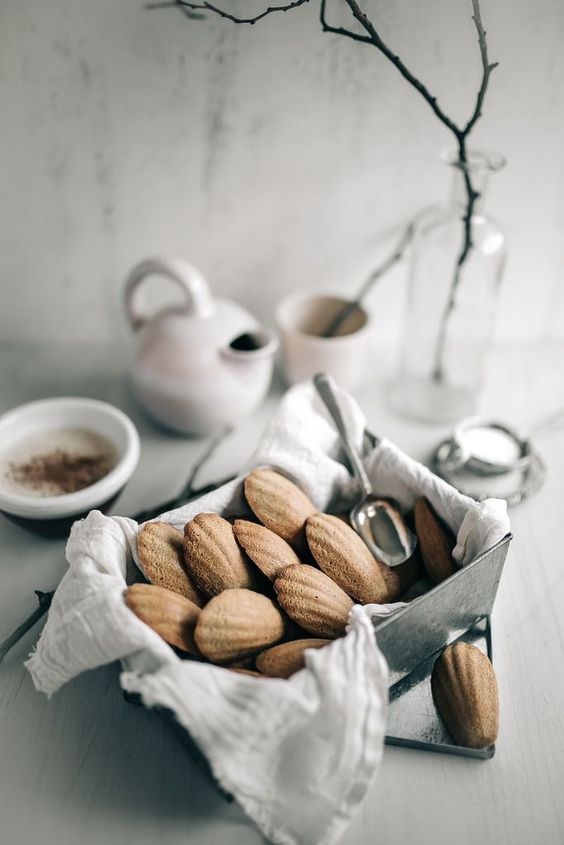
Among them are the treats of small sponge cakes with their distinctive shell-like shape, baked in pans and can be made with the basic ingredients. Known as the madeleine or petite madeleine, these traditional small cakes trace their origins to the Lorraine region in northeastern France. By legend these cakes have been there in the 17th century French cusine, although the increased use of metal moulds (18th century) had led to their increased use. By the end of the 19th century, the madeleine is considered a staple of the diet of the French bourgeoisie.


By etymology, the term madeleine describes “a small cake”. Made from génoise cake batter (with the suspended air in the mixed batter giving the volume to the cake) with traditional recipes adding on finely ground almonds, nuts or lemon zest for their special lemony flavour. In Britain, similar cakes are baked in dariole molds, they are coated in jam, desiccated coconut and topped with glacé cherry.
“On a pound of flour, you need a pound of butter, eight egg whites & yolks, three fourths of a pound of fine sugar, a half glass of water, a little grated lime, or preserved lemon rind minced very finely, orange blossom praliné; knead the whole together, & make little cakes, that you will serve iced with sugar.”
“Cakes à la Madeleine”. Menon, Les soupers de la Cour ou L’art de travailler toutes sortes d’aliments, p.282 (1755)


The madeleine has been mentioned by the culinary writers during the Napoleonic era, especially in the recipe books of Antonin Carême and Grimod de la Reynière. One record of the first recipe traces to the “cakes à la Madeleine and other small desserts” (1758) of a French retainer of an Irish Jacobite refugee, Lord Southwell. Tracing the roots of “Madeleine”, there are several interesting legends pertaining to the origin of the cake. While one considers the name centered from a female character of Lorraine, probably a chef with the patron being Paul de Gondi (17th century cardinal), owner of a castle in Commercy. Another legend consider the inventor to be Madeleine Paulmier, cook for Stanislaus I, duke of Lorraine and exiled King of Poland (18th century). As the legend goes, Louis XV (son-in-law of the duke) charmed by the little cakes prepared by Madeleine Paulmier (1755), named them after her and Maria Leszczyńska, his wife had introduced them soon afterward to the court in Versailles which soon became a favoured French recipe. Two legends link the cake with the pilgrimage to Compostela (Spain) where Madeleine, a pilgrim is said to have brought back the recipe from her voyage or a cook named Madeleine is said to have offered little cakes in the shape of a shell to the pilgrims passing through Lorraine. While another legend states that Madeleine was the creation from the kitchens of Prince Talleyrand by the pastry chef Jean Avice (19th century) who is said to have baked little cakes in Aspice moulds.
Not just in the kitchen, but Madeleine have made their significant impact in literature with Proust’s “episode of the madeleine” as an instance of involuntary memory in his book In Search of the Lost Time. Similar to the madeleine are the “financiers” or the Malaysian Bahulu. One of the benefits of getting down to making Madeleine for the holidays is the ease in its’ preparation, variability of ingredients as well as the versatility of it being a part of the small and the large holiday get-togethers. As for the simplicity in style, a little of “food art” will make the difference. Adding to the festive spirit, madeleine can indeed spice up the holiday season this year.


 Sugar And Spice... Among Other Things
