Posted in Daily, Food, Stories Around the World

Madeleine for holidays

Entering into the last month of the year, the delight of enjoying the twilight mornings with the warm cup of tea in the bitter chill of the air, would be better with a little of the small crunchy or tiny delights to add to the tea. In fact with holidays round the corner, a regular stock of the ready homemade sweet dry desserts especially cakes, cookies and biscuits would come in handy.

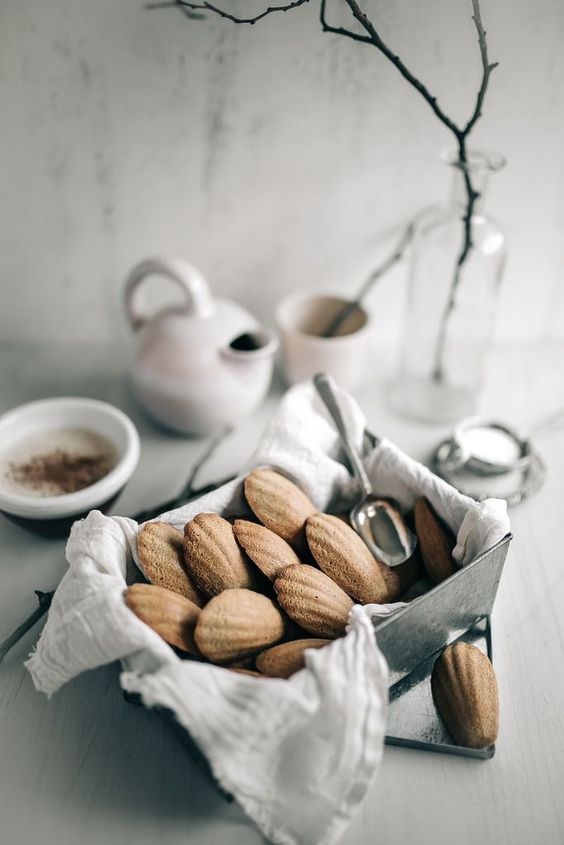
Among them are the treats of small sponge cakes with their distinctive shell-like shape, baked in pans and can be made with the basic ingredients. Known as the madeleine or petite madeleine, these traditional small cakes trace their origins to the Lorraine region in northeastern France. By legend these cakes have been there in the 17th century French cusine, although the increased use of metal moulds (18th century) had led to their increased use. By the end of the 19th century, the madeleine is considered a staple of the diet of the French bourgeoisie.

By etymology, the term madeleine describes “a small cake”. Made from génoise cake batter (with the suspended air in the mixed batter giving the volume to the cake) with traditional recipes adding on finely ground almonds, nuts or lemon zest for their special lemony flavour. In Britain, similar cakes are baked in dariole molds, they are coated in jam, desiccated coconut and topped with glacé cherry.

“On a pound of flour, you need a pound of butter, eight egg whites & yolks, three fourths of a pound of fine sugar, a half glass of water, a little grated lime, or preserved lemon rind minced very finely, orange blossom praliné; knead the whole together, & make little cakes, that you will serve iced with sugar.”
“Cakes à la Madeleine”. Menon, Les soupers de la Cour ou L’art de travailler toutes sortes d’aliments, p.282 (1755)

The madeleine has been mentioned by the culinary writers during the Napoleonic era, especially in the recipe books of Antonin Carême and Grimod de la Reynière. One record of the first recipe traces to the “cakes à la Madeleine and other small desserts” (1758) of a French retainer of an Irish Jacobite refugee, Lord Southwell. Tracing the roots of “Madeleine”, there are several interesting legends pertaining to the origin of the cake. While one considers the name centered from a female character of Lorraine, probably a chef with the patron being Paul de Gondi (17th century cardinal), owner of a castle in Commercy. Another legend consider the inventor to be Madeleine Paulmier, cook for Stanislaus I, duke of Lorraine and exiled King of Poland (18th century). As the legend goes, Louis XV (son-in-law of the duke) charmed by the little cakes prepared by Madeleine Paulmier (1755), named them after her and Maria LeszczyÅ„ska, his wife had introduced them soon afterward to the court in Versailles which soon became a favoured French recipe. Two legends link the cake with the pilgrimage to Compostela (Spain) where Madeleine, a pilgrim is said to have brought back the recipe from her voyage or a cook named Madeleine is said to have offered little cakes in the shape of a shell to the pilgrims passing through Lorraine. While another legend states that Madeleine was the creation from the kitchens of Prince Talleyrand by the pastry chef Jean Avice (19th century) who is said to have baked little cakes in Aspice moulds.

Not just in the kitchen, but Madeleine have made their significant impact in literature with Proust’s “episode of the madeleine” as an instance of involuntary memory in his book In Search of the Lost Time. Similar to the madeleine are the “financiers” or the Malaysian Bahulu. One of the benefits of getting down to making Madeleine for the holidays is the ease in its’ preparation, variability of ingredients as well as the versatility of it being a part of the small and the large holiday get-togethers. As for the simplicity in style, a little of “food art” will make the difference. Adding to the festive spirit, madeleine can indeed spice up the holiday season this year.

Posted in Life, Personal Musings, Quotes, Random Thoughts, Stories Around the World

Weave of the Ribbon

“It’s not the years in your life that count. It’s the life in your years.” Abe Lincoln

Unexpected news or shockers from what was previously imagined as real can give a jolt to the person when understanding hits the surface. Yet when it does happens, how one reacts or rather how all of us react, makes the biggest difference.

35 years male. Single. Known case of thalassemia major. On blood transfusions since age of six years. Recurrent infections. HIV ELISA positive.

40 years female. Recurrent infections since the past year. Atypical pneumonia. Disease profiles variable. HIV ELISA positive.

7 year old male.  Recurrent oral candidiasis. Recent diagnosed pulmonary tuberculosis. HIV ELISA and PCR positive.

These above cases are not even close to the tip of the iceberg of the damage caused by what was originally believed to be the mutated form of the wild virus in non-human primates. Rising to global pandemic proportions, the origins are traced to as early as 1910 wherein probably the wild virus underwent mutations to the present form by series of changes ranging from suppression of the innate and internal immune response, high-risk transmission channels as well as social and environmental changes leading to the rapid spread of the mutated virus form. Though the earliest well-documented case of HIV in a human was done in 1959, the clinical cluster of cases (1981) in the United States with rare types of pneumonia (symptoms of Pneumocystis carinii pneumonia (PCP)) and rise of previously rare skin cancer called Kaposi’s sarcoma (KS) prompted the CDC to develop a task force to control the outbreak. With these opportunistic infections being more prevalent in the hemophiliacs, drug users, certain endemic areas and social or sexual preferences; the task force stepped up the ante and the term AIDS was coined and brought to the forefront of the mass public.

From Ryan White to Greg Louganis or Magic Johnson and many numerous people, each of them had fought their battle with the disease of HIV/AIDS. Whether it was by their circumstances or series of unfortunate events, the questions and chaotic thoughts every person or loved one goes through on hearing the positive confirmation is the plenty of “why me’s” and the uncertainty of the future, disease progress and implications on the personal, professional as well as mental front. None of us realize the reality behind the scene, unless we step into the other’s shoes and walk a couple of miles. Only then the false pictures get morphed with those little details that help one to realize the truth was far from what was initially perceived.

“You cannot hope to build a better world without improving the individuals. To that end,each of us must work for our own improvement and, at the same time, share a general responsibility for all humanity, our particular duty being to aid those to whom we think can be most useful.” Marie Curie

As the global battle continues on multiple fronts, from raising awareness to finding solutions and reparative measures for the ongoing myriad of symptoms and disease complex, society in general as to sit up and take note. Ignorance may be bliss for now, but it always comes at a heavy price. Neither does guilt, accusations or pointing fingers help any. But awareness doesn’t hurt anyone. Instead it helps to build for a better tomorrow. The resilience of mankind lies in the ability to pick the battle and choose wise. Linking the goals for the common future would help for the days of tomorrow.

“A man only begins to be a man when he ceases to whine and revile, and commences to search for the hidden justice which regulates his life. And he adapts his mind to that regulating factor, he ceases to accuse others as the cause of his condition, and builds himself up in strong and noble thoughts; ceases to kick against circumstances, but begins to use them as aids to his more rapid progress, and as a means of the hidden powers and possibilities within himself.” James Allen (As a Man Thinketh)

6 pics

Posted in Christian, poetry, Random Thoughts

A part of HIS Canvas

“Declare his glory among the heathen; his marvellous works among all nations.” (1 Chronicles 16:24)

Entering into the final month of the year, winter brings forth a lot of pleasant memories, realizations, personal goals as well as soul time for family, friends and self. Though every winter may differ from the previous, this season gives a chance for one to reflect their own canvas of life and the wonderful works done by His Hand.

From the rich fields of green fresh with the smell of the spring to the bare beauty and quiet of winter; one learns to appreciate life as God teaches us through the seasons. Every day is a fresh start to learn something new from own experience or through the perspective of the other. Nature itself has a lot of wonders to show and teach us. From the bare headed trees of winter to the flowers that flourish through the winter, each season has something that proves that if one really wants to, one can survive and come through with flying colours, against all odds. For it depends on how much one believes in own self and in His Mighty Works. Faith no matter how simple it sounds, has the more power than mustard seed or even dynamite.

“How many are your works, LORD! In wisdom you made them all; the earth is full of your creatures.” (Psalm 104:24)

God The Artist
By Angela Morgan

God, when you thought of a pine tree,
How did you think of a star?
How did you dream of the Milky Way
To guide us from afar.
How did you think of a clean brown pool
Where flecks of shadows are?

God, when you thought of a cobweb,
How did you think of dew?
How did you know a spider’s house
Had shingles bright and new?
How did you know the human folk
Would love them like they do?

God, when you patterned a bird song,
Flung on a silver string,
How did you know the ecstasy
That crystal call would bring?
How did you think of a bubbling throat
And a darling speckled wing?

God, when you chiseled a raindrop,
How did you think of a stem,
Bearing a lovely satin leaf
To hold the tiny gem?
How did you know a million drops
Would deck the morning’s hem?

Why did you mate the moonlit night
With the honeysuckle vines?
How did you know Madeira bloom
Distilled ecstatic wines?
How did you weave the velvet disk
Where tangled perfumes are?
God, when you thought of a pine tree,
How did you think of a star?

More Angela Morgan