Posted in Daily, Food, Stories Around the World

Of Empanada, Origin and Evolution

“If you were a Colombian, you would have your version of an empanada. If you are an Argentinean, you might find a dough that’s baked and has a butter sheen on it. And then in Ecuador, you’ll find more crispy-fried empanadas. So, yeah, every culture has their own version of empanadas.” Jose Garces

Derived from the Spanish verb “empanar” which translates to “wrap in bread”, these fried or baked pastries stuffed with sweet or savoury filling, known as empanadas have enjoyed widespread global popularity. Across the Caribbean, Latin America, Portugal, Spain, Italy to as far as Philippines; this dish has its’ own local blends that make it delectable and adaptable to every local cuisine.

“You are the olive in my empanada.” Brazilian Saying

Originally believed to be from Galicia, Spain; the empanadas of today may have been the brainchild of the Moors who had occupied Spain for hundreds of years. The idea of wrapping a hardy filling in pastry dough had led to this little delight. Fillings including seafood have been documented in a cookbook published in Catalan, Spain (1520). With the spread of civilization, trade as well as colonization, this savoury delight had travelled around the world. In fact the first empanadas in Western Hemisphere are credited to Argentina with the US celebrating the National Empanada Day on April 8th. While empanadas are a traditional Christmas treat in New Mexico, they’re known as creoles(southwest and south) or as fried pies (southeast) depending on the locality.

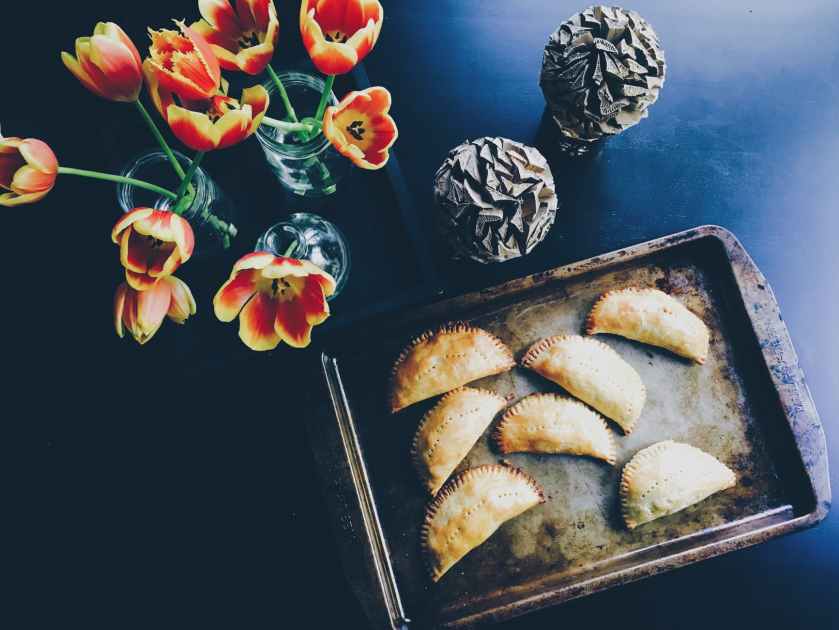
Similar to cut-up pies, empanadas are typically savoury often filled with cod fish or chicken. They are made by folding a disc of thinly rolled dough over the filling into a semicircle and then crimping the edges to seal it. The dough is often made with wheat flour, but can be substituted by corn flour, cornmenal, plantain or potato base, depending on the locally available ingredients. The content of the dough varies on whether the empanadas are to be baked or fried. The art of to make a perfect empanada is to hold the dough spread open, in one hand; while using the other hand to fill it and to crimp the edges. Homemade sweet varients of the empanadas are present in many local cuisines. For instance, the Gujiya is a traditional Indian crescent shaped dessert, similar like a sweet empanada.

There have been various variations similar to empanadas. Catibías, similar to empanadas are made with cassava flour dough with common fillings include ground beef, chicken, guava, and cheese. Pastelitos are similar to empanadas, too, but they’re made with a lighter pastry dough and they can be either baked or fried.

Travelling across the various countries, the ‘Mpanatigghi of Modica (half moon-shaped panzarotti filled with a mixture of almonds, walnuts, chocolate, sugar, cinnamon, cloves and minced beef), meat empanadas (“de pino”) of Chile , panades of Belize and so on, have been the varied presentations of the empanadas. Certain eateries in order to distinguish the varieties, develop a pattern on the pastry fold, crimping style of the edges or burn a letter(an abbreviated indication of the filling) into the dough.

Either way, one of the most easiest delights to be made for a novice cook, are empanadas which serve as quick bites, starters, breakfast, desserts or even for brunches to lunches.

“Don’t be afraid to adapt new ingredients into your own techniques, and traditional ingredients into new recipes.” Jose Garces

Posted in Daily, Life, Photography Art, poetry, Quotes, Reflections

Rise of Spring

“Just living is not enough… one must have sunshine, freedom, and a little flower.” Hans Christian Andersen

With the fresh fragrance of spring in the air, early mornings beckon the restless mind for a moment’s peace. For those of us caught in the daily melee of chaos, where everyday turns into routine; taking ten minutes into the sun, before the morning chores brings a new perspective to life.

“In every walk with nature one receives far more than he seeks.” John Muir

Looking into the hue and colours of nature, it’s quite startling to believe that this was the same brown, wintry landscape a few months ago. As colours are brought to life, nature teaches us a few simple but pertinent lessons of life.

Events will happen by choice or against our will. Time always moves on. But by staying in the rut, we get left behind and no amount of cribbing will get us across those days. Instead buckle up and take one step at a time. Looking back on those days of the past, one will realize that things aren’t that bad, when viewed from far.

The harsh winters of nature brings forth beautiful spring and joyous summer. The distraught of then bears fruit now, as long as we never forget to toil keeping one’s hope, kindness and spirits in tact.

Every tree’s loss of winter doesn’t reflect in its’ branches through spring. Instead new shoots and leaves come to life. Forgive and let go; but learn from it. The pain will lessen with time, but let it not be the cause of the future.

“Knowing trees, I understand the meaning of patience. Knowing grass, I can appreciate persistence.” Hal Borland

I Have Come to You

I have come to you, delighted,
To tell you that sun has risen,
That its light has warmly started
To fulfil on leaves its dancing;

To tell you that wood’s awaken
In its every branch and leafage,
And with every bird is shaken,
Thirsty of the springy image;

To tell you that I’ve come now,
As before, with former passion,
That my soul again is bound
To serve you and your elation;

That the charming breath of gladness
Came to me from all-all places,
I don’t know what I’ll sing, else,
But my song’s coming to readiness.

Afanasy Afanasyevich Fet

“There is pleasure in the pathless woods, there is rapture in the lonely shore, there is society where none intrudes, by the deep sea, and music in its roar; I love not Man the less, but Nature more.” Lord Byron

Posted in Daily, Family and Society, Life, Personal Musings, Reflections, Stories Around the World

From One’s Perspective

The Minister travelled for days by train and car and boat to one of the furthest islands in the nation. As he surveyed the bleak but inspiring landscape, he turned to a local villager and said: “You’re very remote here, aren’t you?” She responded: “Remote from what?”

The scenario of the glass being half empty to half full, or the grass being green on the other side; have been faced by most of us at some point of time or the other. The common thread of thinking running through these moments is “our perception and the reality of what happens”.

“There are things known and there are things unknown, and in between are the doors of perception.” Aldous Huxley

Perspective has been one of the concepts, since the early days, which has been studied and attempts have been made to quantify or qualitatively assess it by mathematicians, philosophers, scientists as well as artists. Despite all the theories proposed, research as well as insight; till this day perception doesn’t exist by itself but leans heavily on our innate beliefs, opinion, experience and knowledge.

“No man has the right to dictate what other men should perceive, create or produce, but all should be encouraged to reveal themselves, their perceptions and emotions, and to build confidence in the creative spirit.” Ansel Adams

While one’s perspective may be right for some, it may be wrong for the other. Then the question arises, how do we draw the limits or the line? The practical aspect is possible as long as we ground ourselves in reality and lean on the principle of “to do unto others as one would want to be done unto oneself”. Simply put, as long as we learn to treat others with mutual respect, equality, freedom, justice, kindness and understanding; all the perspectives would reach the common target and purpose of doing good.

“What I need is perspective. The illusion of depth, created by a frame, the arrangement of shapes on a flat surface. Perspective is necessary. Otherwise there are only two dimensions. Otherwise you live with your face squashed up against a wall, everything a huge foreground, of details, close-ups, hairs, the weave of the bed-sheet, the molecules of the face. Your own skin like a map, a diagram of futility, crisscrossed with tiny roads that lead nowhere. Otherwise you live in the moment. Which is not where I want to be.” Margaret Atwood, The Handmaid’s Tale

Posted in Daily, Food, Uncategorized

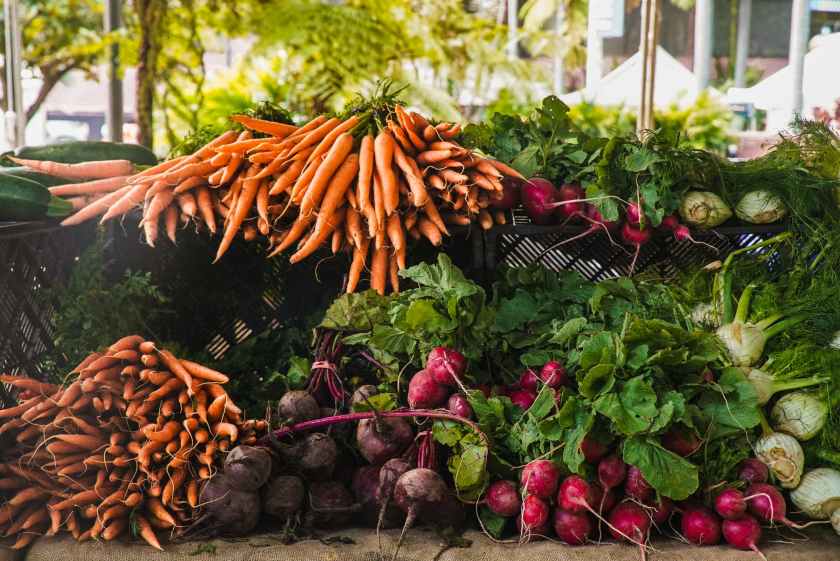
Going “Carrot” All the Way

Being parents or guardians of little children, the most lovable yet tiring and troublesome phase is making them eat their vegetables. The beginnings of this battle with the “veggies” starts when they reach the toddler age, often progressing onto their years, even till high school and beyond.

“When a man is small, he loves and hates food with a ferocity which soon dims. At six years old his very bowels will heave when such a dish as creamed carrots or cold tapioca appear before him.” M. F. K. Fisher

With the advent of various art forms, school activities, newer recipes, extra seasonings and the magic of Bugs Bunny and Popeye the sailor man among others, have brought down the fervor of this battle. Among the various projects among play-schoolers to get them to eat their vegetables was observing special days like the International Carrot Day (4th April). While for the toddlers, activities range from supervised game activities, music, model art with play dough fun and costume art; parents have been tasked with preparing any carroty dish. Ranging from meal based recipes, of soups and main course (pies, curry, sandwiches) to snacks or desserts (“gajjar halwa”, carrot cake or sweet carrot tarts) and juices, the list of recipes is quite extensive. In the course of cooking, there was a couple of “carrot trivia” which make for an interesting read.

“Carrots are devine… You get a dozen for a dime, It’s maaaa-gic!” – Bugs Bunny

Belonging to the family Apiaceae, “Daucus carota”, whose common names include wild carrot, bird’s nest, bishop’s lace, and Queen Anne’s lace (North America), is a herbaceous, mostly biennial white flowering plant native to temperate regions of Europe and southwest Asia, and naturalized to North America and Australia. Interestingly both the words ” Daucus” and “carota” mean orange. Ironically carrots are not always orange, but can also be grown as purple, red, white or yellow variants. Known by the Ancient Greeks as “Karoto” with the plant called as Philtron or “Bird’s Nest”, they were initially grown as medicines, and later as food, also used as insecticidal agent as well. In fact, the Victorians had a carrot based recipe to destroy crickets especially as it was discovered that they were very fond of carrots. The mix was a paste of flour, powdered arsenic with scraped carrots, placed near their habitations.

The role of carrots go beyond the kitchen, with their part cited in the “Trojan War”. As far as legends go ( no documented evidence), the Greek foot soldiers who hid in the Trojan Horse were said to have consumed ample quantities of raw carrots to inactivate their bowels. However, this tale contradicts the fact that carrots are good for constipation. Being a mythical tale, did the soldiers of the Trojan War eat lot of carrots before the fight to clear their intestines and avoid any problems during the important moment ? Most likely, this apocryphal tale was conjured or circulated due to the Hollywood scenes, fiction writers or as a result of the “toddler veggie battles.” Yet their mention in literature is present with the Early Celtic citing them as “Honey Underground”.

“The day is coming when a single carrot, freshly observed, will set off a revolution.” Paul Cezanne

The Wild Carrot is called Queen Anne’s Lace. The reason being Queen Anne of England wore a lacy headdress which some people thought resembled the delicate flower cluster of Wild carrot, giving it its more poetic name, Queen Anne’s lace.

One of the first vegetables to be canned commercially, carrots were marketed on a wide scale. Additionally tobacconists in France used to put a carrot in their bins to prevent their tobacco from drying out. With the progress of preservation and brewery, carrots today, produce more distilled spirit than potatoes. To add on carrot as a sweet snack food, try the “carrot pie flavour jelly bean.” As far as the future holds, carrots are here to stay with their in the market as “bio-fuels“, especially as the oil runs out. So going “carroty” is the theme for now, especially today with trying something “carroty” as a special treat.

Posted in Daily, Family and Society, Life, Personal Musings, Photography Art, Quotes, Reflections

Of Butterflies, Spring and Change

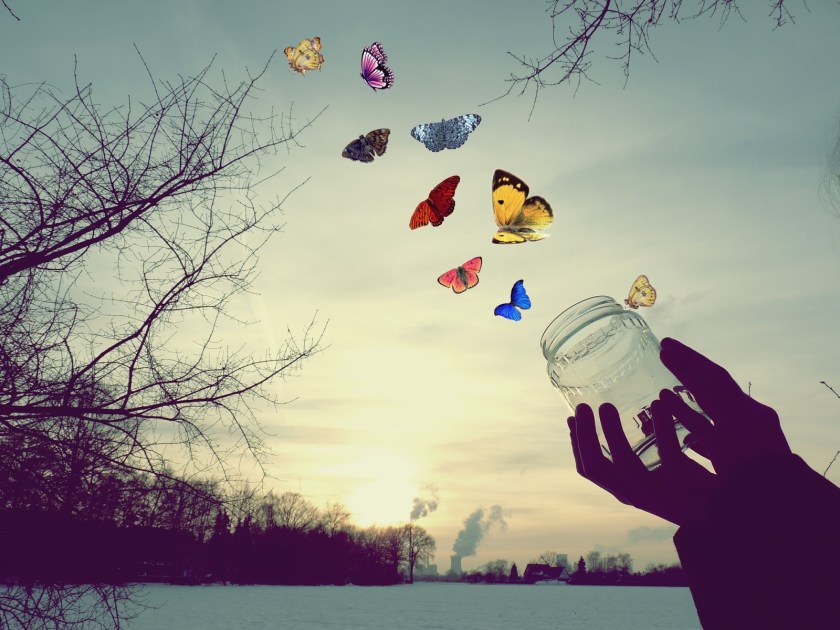
With Spring in full force, the fields become rich with various hues and shades of colours; leaving behind carpets and patches of vibrant flowers. Amidst this mosaic of colours, few winged beauties are seen in the landscape, adding a potency, luster and liveliness to life; never ceasing to amaze man with the marvels and wonder of God’s creation. Come spring and summer, the focus is on the winged patterned coloured “Rhopalocera” species, more popularly known as the “butterflies”.

“As with the butterfly, adversity is necessary to build character in people.” Joseph B. Wirthlin

In grade school, we had studied the life cycle of the butterfly from the caterpillar stage. From a grubby sickly green or brown coloured caterpillar, emerged a magnificent winged delicate specimen of sheer beauty, design and style; though this happens only after the caterpillar undergoes its’ own struggle and transforms. No matter how young we are or how old we become, the delight of a butterfly still holds true, then and now.

“There is nothing in a caterpillar that tells you it’s going to be a butterfly.” R. Buckminster Fuller

Nature teaches us many lessons from the life of a butterfly and here a few pertinent ones that has been observed. First is to be open to change and transformation. From the ugly scrawny state to the winged stage, developing in its’ own chrysalis and then breaking out on own helps develop the wings of courage, beauty and honour. As the story where the caterpillar was helped goes, the butterfly never survived but crumbled down.

“Adding wings to caterpillars does not create butterflies. It creates awkward and dysfunctional caterpillars. Butterflies are created through transformation.” Stephanie Pace Marshall

Second, butterflies never chose to focus on fame and glory. They are pretty not vain, instead they go about the flowers, quietly displaying their colours and spreading happy vibes. They delight in their surroundings embracing each new change as they come, not sticking to one zone but exploring each day as it comes.

“Happiness is a butterfly, which when pursued, is always just beyond your grasp, but which, if you will sit down quietly, may alight upon you.” Nathaniel Hawthorne

Third and most important is to carve one’s niche for oneself. For a caterpillar to transform, it needs to wrap itself in the silky shroud of chrysalis and go through the change. The caterpillar does it alone, embracing the quiet to think and then under the metamorphosis. The journey in our life too is mostly ours. Though we do delight in the company of others; each one has their own inner struggle to overcome and new horizons to brave. What might be easy for one, mayn’t be so for other. Yet to learn to accept others’ as well as to change oneself for the better, is an art of life and pre-requisites for staying alive and happy.

“The butterfly counts not months but moments, and has time enough.” Rabindranath Tagore

We all have our own allotted time in this world. For some of us, along the journey; losses became too many and gains too few. Nevertheless, things will work out eventually. For like the butterfly, time allotted is less but learning to work as well as enjoy the flowers alone will happen once we build the courage to move on. We are all butterflies in the making. When its’ time to fly, remember to use the wings we were blessed with after our change. The world has its’ own share of butterflies among the fireflies, moths, ladybugs and the rest; and we will learn to belong to one when the time is right as long as we believe we can.

“Everyone is like a butterfly, they start out ugly and awkward and then morph into beautiful graceful butterflies that everyone loves.” Drew Barrymore

Posted in Daily, Family and Society, Life, Personal Musings, Quotes, Reflections, Stories Around the World

Like A Child’s Love

“Just imagine becoming the way you used to be as a very young child, before you understood the meaning of any word, before opinions took over your mind. The real you is loving, joyful, and free. The real you is just like a flower, just like the wind, just like the ocean, just like the sun.” Don Miguel Ruiz

Children are simply beautiful. Interacting with children all day long, one is always fascinated by the numerous expressions, emotions they undergo, the innocent laughter and their mischief. A child’s love is always untainted at heart. Unfortunately as they grow from toddlers to adolescence, we adults and collectively society as well as media influences them, such that they lose their own selves and plunge into the niche that society carves for them. As parents, it is difficult to fight against this phenomenon as this has become the way of life and children will eventually grow, evolve and develop. Which is why, the growing years of a child are the most precious ones for parents and guardians.

“What it’s like to be a parent: It’s one of the hardest things you’ll ever do but in exchange it teaches you the meaning of unconditional love.” Nicholas Sparks

The concept of unconditional love is witnessed very often through parenting. A child’s love is never labelled nor constrained. In their very early years, their unblemished minds and hearts have no limits or barriers or categorization on their love, kindness and care. A child’s reasoning mayn’t be understood by adults. Yet as we wait to see the turn of events, one realizes that their acts of childhood are always based on their untainted guileless love and kindness. To be like a child, is a gift for the mind, body and spirit.

“Being deeply loved by someone gives you strength, while loving someone deeply gives you courage.” Lao Tzu

“Some time ago, a man punished his young daughter for wasting a roll of gold wrapping paper. Money was tight and he became angry when the child tried to decorate a box to put under the Christmas tree. Nevertheless, the girl brought the gift to her father on Christmas day and said, ‘This is for you, daddy.’
The man became embarrassed by his overreaction a few days before, but his rage continued when he saw that the box was empty. He yelled at her, ‘Don’t you know, when you give someone a gift, there’s supposed to be something inside?’
The little girl looked up at her dad with tears in her eyes and cried; ‘Oh, daddy, it’s not empty at all. I blew kisses into the box. They’re all for you, daddy.’The father was devastated. He put his arms around his daughter, and begged for her forgiveness.

A little while later, the girl died in an accident. Her father kept the gold box by his bed for many years and, whenever he was feeling down, he would take out an imaginary kiss and remember the love of the child who had put it there.”

“The greatest happiness of life is the conviction that we are loved; loved for ourselves, or rather, loved in spite of ourselves.” Victor Hugo

Posted in Daily, Food

The “PB&J” Way

“Man cannot live by bread alone; he must have peanut butter.” James A. Garfield

One of the iconic American sandwich is the “PB&J sandwich”, which includes one or more layers of peanut butter and one or more layers of jelly ( jam in British English) on bread. Eaten open faced or with one slice of bread folded over ( a “half sandwich”); this sandwich is quite common and popular among Americans especially the children. The history of the peanut butter and jelly sandwich is the story of three essential ingredients; all of which have been around for a long time, when combined together gives us the American favorite and enduring PB&J sandwich; which slowly soared in popularity across the world.

Layer each bread slice with two tablespoons of Peanut butter. The forerunner of the peanut butter of today was when a St. Louis physician, Dr. Ambrose Straub had made a peanut paste for geriatric patients who had trouble swallowing or had bad teeth (1880s). Around the same time, Dr. John Harvey Kellogg ( of the cereal fame) was the first to patent a process for manufacturing peanut butter. Post the Chicago World Fair (1983), where the peanut butter was first introduced and the St. Louis World Fair (1904) when Dr Straub had got a food company to develop the peanut spread further; their popularity rose high with grocery stores stocking up on peanut butter. Upscale tea rooms of New York City, peanut butter appeared as delicacies with watercress, sandwiches, on toasted triangles with soda crackers as well.

Then add two tablespoons of the iconic “strawberry Jelly” to the peanut butter layered bread slices, merge them and enjoy. The development of the jelly (although it has been around for a long time), in the case of this quintessential American PB&J sandwich can be credited to Paul Welch. He had secured a patent (1917) for pureeing grapes and turning them into jelly which he had developed and advertised as Grapelade. This was popular with America’s troops in WWI, who had brought the trend of Grapelade spread on bread, back to their homes after the war.

The first peanut butter and jelly sandwich recipe appeared in the Boston Cooking School Magazine of Culinary Science and Domestic Economics (1901) written by Julia Davis Chandler. The recipe had advised to use currant or crab-apple jelly with the combination being delicious and as far as known then, original.

With creamier peanut butter (doesn’t stick to the palate) being made, Grapelade and pre-sliced bread becoming popular, the PB&J slowly gained popularity. During the Great Depression of 1930s, families discovered that peanut butter had provided a less expensive but satisfying high protein substitute. Yet the major breakthrough came when this was included in the US Military ration menus of World War II. With peanut butter being high-protein, shelf-stable and easily portable; grape-lade on its’ second trip with the soldiers and pre-sliced bread readily available; the combination of the three became a part of the American soldier’s life.

When the soldiers came home from the war, the PB&J sandwich scored with the families. With the great taste and easy to make, both the young and the old loved it, especially when budgets were tight and the times were difficult.

“Everyone has the talent to some degree: even making a peanut butter and jelly sandwich, you know whether it tastes better to you with raspberry jam or grape jelly; on chewy pumpernickel or white toast.” Anna D. Shapiro

Today a wide variety of mix ups and combinations have been seen across globally, with honey or sliced fruit substituted for the jelly component or the transition to “almond butter and jelly” (AB&J) sandwiches. With marshmallow fluff being substituted for the jelly, or added for extra flavor; the “fluffernutter” sandwich is created. Cream cheese substituted for the peanut butter ( a cream cheese and jelly sandwich) or Nutella (possible substitute for one of the spreads) with PB or Jelly are other common variants.

Slight changes can be made to the original recipe by using an artisan bread and heating it in butter, which melts the peanut butter and jelly; creating a crispy, buttery crust on the bread similar to when cooking grilled cheese. White or brown bread alternatives include rye, whole grain or sourdough bread. One other popular variant of “PB&J” sandwich is “the peanut butter and Lucy banana sandwich” or peanut butter, banana and bacon sandwich,known as an Elvis sandwich or simply the Elvis, consists of toasted bread slices with peanut butter, sliced or mashed banana, and sometimes bacon. Honey is seen in some variations of the sandwich as well alternative fillings of sweet potato, carrots, pumpkin, and apples. The sandwich is frequently cooked in a pan or on a griddle, served hot. Additionally the PB&J can be added to pancakes, crepes and even french toast.

Like these combinations, many more are being made with creative cooking on the rise. Just like variety adds the spice to life, jelly up with peanut butter on this day as foodimentarians celebrate “Peanut butter and Jelly” Day today (April 2nd). Mix, match ad spice it up for a quick break from the routine cooking with both kids and family enjoying the break from the routines or predictability the day.