Posted in Daily, Food, Stories Around the World

Egg-nog for Holidays

“The armored infantry was Santa Claus, the battle was out Christmas. What else for the elves to do on Christmas Eve but to let their hair down and drink a a little eggnog.” Hiroshi Sakurazaka

Being Christmas today, the night vigil and celebrations can be drawn to a close by the noon or evening “Christmas” dinner. Along with the regular stuffing of bird or meat, pies closed by pudding and cake; unless the dinner is graced with egg-nog, it will feel like something missing.

Historically also known as milk punch or egg-milk punch, egg-nog or eggnog is a rich dairy based beverage served chilled, sweetened of either alcoholic (brandy,rum,whisky or bourbon) or non-alcoholic variety. Starting with etymology, among the various versions; eggnog is said to be derived from an Old English word for strong beer. Another possibility states that it was derived from noggin, a word for a small cup that was first known to be used as 1588; whereas some attribute the name to Colonial America where colonists referred to thick drinks as grogs and eggnog was widely known as egg-and-grog.

Traditionally made with milk, cream, sugar, whipped egg whites and egg yolks; eggnog is primarily a Christmas time drink whose origins are still debated. By popular consensus, culinary historians believe that eggnog originated from the early medieval British drink known as posset. Made with hot milk, curdled with wine or ale and flavoured with spices; posset was often used as a cold and flu remedy during the Middle ages. Later on eggs were added to the recipe and monks were believed to enjoy posset of eggs and figs. Then on, various adaptations were made to the ingredients depending on the local availability, flavours and tastes of those times. With colonization, travel and cultural mixing; eggnog has gained widespread popularity becoming synonymous with the Christmas time cocktails, dinners and parties.

Eggnog is often homemade using milk, eggs, sugar and flavorings; served with cinnamon or nutmeg. Although often served chilled, on particularly cold days it’s served warm. Additionally eggnog flavouring may also be added to other beverages like coffee ( as an “eggnog latte” espresso), tea and also to dessert foods such as egg-custard puddings and even ice-cream.

Ode to Eggnog
(Author Unknown)

If you see a fat man, who’s jolly and cute,
wearing a beard and a red flannel suit;

And if he is chuckling and laughing away,
while flying around in a miniature sleigh;

With eight tiny reindeer to pull him along;
Then – let’s face it – Your eggnog’s too strong!!

Posted in Daily, Family and Society, Quotes, Random Thoughts, Stories Around the World

Helping Hands

“Non nobis solum nati sumus. (Not for ourselves alone are we born.)” Marcus Tullius Cicero

The difference between each person lies in their behaviour, outlook, attitude and approach to life. While collectively we can label one group “selfish” and the other group “kind”, the difference between both is well illustrated in the story below.

Chopsticks

A woman who had worked all her life to bring about good was granted one wish: “Before I die let me visit both hell and heaven.” Her wish was granted. She was whisked off to a great banqueting hall. The tables were piled high with delicious food and drink. Around the tables sat miserable, starving people as wretched as could be. “Why are they like this?” she asked the angel who accompanied her. “Look at their arms,” the angel replied. She looked and saw that attached to the people’s arms were long chopsticks secured above the elbow. Unable to bend their elbows, the people aimed the chopsticks at the food, missed every time and sat hungry, frustrated and miserable. “Indeed this is hell! Take me away from here!” She was then whisked off to heaven. Again she found herself in a great banqueting hall with tables piled high. Around the tables sat people laughing, contented, joyful. “No chopsticks I suppose,” she said. “Oh yes there are. Look – just as in hell they are long and attached above the elbow but look… here people have learnt to feed one another”.

Remember, if you ever need a helping hand, you’ll find one at the end of your arm… As you grow older you will discover that you have two hands. One for helping yourself, the other for helping others. Audrey Hepburn

One of the simplest things in life is to lend a hand. On some occasions we hesitate doing so without knowing the complete picture, for fear of the repercussions in the society and world, where we can held accountable even if innocent. On those instances, only our gut instincts can help us. Yet in other scenarios, we tend to be lazy and keep our hands buried in our pockets or under the blankets. Ironically we realize our mistakes only when we need help desperately. Helping hands doesn’t have to start big. Even small gestures like cleaning the room, helping an old lady at the grocer’s, giving up a seat in the bus for elders or pregnant mothers, mowing the lawn without being told to do so are all be simple acts to initiate the feel of being helpful. After all, There has to be a purpose of the creation of two hands.

“Somewhere along the way, we must learn that there is nothing greater than to do something for others.” Martin Luther King Jr.

Posted in Daily, Family and Society, Quotes, Stories Around the World

To Heart’s Content

“It isn’t what you have or who you are or where you are or what you are doing that makes you happy or unhappy. It is what you think about it.” Dale Carnegie

Once a lady was talking to a psychologist, where she sadly listed what she did not have. “There are no true friends. There is no good salary. No decent car. Apartments are not good. There is no youth anymore. And there is no hope to have it all someday.”  The plump, pleasant psychologist, straightened his glasses and said complacently, “Of course, you do not have much. And you can continue the list. There is no severe incurable disease. There are no millions of debts. There is no responsibility for someone, for a sick relative or a weak-minded old man. There is no physical disfigurement and no hump. And there is no disability. A lot of things you do not have. And, if you write down what you do not have, then your mood will improve immediately. And hope will appear that this is not only not, but will not.” And the lady thought in her mind counted and smiled.

So, we have a lot of things. Do not need. And everything else can be earned, improved, received as a gift or just get by temporarily. Nothing wrong. The main thing is to be alive and well. And that loved ones were alive and well. And there was no bad. And this is already good. With this, we begin, as they say, the enumeration of what we do not have … Anna

“Be thankful for what you have; you’ll end up having more. If you concentrate on what you don’t have, you will never, ever have enough”  Oprah Winfrey

Many of us have been in the shoes of the lady above, where we were so caught up in the let-downs that we thought we had, forgetting to enjoy the better moments and what we were blessed with. Like the above account from one of my social networking pages reminded me, we discover the joy of living only when we learn to be content. This is no easy feat as each time we turn around or look into any direction, there would be a million comments made, comparisons and disappointments. Yet when we learn to appreciate, enjoy and thank for what we have; we realize that we are blessed in many special ways that we can’t count.

There is a fine distinction in being content or being stuck in a rut and stagnating as well as the yearning to grow. Being content doesn’t imply that you don’t desire more or than you don’t want to grow and progress; it simply means that you’re thankful for what is there at present and patiently working for what is yet to come. For contentment and happiness go hand in hand, with the latter coming to only those who appreciate and use what they have. As quoted, “Contentment is not the fulfillment of what you want but the realization of how much you already have.” (Anonymous) We learn to be happy when we stop looking around. Instead when we focus our time, energy and thoughts on the bunch of “haves”, we realize that inner peace was always there within us and happiness was not lurking round the corner but residing in us all the time.

Posted in Christian, Daily, Reflections, Stories Around the World

Give Us Our Daily Bread

Miracles often occur in our daily life. Sometimes we recognize the, other times we call them coincidences, chance events or circumstances. We try to reason out everything, but on some occasions we reason after the event has happened. Why didn’t we do it then ? Because we were preoccupied or tense or not thinking. In such a case, was it by chance that we had forgotten to think. I had read this story on my social network pages, apparently based on real events and I would like to share it in this special season. This story strongly reminds me of miracles and the power of prayer.

How much does a prayer weigh?

One day, an unhappy woman with a gaunt face entered the store and asked the grocer to give her groceries so she could cook dinner for her children. He asked the woman how much money she had. She replied, “My husband died in the war. And I have nothing but a little prayer.” The merchant admitted that in those days he was not very sentimental and believed that his grocery store was not a place for free distribution of bread to the poor. He casually threw out, “Write it on a piece of paper”, and he continued what he was doing.

To his surprise, the woman took a piece of paper out of her pocket and handed it to the grocer across the counter. She said,” I did it at night when I was looking after my sick child.” Not having had the time to recover from his surprise, the grocer took a piece of paper, but he immediately regretted that he had done this,”what should he do now and how to answer?” Suddenly he had an idea. Without even reading the prayer, he put the piece of paper on the scales and said, “Let’s see what it is worth.”
To his surprise, when he put a loaf of bread on another scale, the scale arrow did not budge. He was even more embarrassed because the arrow continued to stand still, although he quickly put food on the scales, because the other buyers were looking at him. The grocer tried to be rude, but without success. He blushed and therefore became even more angry. In the end, he murmured, “Well, that’s all the scales can handle. Here is the package. You have to pack it all yourself as I’m busy.” Making a sound like a soft sob, the woman took the bag and began to pack the food, wiping her tears with her sleeve as she went about her task. The grocer tried not to look, but in a quick glance saw that he gave the woman a rather large package which still had some space left. Without saying anything, he threw a large head of cheese onto the counter. He did not see the timid grateful smile that flashed in her wet eyes in response to his kindness, whom he had denied with the deceptive impression of his stinginess. When the woman left, the grocer approached the scales, scratching his head and shaking it in bewilderment. He later found the solution.The scales were broken.

The years went by. The grocer often recalled this incident and did not know whether the solution he had found was correct. Why was that woman’s prayer already written and ready to meet his unexpected demand? Why did the poor woman come precisely when the scales were broken? What confused him so that he did not even notice this breakdown and continued to impose products when only a scrap of paper lay on the scale? He felt like a fool and hardly understood what he was doing. The grocer has never seen this woman again. But he had never seen her before. Yet until the end of his life, he remembered her better than any other buyer.

He knew that this incident was not a figment of his imagination, because he still kept a scrap of paper where the prayer of that woman was written: “Please, Lord, give us our daily bread.”

Natalya Solunskaya

Posted in Daily, Food, Quotes

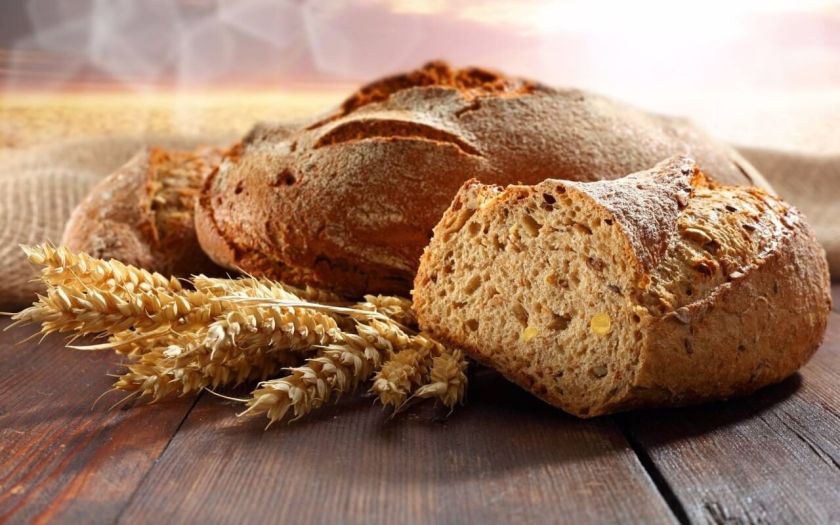
Evolution of Baking

Baking may be regarded as a science, but it’s the chemistry between the ingredients and the cook that gives desserts life. Baking is done out of love, to share with family and friends, to see them smile. Anna Olson

Since the existence of man, the very first instances of baking was believed to have occurred when wild grass grains were soaked in water, mixed together and mashed into a kind of broth-like paste which was cooked by pouring it onto a flat, hot rock, resulting in a bread-like substance. After the experimentation and mastery of fire, the paste was roasted on hot embers which made bread-making easier. To date the world’s oldest oven was credited to the evidence in Croatia dating it back 6500 years ago. The Ancient Egyptians had baked bread using yeast.In Ancient Greece (600 BC) bread making had lead to the invention of enclosed ovens. Baking flourished further during the Roman Empire with professional pastry cooks being in vogue. Rome saw the establishment of the bakers’ guild with an wide variety of breads being available like the libum (sacrificial cakes made with flour), spira (modern day flour pretzels), savaillum (sweet cake) to name a few. Ovens with their own chimneys and mills to grind grain into flour were common features in Roman towns.

Cooking involves a deadline and hungry people and ingredients that expire in a week. It’s stressful. Cooking happens on the stove and on the clock. Baking happens with ingredients that last for months and come to life inside a warm oven. Baking is slow and leisurely. Regina Brett

Over time and with travel, the Roman technique of baking spread throughout Europe and to eastern areas of Asia. Towards the 13th century, commercial baking started off in London with strict regulations being enforced. Yet it was only by early 19th century that alternate leavening agents (besides yeast) like baking soda were more common. Slowly baked goods were available on the streets as handcarts or in downtown cafes (first being in Paris) or stores. With the advent of automated machinery, the commercialization of baking grew by leaps and bounds.

Baking can be done with a few simple ingredients, so it’s about simplicity and nostalgia – people are reminded of their childhood. Paul Hollywood

The technique of baking is not confined to bread alone, but ranges from biscuits to cakes, casserole to pudding and pies as well as roast, tarts and viennoiserie to list a few. Each country has their own set of baked goods. Adobe bread of southwest US, Barley bread in England, Baozi of China, pan de vapor of Mexico, Naan of India are a few of the baked breads that vary across various regions and countries. In fact a bread variety can be named for every letter of the alphabet.

If baking is any labor at all, it’s a labor of love. A love that gets passed from generation to generation. Regina Brett

Fast forwarding to today, baking has become an art with more flavours, designs and artful masterpieces being created. From cultural as well as religious significance to high teas, daily food, party events and even nursery rhymes (pat-a-cake, bakers’ man) the art of baking has always been an integral part of man’s subsistence and lifestyle. A day at home or any festive season, (especially Christmas) without baked goods would be like missing important pieces of the puzzle, not to forget the pleasant memories as well as burst of flavours and taste lost. As Lidia Bastianich said, “Make gifts meaningful by putting the time in creating them, whether baking and cooking, or in making arts and craft. It will all have more meaning for the giver and receiver.” Baking is a labour of love and something that brings rest to a tired, wandering or lost soul with a plate of freshly baked bread, whichever style of type it may be.

Posted in Christian, Daily, Stories Around the World

Colours to White Christmas

“I’m dreaming of a white Christmas,
Just like the ones I used to know,
Where the tree tops glisten
And children listen
To hear sleigh bells in the snow.” ~ Irving Berlin

Christmas brings forth its’ own hue of colours with each colour bringing its own significance. Ranging from prosperity and year round presence of “green” to “red” which depicts the fall of Adam, blood of Christ or Santa’s coming; these two form the predominant hues of the season. Other major colours include blue denoting the sky and heaven, purple for the altar and the coming of the light and presence of sun in cold months of winter as denoted by the colour “gold”. Yet the most evasive of all is the pristine colour of white, which represents purity, spotless, goodness and peace; akin to the birth of the Lord.

Trending through the Christmas cards, pictures, stories and carols is the scene of “White Christmas”. While this is the case of the wintry lands, the rest of the world may see a little to hardly any snow. Yet the dream of White Christmas lurks for many reasons ranging from beauty, artistry to the pristine pureness of Christmas. For those of us who can’t experience the snow; the closest we can get to “White Christmas” is by engaging in the spirit of love, sharing, kindness and generosity. Whichever colour it may be, Christmas season is here for all.


Posted in Daily, Life, Reflections, Stories Around the World

Attain Peace of Mind

“Sit down before fact as a little child, be prepared to give up every preconceived notion, follow humbly wherever and to whatever abysses nature leads, or you shall learn nothing. I have only begun to learn content and peace of mind since I have resolved at all risks to do this.” Thomas Huxley

Very often we feel that our minds are too restless, filled with disturbing thoughts of “what-ifs”, “whys”, “hows” and “when”. Yet the reality is that all these are suppositions of things that have yet to happen or sequence of events that we are trying to predict. The truth is man by nature is restless and in trying to alleviate this feeling, we dwell in unnecessary chaos. Finally we claim that the peace is disturbed.

“If you want peace of mind, stop fighting with your thoughts.” Anonymous

Peace of mind revolves around a state of calmness both mental and emotional, not harbouring thoughts of no worries, fears or stress. Then the mind is quiet and one experiences a sense of happiness with freedom. Although such peaceful moments are not rare, they are hard to attain unless we empty our thoughts once in a while. Once we practice the art of “let it be, let go” and putting our stress in a jar to hand over to God, we then discover that the weight of jar has reduced after sometime. Slowly over time, the peace within returns and the days don’t become dreary anymore.

Once Buddha was walking from one town to another town with a few of his followers. This was in the initial days. While they were travelling, they happened to pass a lake. They stopped there and Buddha told one of his disciples, “I am thirsty. Do get me some water from that lake there.” The disciple walked up to the lake. When he reached it, he noticed that some people were washing clothes in the water and, right at that moment, a bullock cart started crossing through the lake. As a result, the water became very muddy, very turbid. The disciple thought, “How can I give this muddy water to Buddha to drink!” So he came back and told Buddha, “The water in there is very muddy. I don’t think it is fit to drink.” After about half an hour, again Buddha asked the same disciple to go back to the lake and get him some water to drink. The disciple obediently went back to the lake. This time he found that the lake had absolutely clear water in it. The mud had settled down and the water above it looked fit to be had. So he collected some water in a pot and brought it to Buddha. Buddha looked at the water, and then he looked up at the disciple and said, “See what you did to make the water clean. You let it be and the mud settled down on its own and you got clear water. Your mind is also like that. When it is disturbed, just let it be. Give it a little time. It will settle down on its own. You don’t have to put in any effort to calm it down. It will happen. It is effortless.”

What did Buddha emphasize here? He said, “It is effortless.” Having ‘peace of mind’ is not a strenuous job; it is an effortless process. When there is peace inside you, that peace permeates to the outside. It spreads around you and in the environment, such that people around start feeling that peace and grace.