Posted in Christian, Daily, Stories Around the World

Christmas and Oranges

For those of us who are involved in Christmas-time festive, the link between oranges and Christmas will perplex unless we have heard the story connecting them. In fact for “Christmas historians”, oranges originated with St. Nicholas, stockings and gold.

The legend is traced to (and the most popular explanation) St. Nicholas, an early Christian bishop of the ancient Greek city of Myra during the time of the Roman Empire who was a wealthy man and spent his life helping others. According to the legend, he had learnt of a poor shopkeeper who couldn’t afford wedding dowries for his three daughters. As the father was reluctant to accept any gifts, in order to help the family, St. Nicholas went to the town at night and tossed three sacks of gold through the window (or down the chimney as some narrate). The gold had landed in the girls’ stockings, which were drying by the fire. In the morning by the time the family had woken up, the gold had condensed into balls in the toes of the stockings.

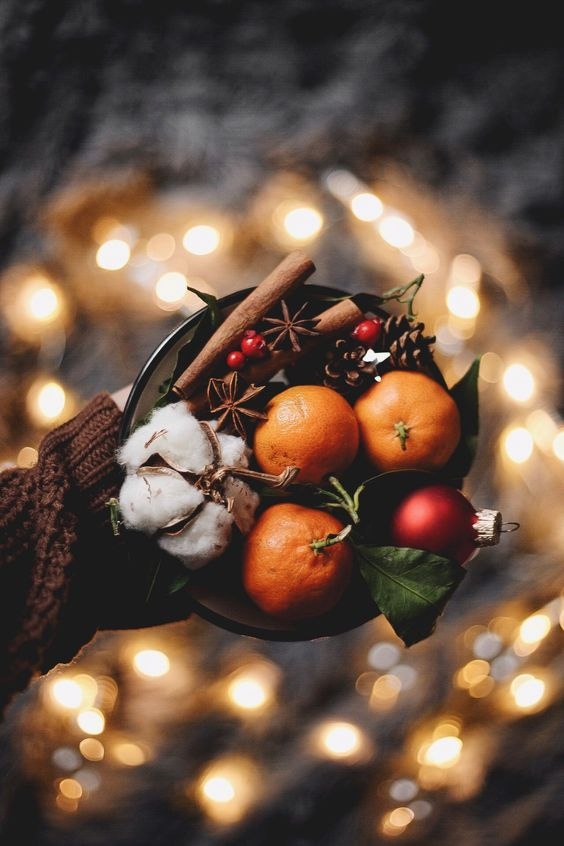
Following St. Nicholas’ example, oranges were given and shared at Christmas time, as representations of gold and a way to celebrate generosity and caring for those in need.

Others reasons for handing oranges at Christmas can be traced to the fact there were once considered as luxurious items and scarce commodities; hence considered as rare treats when received. During the Great Depression and the wars, oranges were rarity in the markets and homes.

Another theory behind the tradition is that orange segments signify the ability to share what one has with others, symbolizing “the season of giving” of December. Reminding us of the taste of summer, oranges are indeed a “must” gift in the stockings.

“I pretended like all the oranges rolling everywhere were her happy memories and they were looking for a new person to stick to so they didn’t get wasted.” Stephen Kelman

Posted in Christian, Daily, Stories Around the World

Setting Up the Tree

“Freshly cut Christmas trees smelling of stars and snow and pine resin – inhale deeply and fill your soul with wintry night.” John J. Geddes

Interestingly the concept of the using trees to celebrate festivals or major events have been there since the early days of civilization. Before the emergence of Christianity, trees and plants that stood the drought and force of winter, remaining green against the white canvas held a special meaning for the people in the cold winter. Believing that evergreen boughs hung over the doors and windows would keep away evil, ghosts and illness as well as remind one of the spring around the corner, Pagans used branches of it to decorate their homes during the winter solstice. Fir Trees were decorated in the Roman temples at the festival of Saturnalia. Similar practices were followed by Ancient Egyptians and Druids during their pagan festivals.

Although for Christians, the fir tree symbolizes as a sign of everlasting life with God; the initial origins are still doubtful. One of the earliest related stories is traced to Germany based on Saint Boniface. In the year 722 AD, he had encountered some pagans who were about to sacrifice a child at the base of a huge oak tree. To prevent the sacrifice, he had cut down the tree and a Fir tree grew up at the base of the oak. He then spread the message that this lovely evergreen, with its branches pointing to heaven, was a holy tree, the tree of the Christ child, and a symbol of His promise of eternal life.

Another legend from Germany of how the Christmas Tree came into being goes as a reminder of care and love for fellow beings. On a cold Christmas Eve night, a forester and his family were gathered gathered round the fire in their cottage to keep warm. Suddenly there was a knock on the door. When the forester opened the door, he found a ragged poor little boy standing on the door step, lost and alone. The forester welcomed him into his home and the boy was fed, washed and put to bed in the youngest son’s own bed. The next day which was Christmas Morning, the family were woken up by a choir of angels and the poor little boy had turned into Jesus, the Christ Child. The Christ Child went into the front garden of the cottage and broke off a branch of a Fir tree and gave it to the family as a present to say thank you for looking after him. Since then, people have remembered that night by bringing a Christmas Tree into their homes.

The Christmas tree tradition as we now know it in the 16th century when devout Christians brought decorated trees into their homes can be credited to Germans. They had built Christmas pyramids of wood and when wood was scarce, decorated them with evergreens and candles. Yet the popular belief is that Martin Luther, the 16th-century Protestant reformer, had first added lighted candles to a tree. In order to recapture the brilliant view of the twinkling stars amidst the evergreens, for his family; he erected a tree in his main family room and wired its branches with lighted candles. In 1846, the sketch of the then popular royals Queen Victoria and Prince Albert standing with their children around a Christmas tree; had resulted in widened popularity of the Christmas tree and its’ acceptance and appearance in many households. Since then the trend has caught on and stayed.

From Christmas lights to handmade ornaments, apples , nuts, marzipan cookies, Gingerbread men and so on, Christmas trees have been adorned in homes, neighbourhoods and communities. While the traditional fir tree has been replicated where ever possible; Christmas trees range from pine trees, spruce trees or even tall trees in their garden especially in tropical climates. Although the Christmas tree has been vastly popularized commercially or artistically; the true origin and concept still stands the same; adorning our homes, being the evergreen surviving the winter ice and snow.

Posted in Daily, Food, Musique

The Muffin Man

Do [or “Oh, do”] you know the muffin man,
The muffin man, the muffin man,
Do you know the muffin man,
Who lives on Drury Lane?

Yes [or “Oh, yes”], I know the muffin man,
The muffin man, the muffin man,
Yes, I know the muffin man,
Who lives on Drury Lane.
(Source: Opie and P. Opie, The Singing Game (Oxford: Oxford University Press, 1985), pp. 379-82))

One of the traditional nursery rhymes of English origin, “the muffin man” was recorded around the early nineteenth century as confirmed by British manuscripts circa 1820. Towards the mid-nineteenth century the rhyme as well as the game had spread over to other countries with regional variations in the lyrics as well as the game altering as a forfeit game, guessing game and a dancing game. Whichever style it may be in, as long as the children have fun, it doesn’t matter.

Interestingly, the muffins in the song were based on the English muffins, not the sweeter American cupcake shaped variety. The muffin is an individual-sized, baked product which refers to two distinct items, a part-raised flatbread or a cupcake-like quick-bread. The former i.e. the flatbread version is of British or European origin dating from at least the early 18th century or even earlier. While the latter i.e. the quick bread muffins originated in North America during the 19th century. Like all bread related products, muffins were an evolution over time with human ingenuity, local ingredients, sudden requirements, cultural expectations laced with technological advancement as well as creative baking styles.

I believe the world to be a muffin pan, and there certainly are a lot of muffins here. Aaron Funk

As far as the origins of the word “muffin” goes, it can be traced to old French word “moufflet” applied to bread meaning soft, or even Low German word “muffe” meaning cake. Initially it started off as small yeast cakes light textured roll, round and flat and commonly enjoyed during winter when they are slit, tasted, buttered and served hot with tea or jam. What initially started off as a basic recipe, towards the twentieth century, they varied from the type of flour (white, graham, rye and corn) to add-ons’ from handful of chopped dates or raisins to the base being of bran, blueberry, corn, apple, oatmeal as well as being bigger in size.

I’m all over the place with muffins. Carrots are great. Banana, chocolate chip, they rock, too. Shawn Mendes

Into the final month of this year, there has to be something special on the table once in a while. The beauty of muffins is that they are so quick and easy to make, particularly since the ingredients are only lightly mixed, not beaten smooth and can be made in a pressure cooker as well. Besides making a good snack while counting calories, the variety of tastes and mixes that can be experimented on are quite interesting. With today being the “National Oatmeal Muffin Day” in the west, it would be fun to give a try for some simple homemade muffins- cupcake style or the “English muffin way”.


Posted in Daily, Family and Society, Personal Musings, Quotes, Stories Around the World

Driving Force of Love

“The greatest happiness of life is the conviction that we are loved; loved for ourselves, or rather, loved in spite of ourselves.” Victor Hugo

It was a busy morning, approximately 8:30 am, when an elderly gentleman, in his 80s arrived to have stitches removed from his thumb. He stated that he was in a hurry and that he had an appointment at 9:00 am. I took his vital signs, and had him take a seat, knowing it would be over an hour before someone would be able to see him. I saw him looking at his watch and decided, since I was not busy with another patient, I would evaluate his wound. On examination, it was well healed, so I talked to one of the doctors, got the needed supplies to remove his sutures and redressed his wound. While taking care of him, we began to engage in conversation. I asked him if he had a doctor’s appointment this morning, as he was in such a hurry. The gentleman told me no, that he needed to go to the nursing home to eat breakfast with his wife. I then inquired as to her health. He told me that she had been there for awhile and was a victim of Alzheimer’s Disease. As we talked and I finished dressing his wound, I asked if she would be worried if he was a bit late. He replied that she no longer knew who he was, and hadn’t recognized him in five years. I was surprised, and asked him, “And you still go every morning, even though she doesn’t know who you are?” He smiled and patted my hand and said, “She doesn’t know me, but I still know who she is.”

“Being deeply loved by someone gives you strength, while loving someone deeply gives you courage.” Lao Tzu

When a couple starts off in their journey in life together, they slowly learn about each other, work through difficulties and despite the faults that each has, they overlook them because of love, as the latter has no limits, tally marks, check posts or boundaries. As time progresses and disease catches up with age, losing the treasured moments is disheartening for all. Yet despite the disease that strikes, the bonds of true love of one is strong enough to hold both. This story that I had read exemplifies the fact that whether true love has no time limit.

“The most desired gift of love is not diamonds or roses or chocolate. It is focused attention.” Richard Warren

The art of love doesn’t lie in the lone act of giving gifts or worldly pleasures. It lies in giving your time to understand the other person, what they are going through whether it be joy or sorrow, triumphs or difficulties. For the strings of love will be strong to bind both through trying times when the love grows and strengthens over time. In fact our actions speak louder than the words that we say or the words that we write, although they are important as well. Amidst the daily schedule, take out some time for each other so that you learn about each other and find some quiet time to rejuvenate, find peace and share moments as well as memories for later.

“Love is not only something you feel, it is something you do.” David Wilkerson

Posted in Daily, Family and Society, Quotes, Stories Around the World

The Three Sieves

“Think before you speak. Read before you think.” Fran Lebowitz

The greatest ability that puts man apart from the rest of the oxygen dependent genres is the ability to read, write, think, comprehend and speak various languages understood with all of his kind. The gift of verbal and non-verbal communication of man is at a higher level than the rest of the living species.

“There is a time and a place for things. Sometimes one needs to put a filter on oneself. That can be a good thing.” Tori Amos

Which is why before we say something rash or simply repeat the hearsay, think if doing so is worth the time, effort, energy as well as the consequences and the aftermath. The wheel of time is such that it can be only move forward. Once a particular event has happened for good or bad, we can’t change it but only deal with it or take corrective measures.

“Speak only if it improves upon the silence.” Mahatma Gandhi

Unless we learn to sieve our words and thoughts when we tweet, speak or cast them to the world around us; we would end up with a whole load of regrets, guilt and uneasiness. It is easy to fill in conversation gaps, catch attention or be the first with the information; yet unless it is true, beneficial, required, non intrusive and kind; saying nothing is more restful to oneself and others as well.

“Before you speak, listen. Before you write, think. Before you spend, earn. Before you invest, investigate. Before you criticize, wait. Before you pray, forgive. Before you quit, try. Before you retire, save. Before you die, give.” William Arthur Ward

“One day, the old wise Socrates walks down the streets, when all of the sudden a man runs up to him “Socrates I have to tell you something about your friend who…”
“Hold up” Socrates interrupts him “About the story you’re about to tell me, did you put it trough the three sieves?”
“Three sieves?” The man asks “What three sieves?”
“Let’s try it” Socrates says.
“The first sieve is the one of truth, did you examine what you were about to tell me if it is true?” Socrates asks.
“Well no, I just overheard it” The man says.
“Ah, well then you have used the second sieve, the sieve of good?” Socrates asks “Is it something good what you’re about to tell me?”
“Ehm no, on the contrary” the man answers.
“Hmmm” The wise man says “Let’s use the third sieve then, is it necessary to tell me what you’re so exited about?”
“No not necessary” the man says.
“Well” Socrates says with a smile “If the story you’re about to tell me isn’t true, good or necessary, just forget it and don’t bother me with it.”
Socrates

Posted in Daily, Food, Random Thoughts

Cover with Chocolate

The greatest tragedies were written by the Greeks and Shakespeare…neither knew chocolate. – Sandra Boynton

On my evening shopping spree, as I running through the aisles, the poster announcing a discount on the chocolate syrup on the event of Chocolate Covered Anything Day (December 16th) caught my eye. With a toddler in tow and it being the Christmas season, I couldn’t resist the offer. Usually when I use chocolate in cooking, I lavishly blend it with the desserts and shakes. For simply dipping food in chocolate and just having a bite, leaves the taste buds still craving. Yet for the fun of covering chocolate over variety of foods, I have planned on a chocolate dipped fruit salad, chocolate rice pudding as well as chocolate covered banana fritters (to be on the safe side). Even though the chances are high that no one can resist chocolate, simply rice with choclate is still a weird combination although wheat (roti) and chocolate spread works well. But there is no harm in a little bit of experimentation. With all the fun, personally I feel that the celebration of “Chocolate Covered Anything Day” is simply another reason to justify the need to indulge in chocolate, without triggering the guilty feel.

Chocolate comes from cocoa, which is a tree, that makes it a plant. Chocolate is salad. – Unknown

Posted in Daily, Family and Society, Stories Around the World

Love the Dandelions

“I was a dandelion puff…Some saw the beauty in me and stooped quietly to admire my innocence. Others saw the potential of what I could do for them, so they uprooted me, seeking to shape me around their needs. They blew at my head, scattering my hair from the roots, changing me to suit them. Yet still others saw me as something that was unworthy and needed to be erased.” Nicole Bailey-Williams

A man who took great pride in his lawn found himself with a large crop of dandelions. He tried every method he knew to get rid of them. Still they plagued him. Finally he wrote to the Department of Agriculture. He enumerated all the things he had tried and closed his letter with the question: “What shall I do now?” In due course, the reply came: “We suggest you learn to love them.” ( adapted from Anthony de Mello’s The Song of the Bird)

We all have our own set of “dandelions” like a difficult boss, hectic work load, nosy neighbours, gossipy community member who we encounter on a daily basis, a disorderly household or even the unruly hair that refuses to settle down; the list is endless. While we would be able to change few of them them, the others would be in the category that we can’t change despite countless efforts, manoeuvres and attempts. What we can’t change, we shouldn’t fight. When we learn to accept and find a way to work around our “dandelions”, we achieve happiness in all the other good parts of life. There is a whole wide green lawn out there, yet only when we kick off our shoes, step into the green blades (scattered with the dandelions or not), we learn to enjoy the sense of beauty that nature offers us.

“Dandelions, like all things in nature are beautiful when you take the time to pay attention to them.” June Stoyer

In our lives, at work, in the neighbourhood and community and even among our extended families; there would be “dandelions” cropping every now and then. Yet these “dandelions” have their own beauty. As seen through nature and in various places, dandelions are not always considered as weeds. From being a medicinal herb to being cultivated as a crop for dandelion wine or tea, their uses vary on occasion, place, purpose and requirement. Likewise, when we learn to enjoy every “dandelion”, their beauty and abilities will be appreciated. Remember the fun memories with dandelions in our childhood. Be like a child with the “dandelions” we find in our life, curl the stems in water, blow out the seeds, paint them and above all, make cherished memories having fun.

“Dandelions are just friendly little weeds who only want to be loved like flowers.” Heather Babcock