Posted in Food

Of Stuffed, Rolled and Creativity

If anyone had ever said that working from home would be a must for the next couple of weeks; that would be one of the sole reasons to go royally insane. When those little minds are hungry or craving for a snack, the clocked in “office hours” go for a six as the whines of “snack time” reach the grey and white matter. Which is why after repeated snacks of various creations with biscuits, cake (made earlier), fritters and ready to eat snacks, being “boring”; the need to spice things up becomes a necessity. So out goes the rolling pin, a plate of stuffing mix (meat and herbs) and we are good to go.

Interestingly, there are many recipes which can be tweaked a bit to provide their entry into the snack hour. One of the favorites and easy to work with is the “wrapped in the blanket concept”. The popularity is summarized by one of the most favoured recipes for cocktail parties or large luncheons to serve as an appetizer, are the “pigs in blankets” or “franks in blanks”. Essentially made of a frank rolled in a piece of bread -bun or pastry, this can range from a small snack to a large jumbo sized meal. While the rule is to put in small franks or breakfast sausages in a bit of dough, one can spice up the dish by own choice.

Delving into the global variations through various cuisines, the sausage can be wrapped up in a tortilla and deep fried in vegetable oil, going by the name “salchitaco” by the Mexican cuisine. Or one can prepare it as Moshe Ba’Teiva (Moses in the basket), an Israeli dish made by rolling up the kosher hot dog in a ketchup-covered sheet of puff pastry or phyllo dough and serve it baked. On similar lines, Argentinians wrap up the sausage topped with ketchup and bake it. For those who want to keep on the far side of added calories, the sausage wrapped in pastry can be steamed to; like the Chinese Lap Cheong Bo. For the home kitchen, one can simply use puff pastry or a tortilla to just wrap up the filling and fry or bake it.

Another popular snack food is the Italian arancini. Made of a ball of rice coated with bread crumbs and then deep-fried; these snack food can be prepared in raw and stored in the fridge, to be made on demand and as required. The fillings can be made of meat (minced slow-cooked with spices), cheese (mozarella or caciocavallp) or filled with both (like ham and mozarella).

One of the advantages of knowing these different styles, is that they come to the rescue especially when caught unawares. The plus part lies in the fact that they use the simple ingredients available in the pantry, which may be modified as per own requirement. As always said, the fun part of “kitchen experimentation” lies when tweaking old recipes a bit and adding a little imagination and creativity to the mix.

Posted in Food

Topsy, Up-turned and Sweet

If today’s entry went into the kitchen journal, it would be under the set of “kitchen disasters nearly rescued.” With the lock-down still in effect, the demand for dessert is quite strong. So with a share of the pineapple crop from home, going for an pineapple pie was a quick and easy solution. Yet has anyone wondered what happens next, when one has planned to make the puree for an apple pie, but got the cuts turned to the near brown-black? While on one hand, the litany of “not now” goes on and the contents get thrown out; the other side is to improvise and make it into a palatable dessert.

Entering into the scenes behind one of the famous dishes, history teaches that some of the best creations happen with quick thinking, courage, improvisation and a whole dash of creativity, all occurring in a short span of time. One such dish, is the Tarte Tatin.

As the records go, the 188os saw a special dish created at the Hôtel Tatin, Lamotte-Beuvron, Loir-et-Cher which is south of Paris, which was run by two sisters, Stéphanie and Caroline Tatin. Records of the popular legend state that, Stephanie Tatin had left the apples cooking in butter and sugar for a long time, beyond the required effect meant for an apple pie. To salvage the dish, the pastry base was put on top of the pan of apples and then the whole set into the oven. The dish when turned out as an upside down tart was a welcome addition to the menu, which stayed on since then.

Not known as the Tarte Tatin of now, these upside down dishes were a specialty of the Sologne region. Whether it was the forerunner of the recipe of today’s, food historians still debate on these points, especially with the lack of historical evidence at hand. Regardless, it is adventures like these that give one inspiration to salvage the contents at hand, and make a dish for the love of cooking and for own pleasure.

Keeping to the upside theme, one dessert cake would be the “pineapple upside down”cake. The cake is baked in a single pan with toppings, which can range from chopped or sliced (glazed, plain or caramelized) apples, cherries peaches or pineapple placed at the bottom of the pan. When served, the upside-down cake is de-panned, thus righting it to the “right-side up”. The fruits form a baked topping after the cake is inverted. Sticking to the traditional upside-down desserts, the choice ranges form the regular American pineapple upside-down cake to the French Tarte Tatin or the Brazilian or Portuguese bolo de ananás.

While many local cuisines may have their own set of similar dishes or recipes, getting inventive sure helps one to savour the other side of the globe. When travelling is out of the question, creating the dish is a voyage worth embarking on.

Posted in Food, Stories Around the World

Of “Chai” Times

One of the highlights of the weekdays used to be the fifteen minute “chai session” that used to happen in the break room. As we weren’t allowed to carry over beverages to our desks, the break was a well anticipated event; not only for those who love “chai” but the camaraderie that went along with it. The experience of “chai time” started into the early days of college, where the campus canteen used to be the centre of “chai and biscuits” at any time of the day or evening. With the hot brew comforting each of us, the woes, worries, near-misses and the best highlights as the day ends. Through the years, these sessions had stayed on in the campus life and eventually even into the office.

“Tea time is a chance to slow down, pull back and appreciate our surroundings.” Letitia Baldrige

Delving into the history and tradition of tea, each area and country have their own special styles and customs. Bringing these styles home feels like sharing a . Known as “shai” in Egypt, the widely preferred tea is the black tea. It is prepared as “Koshary tea” wherein the black tea is steeped in boiled water, letting it set for a few minutes, sweetened with cane sugar or flavoured with fresh mint leaves with milk, the latter being by choice. The other variety is the “Saiidi tea” which is prepared by boiling black tea over a strong flame for five minutes or longer. Being extremely bitter, it needs plenty of cane sugar to go along with it.

Coming over to East Frisia, the traditional tea preparation is a special art in itself. A white rock candy sugar, known as “kluntje” is added to an empty cup. Then tea is poured over the Kluntje, with a heavy cream “cloud” added on. Served without a spoon or being stirred, this tea is had un-stirred in three tiers. Initially it tastes predominantly of cream, then the taste of tea with the final sweet taste of kluntje at the bottom of the cup. As the kluntje melts slowly, it allows multiple cups of tea to be sweetened. Stirring the tea would merge all the tiers as one, thereby missing out on the traditional beauty of the tea savouring. Being a guest, less than three cups of tea is being rude tot he host. Once done, the cup has to be placed upside down on the saucer or the spoon in the cup to signal that one is done and satisfied.

The Sahelian region of the Sahara, green gunpowder tea is had with a session of storytelling and heartfelt conversation. The tea is poured into the glasses and back, with a foam building on top of it. Had with plenty of sugar and little milk, the Sahelian tea has the first infusion as bitter as death, the second as flavourful as life (go in between) and the third sweet as love.

“A thoughtful cup of tea brought to your bedside each morning means more to me than the huge bouquet of flowers bought once a year.” Penny Jordan

With the lock-down on and the friendly “chai” sessions out of the equation, sharing tea in a special through video chats makes the circle of friendship fun, endearing and lovely. Besides having plenty of tea customs to choose from, each weekend session of tea, feels like bringing another part of the world home.

Posted in Food

“Bits, Flipped or Sunny Side Up”

Coming back home into the noon hours, the quiet inside suddenly turned into a boisterous clamouring of feet and run of words. Nevertheless this noise was a welcome respite after winding up the work schedule at the main company. With the lock-down phase going quite strong; to close a couple of financial year-end projects, it was necessary to touch the base and camp in there for the last two days.

Being back at home with my better-half who was holding the fort, it was quite interesting to hear the events of past hours. With pieces of tales of the movie night, “One-eyed Jacks”, “dad let us sleep in”, “we had tons of ice-cream” and “we won the match”, the last day and half saw them getting involved in something new. What made it more interesting was the plate of “Adam and Eve on a Raft” with a cup of iced tea to go with the “accounting”. With food already in the fridge for yesterday was told, “getting creative with bread, a couple of eggs and other stuff” was what made the morning hours go by till lunch.

[1947]
“Adam and Eve on a Raft
Rounds of bread, 2 eggs, Butter or lard, Salt and pepper to taste
Cut a large round of bread, and fry it in hot butter or lard until a golden brown. Then place it on a hot platter, and keep warm. Poach the eggs carefully, season and place on bread.” Blondie’s Soups Salads Sandwiches Cook Book, selected and illustrated by Chic Young [Bell Publishing Company:Drexel Hill PA] 1947 (p. 134)

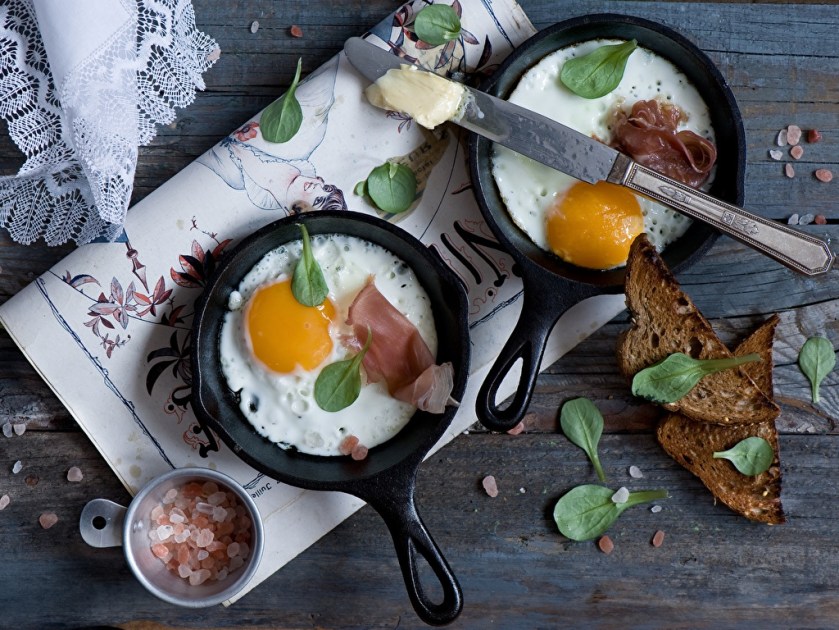
A handful of eggs, flour based food as base and basic vegetables of onions, tomatoes and a dash of salt, pepper and spices opens up a whole new slot of recipes. Call them by any name, but eggs on toast can be extrapolated to being “in-the-basket”, “pirate-eye” or the indigenous dish of “huevos rancheros” or Huevos estrellados” to name two.

Technically “egg in a hole (or frame)”, known by numerous other names like “one-eyed Jack” or “popeye”, refers to an egg prepared in the circular or square hole cut into the piece of bread, or even a bagel or waffle. When the buttered bread browns in the pan, the egg is cracked into the “basket” carved out in the toast. Depending on when one chooses to place the egg, flip the bread or cover it, results in varying shades of the same dish living up to all of it’s titles names.

[1990]
“One-eyed Jacks.
Use an upside-down cup to cut a hole out of the center of a slice of bread. lay the bread in a hot, greased pan and crack an egg into the hole. Fry it a few minutes until the egg sets, then flip the bread and egg with a spatula and cook the other side. You’ll have an egg and toast all in one.” Boy Scout Handbook, Boy Scouts of America 1990 (p. 109)

Even fried eggs have their own set of indigenous recipes, based on the local and regional cuisine. From the Portugese bife a cavalo, German Strammer Max, Chilean lomo a lo pobre, the Danish uitsmijter ham (or spek) en kaas or the Russian yaichnitsa are just few of the many recipes to decide from. Delving into the Mexican cuisine, huevos rancehros is one of the large traditonal Mexican brunches that one can prepare as same or in a variation. Keeping it simple, the basic dish consists of fried eggs served on lightly fried or charred corn or flour tortillas topped with a salsa fresca made of tomatoes, chili peppers, onion, and cilantro. It can be served with rice, refried beans or slices of avocado. Shifting over to lunch hours, Huevos estrellados (Madrid) refers to pan-eggs fried with French fries, meat (ham, bacon) and served hot with potatoes. While one can alter the recipes as suited for self, the combinations available are endless.

With the lock-down till on, trying out something different but simple puts an interesting spin to weary days. The fact that eggs, bread (or even pita or roti) with added simple kitchen ingredients pave way for an endless process of creativity as well as satisfying the taste buds, allows one to don the apron and start off.

[2006]
“Eggs in a Basket
2 servings
Kids get a kick out of this dish, especially when they get to make the basket.
Using a 2 1/2 inch biscuit cutter or small glass, cut a hole out of the center of 2 slices sandwich bread. Melt in a large skillet over medium heat 2 tablespoons butter, plus more as needed. Add the bread and cook for about 30 seconds. Crack into the holes 2 eggs. Do not worry if some of the white remains on top of the bread or runs out from underneath. When the eggs begin to set, 2 or 3 minutes, flip the bread and eggs, using a spatula. Add more butter as needed. Fry the other side until the eggs are done to your liking. Grill the rounds of bread in butter and serve them as well.” Joy of Cooking, 75th anniversary edition, Irma S. Rombauer et all [Scribner:New York] 1997, 2006 (p. 196)

Posted in Food

Gooey, Melted and Dipped

Though holidays have been around the corner, the requirement to stay within the premises has taken the thrill out of it for the children. Quite often the early rays see them waking up eager to soak in the morning sunshine, by evening they are quite restless. Which is why calling it an early night, helps most of the time. If the indoors become too stifling, supper outside helps to get them in the mood right for bedtime. All one needs is an old crock-pot, plenty of cheese, long dipping forks, cut pieces of bread (or crackers, roti), a camping spot, a guitar and we are good to go.

Essentially a melted cheese dish served in the pot over a stove, eaten by dipping bread into the cheese using long stemmed forks; the fondue has been found initially in the Swiss cuisine, traced to around the early 19th century by food historians. This dish can be made as simple with melted cheese and seasonings (a little flour, tiny pinch of nutmeg) together with dry white wine, flavoured with kirsch, served as a hot dip for pieces of bread or as a dish of hot liquid in which small pieces of food are cooked or dipped and also as a baked souffle-like dish usually containing cheese and cracker crumbs or breadcrumbs.

“Give me a good sharp knife and a good sharp cheese and I’m a happy man.” George R.R. Martin

Often regarded as a peasant’s meal, the recipe required very simple ingredients and just a heavy earthenware or iron meant to distribute the heat evenly. In fact, Swiss recipes traced to the recipe can be found in the early 1600s. Obscure mention of the fondue can see in the Homer’s Iliad (around 800 BC) where it was referenced as a “mixture of goat’s cheese, wine, and flour.” Records mention of Swiss peasant families (1700s) eating aged bread and cheeses together as a wintertime food. The discovery of then, that if cheese was melted with a dash of added wine, garlic and herbs; the stale bread dipped into this flavorful mixture was a pretty enticing meal.

[1899]
“Cheese Fondu: Use one tablespoonful of butter, one cupful of fresh milk, one cupful of fine bread-crumbs, two cupfuls of grated cheese, a teaspoonful of dry mustard, two eggs, and a little cayenne. Melt the butter in a chafing-dish, add the milk, bread-crumbs, cheese, mustard, and cayenne. Stir constantly, and add two eggs, slightly beaten, just before serving. Serve on hot toast or crackers. Remember to have the plates hot.-A.R.” The American Pure Food Cook Book, David Chidlow et al [Geo. M. Hill Company:Chicago] 1899 (p.268)

From the change of ingredients to types of cheese used, cheese fondues vary based on style, region and local recipes.For instance, the Italian Fonduta alla valdostana is made of Fontina, milk, eggs, and truffles while the Swiss Vaudoise uses Gruyère cheese. Other Swiss recipes include Appenzeller cheese with cream added; Gruyère, Emmental, crushed tomatoes and wine or made spicy with Gruyère, red and green peppers, and chili; or with Gruyère, Fribourg vacherin and mushrooms.

Though known famously to the Swiss cuisine, similar recipes involving melted cheese have been seen in not just the French but the Mexican and Spanish cuisine (caldo de queso,chile con queso). And where table-side cooking has been the norm in Asian cooking, dishes involving melted cheese has been always a part of the indigenous cuisine like the ema datshi, chhena jhili, rasabali or churu.

Ever since the spread of recipes over to different cuisines, the term “fondue” is referred to food dipped into a communal pot of liquid kept hot in a fondue pot. From meat to tomatoes or potatoes as well as choclate, fondue is essentially more of a way of cooking.

More than the taste of the meal, it is the friendly and family feel that is shared by the meal. One of the best memories had during the childhood was when we used to gather around the crock-pot of melted cheese and tip off the bread from the other’s fork. The inner who tips the maximum gets a whole stash of candies from the losing side. With all this and simple ingredients, making a simple dish of cheese fondue can make for a welcome change, especially in the outdoor cooking. Little wonder why then experimentation with fondue recipes can drive the strain of the lock-down away.

Cheese Fondue
Basic Recipe
600 g (21 oz) shredded cheese (1/2 Gruyere, 1/2 Emmentaler), 1 garlic clove, 3 dl (1 1/4 C) dry white wine, 3 tsp cornstarch, 3 small glasses kirsch, ground pepper, nutmeg. Rub a heavy saucepan or heat proof clay fondue pot (Caquelon) with the split garlic clove. Dissolve the cornstarch in the kirsch. Put the cheese and wine into the pan and slowly bring to a boil, stirring constantly. When the cheese is completely melted, add the kirsch and cornstarch mixture, stirring vigourously. Continue to cook. Season with pepper and nutmeg. Serve over an alcohol lamp. The cooking should continue on low heat. Stir constantly with small pieces of bread speared on a fondue fork. There are several varieties of fondue:
In the Canton of Vaud, fondue is prepared with Gruyere cheese only, but at varying stages of ripeness. Sometimes it is mixed with cheese from the Jura. In the Jura, the fondue is made up of 1/2 Jura cheese and enhanced with 1-2 challots per person. The challots are eaten last.
In Geneva three kinds of cheese are used: Gruyere, Emmentaler and Vaudois cheese. Then, sauteed chopped morsels (fresh or dried and pre-soaked) or diced tomatoes are added.
Fondue is usually eaten with bite-sized pieces of crusty bread speared on a fondue fork. One can also, however, use small potatoes or potato slices. Fondue aficionados dunk their bread in kirsch before dipping it into the cheese. And don’t forget: whoever loses his bread in the pan must pay for a round of beer or a bottle of wine. If it happens to a lady she must kiss the man sitting next to her. On the whole, however, the former is more popular.”
Cooking in Switzerland, Marianne Kaltenbach [Wolfgang Holker:Zurich] 1984 (p. 84)
Posted in Food, Stories Around the World

Coffee, Sugar and a Twist

One of the big benefits of work-from-home option, are the ease of getting a slow mornings. With a large chunk of time, saved from missing the commute, one can savour the first bite of coffee, the afternoon aroma of the beans and the night experimentation with newer styles. Though one downside is that, too many regular coffee or the plain espresso, makes one want to grab for a cafe made latte for a change. With the present situation, as one can’t go to the cafe, the quest is on to bring the cafe home. The subsequent research for cafe-made coffees to be experimented at home lead to plenty of “aha” moments.

“Come on, don’t you ever stop and smell the coffee?” Justina Chen Headley

Getting into mood of completing the daily work requirements, the daily shot in different shades of black to brown is what keeps the morning work to the grind. So with the home espresso machine in tow, the regular morning shot was had with a small twist the past couple of days. When the bite of coffee needs to be mellowed a tinge, the regular shot of espresso can be diluted by little milk (less than 100ml) for the Manilo, which is actually a flat-white but lot smaller.

Going towards the Cuban tradition to drink coffee strong and sweet where the sugar is often mixed with the coffee beans prior to the latter being brewed, making the homemade Cuban espresso involves knowing the traditional way. The traditional method of brewing coffee was the filter method using a cloth cone; but the modern brewing recipes prefer a moka pot than the espresso machine. Made best using the darker roasts (preferably Italian or Spanish), a little of the the espresso shot is taken, sweetened with natural brown sugar and then the whole mix whipped. The mixture is then added to the remaining espresso and vigorously mixed into a creamy foam, the espuma or espumita. A sweeter and more viscous coffee is made by this method, than by adding the normal brown sugar to the espresso. This espresso brewed with sugar goes by various cafe names like the Café Cubano, Cuban coffee, Cuban espresso, cafecito, Cuban pull, or Cuban shot. Another technique is to place the sugar (white or brown) in the cup as the coffee is dripped into it; the whole mix then stirred into a froth. Adapting to the takeaway option, “the Cuban Colada” is 3–6 shots of Cuban-style espresso in a cup along with small demitasses to take to work.

Though deceptively simple, this Miami café Cubano has few variations. One is the cortado, made of an espresso mixed with a roughly equal amount of warm or steamed milk to reduce the acidity. The milk is not frothy and “texturized”. The Cuban cortadito is generally mixed with heated sweetened condensed milk. Other styles include the café con leche condensada or bombón (espresso with condensed milk) and the leche y leche. The latter is made with condensed milk integrated throughout and a dollop of cream resting on top. The café cortado (espresso with a dash of milk) is almost similar to the Italian macchiato or the French noisette (hot milk to espresso is 1:2 ratio).

Another style is the Café con leche which literally translated from Spanish means “coffee with milk”. Originating as an Spanish coffee beverage, the espresso (strong and bold) is mixed with scalded milk in an approximate 1:1 ratio. If the amount of milk is higher, it becomes the café con leche en vaso or café con leche de desayuno. This preparation is closer to the Italian caffè latte or latte, than the French café au lait. The Cuban “Café con leche” is made when the espresso (without the sugar) is poured to the desired darkness into the cup of hot or steamed milk.

Researching on the Cuban coffee style alone resulted a whole new set of recipes and ideas being unlocked. Adding a personal variation based on the time of the day, especially iced for the noon makes for an nice twist to the usual. In the midst of all these concoctions, the only requirement is the mix being drinkable. That being the must, the rest is purely on the recipe, imagination and what is at hand. With all this being there, little reason why the lock-down hasn’t resulted in being a drag so far. Letting this first phase of the “espresso specialties” sink in, the next few days would result in plenty of interesting trials as well as errors.

Posted in Food

Airy, Sweet and Light

Being in the “work from home” phase doesn’t result in fulfilling the work targets especially when the kids are still in holiday mode, getting bored with the stability of routine. Which is why, an attempt was made to channel their energy in the culinary style. A few blocks of dark chocolate, plenty of eggs from the farm, a quart of milk with the recipe for homemade mousse at hand and and we were good to go.

Going by their French origins, “mousse” which means foam, is a dish with plenty of air in it, giving it’s soft, light and fluffy or soft, creamy and thick texture. Made both as a sweet or savoury dish, mousse has been an integral part of many recipes (primarily desserts) since the 18th century. With the little documented history that is available, food historians quote recipes of savoury mousse, followed by fruit mousse and then the dessert mousse (especially choclate towards the mid-19th century) which increased their popularity.

“Mousses. These are a go-between souffles and ordinary iced creams. They are lighter and more spongy than the latter, on which account they are often better liked. They have the further advantage of needing no freezing before they are moulded. The mixture is first thickened over the fire like a custard, then put in the mould and set in an ice cave until firm enough to turn out. A cave is a necessity for the proper concoction of these dishes. To ensure success they need great care in the preparation.” Cassell’s New Universal Cookery Book, Lizzie Heritage [Cassell and Company:London] 1894 (p. 966-7)

Made typically with whipped egg whites or cream, or both; flavoured with chocolate, coffee, caramel, fruit purees or vanilla; sweet mousses are often had chilled to give a dense airy and soft texture. To give a richer feel, egg yolks may be stirred and beaten as well. Sweetened mousse also makes for a good filling between layers of thin cut sponge cakes or simply mixed between layers or onto cupcakes. Such preparations may need for the addition of gelatin into the mousse. Savoury mousse may be made from meat, fish, shellfish, foie gras, cheese or vegetables pureed and beaten. These hot mousse often get their light texture from the well beaten egg whites.

While many food historians often relate to mousse as one of the varied desserts made with whipped cream. The latter was often poured into the mixture or on top especially on preparations of coffee, liqueur, fruits to form the foam of simple to complex pyramidal shapes. Often known as crème en mousse (cream in a foam), crème mousseuse (foamy cream) or mousse ‘foam’, these recipes were there in the late 1760s. Though food historians largely believe that it was the experimentation with chocolate that lead to the rise of the new set of dessert recipes.

Early American dessert mousse recipes (as seen in the cookbooks) were often classified with ice-creams; wherein it was almost similar to parfait. What make the mousse different, is the four components that needed to be checked off, in the ingredient mix. First is the base (chocolate, strawberry puree, passion-fruit or even chicken), the binder (egg whites, gelatin) and the lightening agent or aerator (beaten egg whites, whole eggs, egg yolks or whipped cream). Some recipes call for specific flavouring agents or like extracts, liqueurs or spices, as per choice.

The difference in the mousse lies not only in it’s ingredients but also on how well the lightening agent is prepared and the folding. If there may more than one type of aerator, fold it in the order of most stable to least stable. On folding, too much of mixing will cause the aerator to be deflated, losing the soft feel of the mousse.
Which is why plenty of tiny hands do help in the making of the mousse. From the beating of the egg whites to licking the bowl well, it gives them a fun way to expend their energy. With the ingredients being mainly of the pantry type and plenty of time on hand; making mousse gives an added touch to the post-lunch dessert of ice-cream on the hot afternoons.

[1897]
“Chocolate Mousse
Take four strips of chocolate, 1 quart of milk, 6 eggs and 1 tablespoon of cornstarch, dissolve the chocolate in a little warm milk, put the quart of milk on to boil and stir in the chocolate gradually. Set the saucepan where it will cook slowly. Beat the eggs well, mix in the cornstarch and add to the milk and chocolate. Sweeten to taste and boil gently until smooth and thick, stirring until done. Flavor with vanilla and pour into a glass dish. Serve cold with sweetened whipped cream heaped upon it.”
—“Housekeepers’ Column,” Boston Daily Globe, March 16, 1897 (p. 8)