Posted in Food, Stories Around the World

Chocolate for the Holidays

As the holiday season grows near and school is closed till the next year has set into it’s first week, the official holiday snacks and treats season has begun. Young or old, age has never been a bar for the holiday favourites. With the very basic ingredients of crushed cake or biscuit mix, cocoa, sugar (and a little of the rum for that extra holiday spice for the “adults only” time); can result in the favourite holiday treat of the “romkugle, trøffel or sputnik” or simply, the rum balls.

A truffle-like confectionery flavoured with chocolate and rum, these rum balls complete every holiday season. Often coated in chocolate sprinkles, desiccated coconut, icing sugar or cocoa, these cookie, cake or biscuit based treats can be made in a jiffy with no baking required. With the festive preparation in full swing, the less complicated it is, the more popular the recipe.

Making these chocolate balls is an event, for more than the different regional variations, many a time it is a family tradition passed down form one generation tot he next. The basic ingredient is the choclate and as for the rum, that may be replaced by similar rum flavouring or any flavoring of non-alcoholic variant. The basic step is to crush the cake (or biscuit) material, mix it with fat, cocoa, a moist binding ingredient like jam or condensed milk and optional ingredients like chopped nuts, raisins, sultanas, ground walnuts, white chocolate or even peanut butter. Once the mix holds together, it can be rolled into small balls and coated with flavouring of choice. Regional variations as well as names exist for these chocolate rum balls. From the Dansk Romkugl or Trøffel, Deutsch Rumkugel or the Polski Bajadera, each regional recipe has a subtle variation. The Hungarian kókuszgolyó are made with whole cherries placed inside the balls and then rolled in coconut flakes.

Going for a healthy twist from the regular, the Danish Havregrynskugle or the “Oatmeal Ball” may be another new holiday recipe to work on. Slightly smaller than a ping pong ball and made of oatmeal, sugar, cocoa, vanilla, butter with a small amount of coffee mixed to a compact mass, these balls are formed and then rolled in shredded coconut, nib sugar, sprinkles or toppings of choice. Similar to this confectionery is the Israeli Kadur Shokolad, where these chocolate balls are made with Petit Beurre crumbs.

Although these treats are holiday favourites, they are in no way confined to it. More than “just desserts”, they become a part of the family tradition as all hands, the tiny ones as well as the experienced hands join in for the holiday memories. As for alterations and combinations, chocolate for the year end would be loved in any form or any manner, liquid or solid, elaborate or simple; the year end sugar and choclate rush is the norm. As for gifts, there is nothing like a gift of choclate covered rum balls or cakes to bring the present year to a delightful and delicious end.

Posted in Family and Society, Life, Quotes, Reflections, Stories Around the World

Hold on to “the Cloak”

“There is nothing noble in being superior to your fellow man; true nobility is being superior to your former self.” Ernest Hemingway

While putting together the events and details for the Christmas program at the work place, finesse and tact was required while bringing out the various talents (obvious or hidden) present in colleagues, seniors and juniors alike. As each one had volunteered their various acts, from solo vocals or music to the Christmas choir, play and message; the underlying talents were brought to light. While some were good, few were exquisite as the rehearsal audience was charmed by the music, song and talk. Surprisingly, the best of the talented were the ones who didn’t wax eloquent but showed their creative side with poise, charm and humility.

“…talent means nothing, while experience, acquired in humility and with hard work, means everything.” Patrick Süskind

Deeply introspecting the social life of today, one is often listing own achievements either as an open declaration, bragging or defending their glory; instead of growing and perfecting these talents. When social performance and creativity costs humaneness, kindness and humility, it is time to retrospect and learn from the centuries of time where greatness actually lies. As Rick Warren had said, “True humility is not thinking less of yourself; it is thinking of yourself less.” Each one is blessed in their own way, holding their own repertoire of skills, creativity and art. While one is not better than the other; being really good at something doesn’t require one to wear a placard on them declaring the same. Along with own skill and work; the character within speaks the loudest. As the short anecdote experienced by one of the actors of Indian cinema had narrated, the way we behave speaks a lot louder than what one says. True humility is when we acknowledge that there is always something new to learn and perfecting oneself, regardless of the achievements of the present.

“I have three precious things which I hold fast and prize. The first is gentleness; the second is frugality; the third is humility, which keeps me from putting myself before others. Be gentle and you can be bold; be frugal and you can be liberal; avoid putting yourself before others and you can become a leader among men.” Lao Tzu

Amitabh Bacchan says…”At the peak of my career, I was once travelling by plane. The passenger next to me was elderly gentleman dressed in a simple shirt and pants. He appeared to be middle class, and well educated. Other passengers perhaps recognising who I was, but this gentleman appeared to be unconcerned of my presence… He was reading his paper, looking out of the window, and when tea was served, he sipped it quietly. Trying to strike a conversation with him I smiled. The man courteously smiled back and said ‘Hello’. We got talking and I brought up the subject of cinema and movies and asked, ‘Do you watch films?’ The man replied, ‘Oh, very few. I did see one many years ago.’ I mentioned that I worked in the movie industry. The man replied..” oh, that’s nice. What do you do?’ I replied, ‘I am an actor ‘ The man nodded, ‘Oh, that’s wonderful!’ And that was it… When we landed, I held out my hand and said, ” It was good to travel with you. By the way, my name is Amitabh Bacchan !’ The man shook my hand and smiled, “Thank you… nice to have met you..I am J. R. D. Tata!”I learned on.that day that no matter how big you think you are, there is always someone *bigger*. Be humble, it costs nothing.
(Source: The Internet and Social Networks. While some articles say, it was the actor Amitabh Bacchan, others say it was the famous actor Dilip Kumar. Regardless of the actor, it was behaviour of the Great Indian personality J.R.D. Tata which teaches one about humility.)

Posted in Food, Stories Around the World

From Muffin to Cruffin

“You don’t get tired of muffins. But you don’t find inspiration in them.” George Bernard Shaw, Man and Superman

While the busy mornings may start off with a muffin, a regular dose of the latter may inspire a change from the regular. What happens when the dough of the muffin is not poured but moulded in with something different? Voila, then is the cruffin, the brainchild of Kate Reid of Lune Croissanterie in Melbourne (2013). The “cruffin” is a hybrid of the croissant and the muffin. The pastry is made by proofing, shaping the laminated dough which is then baked in a muffin mould.

Although the entire procedure may sound quite simple, the delight of the cruffin lies in the filling and the garnishing. From the double choclate chip to caramel flavoured choclate or salty flavoured cream or rich strawberry jam, cruffins can be filled with a variety of creams, jams, crème pâtissières, curds and garnished with slivered almonds, pine nuts, glazed cherries, candied fruits, honey, maple syrup and the like. The entire cruffin, though a bit messy, is worth the long queue at the bakery. As far s homemade baking is concerned, cruffins are perfect for weekend or holiday baking and as far as fillings are concerned, let the favourites rule.

Extrapolating the idea over to the other morning regular, the donut; adding a little spice by making the donut dough a bit more pastry like, the cronut was born. The cronut, a croissant-doughnut pastry was invented by pastry chef Dominique Ansel of Dominique Ansel Bakery based in New York City(2013).

Made from croissant-like dough which was filled with flavored cream and fried in grape seed oil, this pastry doughnut had caught the flavour and imagination across the globe. So much so that these cronuts with flavoured cream were listed as one of the best “extremely fun” inventions by TIME Magazine (2013).

With the cronut and the cruffin, various combinations like cookie shots, zonuts have been seen. For the home chef, whether it be the standard regular recipe or not, the kitchen is a place to mix and match. As for dessert lovers, the change of taste, flavours and art are what makes the tasty moments of the day.

Posted in Food, Stories Around the World

The “Brownie” Way

“And I’ve just pulled a new brownie out of the oven: a deep, dark chocolate base with a praline pecan topping, sort of a marriage of brownie and that crispy top layer of a good pecan pie.” Stacey Ballis (author of Wedding Girl)

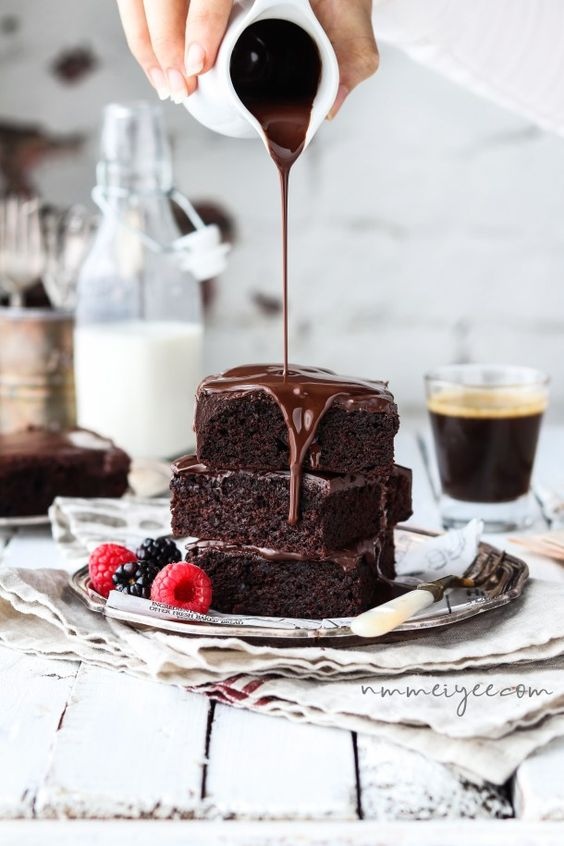
Something quick, easy and delectable are few of the pre-requisites required for adding to the list of holiday baking. If chocolate is added in, the better. It would be something that blend in with other well loved and basic desserts. That something would be square, baked or frozen cut choclate cake pieces, more popularly known as the “brownie”. Coming in a variety of forms, from fudgey to cakey with nuts, fudge, frosting, cream cheese, chocolate chips and the favourites included in the batter; the brownie is an all-time favourite of many. Like sheet cookies, they may eaten by self or with milk, ice cream (a la mode), topped with whipped cream or sprinkled with powdered sugar and fudge.

Like all delectable treats, brownies have their own share of legends. As one legend credits the brownie to the creative ingenuity of Palmer House Hotel pastry chef (1893) for the Palmer House Brownie with walnuts and an apricot glaze made for the Chicago World’s Columbian Exposition on the request of the owner’s socialite wife Bertha Palmer. The first-known printed use of the word “brownie” was to describe a dessert in the Boston Cooking-School Cook Book by Fannie Farmer (1896 version) in reference for a cookie-type confection that was colored and flavored with molasses and made in fluted marguerite molds. Later further publications like The Boston Cooking-School Cook Book (1906) edited by the same Fannie Merritt Farmer records a recipe brownie as an adaptation of her chocolate cookie recipe to a bar cookie baked in a rectangular pan. Another well record as written in the Baking Classics (Betty Crocker) is of a housewife who was making a chocolate cake but forgot to add baking powder. When her cake didn’t rise properly, instead of tossing it out, she cut and served the flat pieces (Bangor, Maine) which would probably account for the Bangor Brownies.

As food historians try to still trace the exact inventor of the “brownie” while the legends credit it to added melted chocolate to a batch of biscuits (added by mistake) or the cook who didn’t have enough flour while baking a cake; brownie are one of the simple things that can be made quite elaborate for the festive season. For instance consider the sandwich brownie (with an ice-cream, cream, icing sugar, meringue or peanut butter as the filling in the middle) or the layered brownie with double chocolate chip at the base, then the layer of Oreos and finally brownie batter on billows of cream cheese, a delight for the wintry holidays. As for the mix, add a scent of cinnamon, essence of the vanilla (blondie twist), sprinkle of the flavours of star-anise, honey or even a little of the cayenne for that extra “hot” to the sweet; brownie can be made as to own choice, flavours and twists. A platter of homemade special brownie can give an extra zest to the holidays. So set, get and go experimenting for a new family festive tradition.

1907
Lowney’s Cook Book
Boston, Massachusetts

Bangor Brownies (p 261)
¼ cup butter
1 cup brown sugar
3 squares chocolate
1 egg
½ to ¾ cup flour
1 cup nut meats
¼ teaspoon salt

“cut in strips”
Source: New England Recipes 

Posted in Daily, Food, Stories Around the World

Madeleine for holidays

Entering into the last month of the year, the delight of enjoying the twilight mornings with the warm cup of tea in the bitter chill of the air, would be better with a little of the small crunchy or tiny delights to add to the tea. In fact with holidays round the corner, a regular stock of the ready homemade sweet dry desserts especially cakes, cookies and biscuits would come in handy.

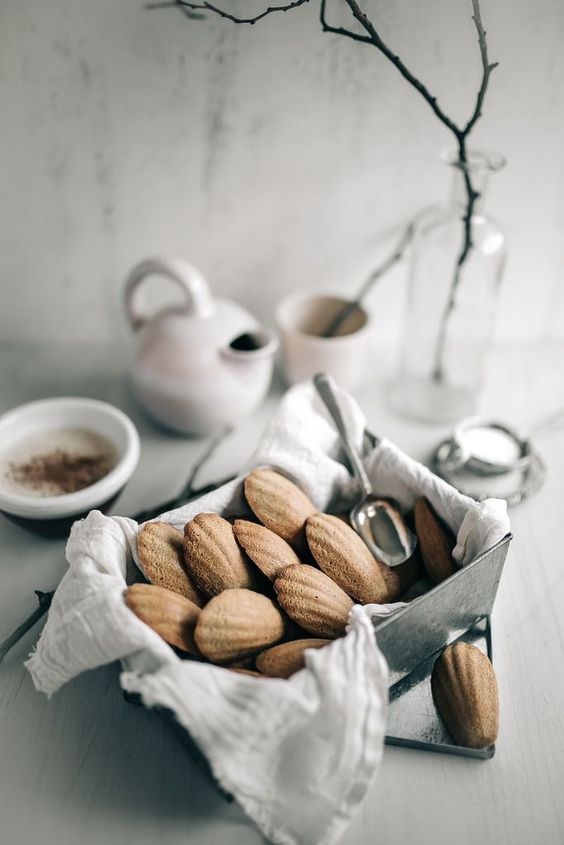
Among them are the treats of small sponge cakes with their distinctive shell-like shape, baked in pans and can be made with the basic ingredients. Known as the madeleine or petite madeleine, these traditional small cakes trace their origins to the Lorraine region in northeastern France. By legend these cakes have been there in the 17th century French cusine, although the increased use of metal moulds (18th century) had led to their increased use. By the end of the 19th century, the madeleine is considered a staple of the diet of the French bourgeoisie.

By etymology, the term madeleine describes “a small cake”. Made from génoise cake batter (with the suspended air in the mixed batter giving the volume to the cake) with traditional recipes adding on finely ground almonds, nuts or lemon zest for their special lemony flavour. In Britain, similar cakes are baked in dariole molds, they are coated in jam, desiccated coconut and topped with glacé cherry.

“On a pound of flour, you need a pound of butter, eight egg whites & yolks, three fourths of a pound of fine sugar, a half glass of water, a little grated lime, or preserved lemon rind minced very finely, orange blossom praliné; knead the whole together, & make little cakes, that you will serve iced with sugar.”
“Cakes à la Madeleine”. Menon, Les soupers de la Cour ou L’art de travailler toutes sortes d’aliments, p.282 (1755)

The madeleine has been mentioned by the culinary writers during the Napoleonic era, especially in the recipe books of Antonin Carême and Grimod de la Reynière. One record of the first recipe traces to the “cakes à la Madeleine and other small desserts” (1758) of a French retainer of an Irish Jacobite refugee, Lord Southwell. Tracing the roots of “Madeleine”, there are several interesting legends pertaining to the origin of the cake. While one considers the name centered from a female character of Lorraine, probably a chef with the patron being Paul de Gondi (17th century cardinal), owner of a castle in Commercy. Another legend consider the inventor to be Madeleine Paulmier, cook for Stanislaus I, duke of Lorraine and exiled King of Poland (18th century). As the legend goes, Louis XV (son-in-law of the duke) charmed by the little cakes prepared by Madeleine Paulmier (1755), named them after her and Maria Leszczyńska, his wife had introduced them soon afterward to the court in Versailles which soon became a favoured French recipe. Two legends link the cake with the pilgrimage to Compostela (Spain) where Madeleine, a pilgrim is said to have brought back the recipe from her voyage or a cook named Madeleine is said to have offered little cakes in the shape of a shell to the pilgrims passing through Lorraine. While another legend states that Madeleine was the creation from the kitchens of Prince Talleyrand by the pastry chef Jean Avice (19th century) who is said to have baked little cakes in Aspice moulds.

Not just in the kitchen, but Madeleine have made their significant impact in literature with Proust’s “episode of the madeleine” as an instance of involuntary memory in his book In Search of the Lost Time. Similar to the madeleine are the “financiers” or the Malaysian Bahulu. One of the benefits of getting down to making Madeleine for the holidays is the ease in its’ preparation, variability of ingredients as well as the versatility of it being a part of the small and the large holiday get-togethers. As for the simplicity in style, a little of “food art” will make the difference. Adding to the festive spirit, madeleine can indeed spice up the holiday season this year.

Posted in Life, Personal Musings, Quotes, Random Thoughts, Stories Around the World

Weave of the Ribbon

“It’s not the years in your life that count. It’s the life in your years.” Abe Lincoln

Unexpected news or shockers from what was previously imagined as real can give a jolt to the person when understanding hits the surface. Yet when it does happens, how one reacts or rather how all of us react, makes the biggest difference.

35 years male. Single. Known case of thalassemia major. On blood transfusions since age of six years. Recurrent infections. HIV ELISA positive.

40 years female. Recurrent infections since the past year. Atypical pneumonia. Disease profiles variable. HIV ELISA positive.

7 year old male.  Recurrent oral candidiasis. Recent diagnosed pulmonary tuberculosis. HIV ELISA and PCR positive.

These above cases are not even close to the tip of the iceberg of the damage caused by what was originally believed to be the mutated form of the wild virus in non-human primates. Rising to global pandemic proportions, the origins are traced to as early as 1910 wherein probably the wild virus underwent mutations to the present form by series of changes ranging from suppression of the innate and internal immune response, high-risk transmission channels as well as social and environmental changes leading to the rapid spread of the mutated virus form. Though the earliest well-documented case of HIV in a human was done in 1959, the clinical cluster of cases (1981) in the United States with rare types of pneumonia (symptoms of Pneumocystis carinii pneumonia (PCP)) and rise of previously rare skin cancer called Kaposi’s sarcoma (KS) prompted the CDC to develop a task force to control the outbreak. With these opportunistic infections being more prevalent in the hemophiliacs, drug users, certain endemic areas and social or sexual preferences; the task force stepped up the ante and the term AIDS was coined and brought to the forefront of the mass public.

From Ryan White to Greg Louganis or Magic Johnson and many numerous people, each of them had fought their battle with the disease of HIV/AIDS. Whether it was by their circumstances or series of unfortunate events, the questions and chaotic thoughts every person or loved one goes through on hearing the positive confirmation is the plenty of “why me’s” and the uncertainty of the future, disease progress and implications on the personal, professional as well as mental front. None of us realize the reality behind the scene, unless we step into the other’s shoes and walk a couple of miles. Only then the false pictures get morphed with those little details that help one to realize the truth was far from what was initially perceived.

“You cannot hope to build a better world without improving the individuals. To that end,each of us must work for our own improvement and, at the same time, share a general responsibility for all humanity, our particular duty being to aid those to whom we think can be most useful.” Marie Curie

As the global battle continues on multiple fronts, from raising awareness to finding solutions and reparative measures for the ongoing myriad of symptoms and disease complex, society in general as to sit up and take note. Ignorance may be bliss for now, but it always comes at a heavy price. Neither does guilt, accusations or pointing fingers help any. But awareness doesn’t hurt anyone. Instead it helps to build for a better tomorrow. The resilience of mankind lies in the ability to pick the battle and choose wise. Linking the goals for the common future would help for the days of tomorrow.

“A man only begins to be a man when he ceases to whine and revile, and commences to search for the hidden justice which regulates his life. And he adapts his mind to that regulating factor, he ceases to accuse others as the cause of his condition, and builds himself up in strong and noble thoughts; ceases to kick against circumstances, but begins to use them as aids to his more rapid progress, and as a means of the hidden powers and possibilities within himself.” James Allen (As a Man Thinketh)

6 pics

Posted in Life, Personal Musings, Quotes, Stories Around the World, Work

Alone or With A Leaf

“In the depth of winter, I finally learned that within me there lay an invincible summer.” Albert Camus

The absence of my toddler at the table for his allotted cartoon time, had sent me to the garden. With the rains and the winds still lashing on though in a minimal way, I was mentally prepared to see him in mud. Surprisingly, I found him by the small pond (covered with a strapped wire mesh thankfully) with a little leaf complete with a long stalk in hand. On closer view, he was gently prodding two tortoises to reach their temporary home soon, before the night fall. While one with the help of the “leaf” had reached the pond soon; the other had almost managed on it’s own. With both of them safely in their home, the wide smile on the young face was worth the muddy shirt.

“Ever tried. Ever failed. No matter. Try Again. Fail again. Fail better.” Samuel Beckett

All of us have our own moments, of being “the tortoise” or “the child”. Wherein, one may need the extra support to go ahead or one has been the provider of that extra support. On the other hand, there have been many who have been in the shoes of the tortoise without that help. Each step was taken with effort, not calculating or finding the prospects in the future; but going about the task and dealing with each aspect along the way.

“At the very moment when people underestimate you is when you can make a breakthrough.”? Germany Kent

Once one has crossed the finish line, on looking back, the feeling of awe, relief, happiness, contentment and thanksgiving all come rolled in one. Later as one dissects the situation, the realization comes that all things are possible, no matter how big it may seem; as long as we keep the self belief and start tackling it, no matter how small the step may seem to be. No sculpture is made one blow alone, but by series of continued chipping to create the many planes, inclinations, curves and angles for the final effect. Our lives reflect a lot similar. Help or no help, once we start moving, one reaches the end point sooner than just twiddling the thumbs or flapping around. Beauty in life as such, is experienced only after a wee little effort on own part.

“You may be the only person left who believes in you, but it’s enough. It takes just one star to pierce a universe of darkness. Never give up.” Richelle E. Goodrich

A Determined Spirit
Author Unknown

Once upon a time, a small bird named Tasoo lived in a vast jungle. One hot summer day, a terrible wildfire erupted and the flames devoured many trees and animals living in the jungle. Other birds flew high into the sky and far away to safety, but Tasoo couldn’t bear to leave her precious jungle home to burn. Day and night, she flew with all her might back and forth to the river, filling her tiny beak with water to drop on the raging fires. Tasoo’s rare heart of courage and unshakable determination moved the heavenly gods to shed tears, and a great rain poured down upon the jungle, extinguishing the flames. And so it is that even the smallest actions of a determined spirit can change the world.
(Popular parable of the Quechua (Incan) Indians of South America)