Posted in Daily, Food, Photography Art, Stories Around the World

Of Cheese and Blue Streaks

While cleaning out the larder over last weekend, I had chanced upon a blue veined gooey stuff enclosed tight in a packet. On closer inspection, apparently it was a piece of cheese misplaced post the local grocery shopping and was out of sight for a month, resulting in the mold setting in. Seeing the blue green veins streaking across the white; what came to mind was the difference between blue and bad cheese.

Blue cheese was believed to be an accidental discovery. As legend says of the making of Roquefort cheese by a young boy who had abandoned his meal of bread and ewes’ milk cheese (on seeing a beautiful girl) returned back months later to find his old cheese soft, crumbly, blue veined and with a tangy flavour transformed so by the mold (Penicillium roqueforti). Similar legends have been heard with the drunken man and his cheese. The early years saw that cheeses were stored in natural temperatures and moisture-controlled caves which happen to be favorable environments for many varieties of harmless mold.

Over the years, many varieties of blue cheese have been created with few having their own stories. For instance, the Gorgonzola one of the oldest known blue cheeses, having been created around AD 879, is said that to have its blue veins only around the 11th century. Stilton cheese, an English cheese (popular since the 1700s) was set in the modern shape and style by Frances Pawlett (or Paulet), a “skilled cheese maker” of Wymondham, Leicestershire. Thus with strict codes, only the three counties of Derbyshire, Leicestershire and Nottinghamshire had market the cheese as Stilton. Later varieties(20th century) of blue cheese like the Danablu and Cambozola (cow’s milk cheese of a combination in style of a French soft-ripened triple cream cheese and Italian Gorgonzola) were made with few variations from the original. Danablu was made from full fat cow’s milk and homogenized cream with copper wires or rods used to pierce the formed curds to distribute the mould (Penicillium roqueforti) evenly through the cheese and then the cheese is aged for eight to twelve weeks.

With blue cheese varieties, one must know to differentiate between the good and bad mold. If mold grows on soft cheeses like cottage cheese, cream cheese or ricotta; or on shredded, crumbled and sliced cheese, it is best to be discarded. As far as hard and semi-soft cheese like cheddar, Colby, Parmesan or Swiss are concerned, the moldy part with an inch extra around it can be removed and the rest of the cheese can be used. With moldy cheese one has to be careful with its’ use and storage.

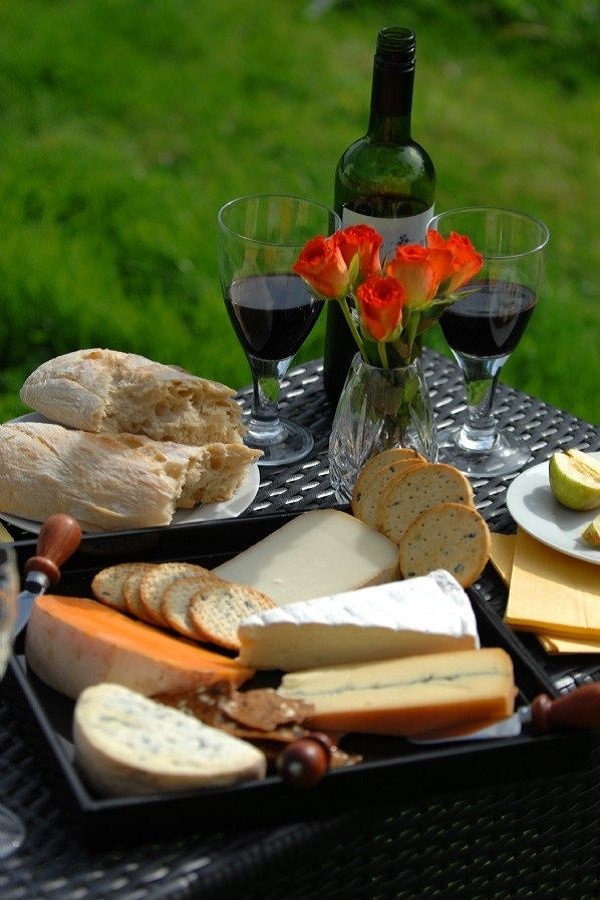
For foodimentarians with a special love of desserts, home food or for that quick added or unique touch to the regular meals, cheese (be it from cow, goat or sheep milk or homemade, local store bought, cheese market special or blue cheese varieties) is a pantry must. With a change from the regular, cheese gives an option of taking Stilton sandwiches to work, Gronozola on toast, shredded Brie or Danablu on salads, dressings or crumbled and used in cheesecake recipes, cheese themed parties or simply the change from the sweet dessert to the cheese platter with wine for afters.

Posted in Daily, Family and Society, Life, Reflections, Stories Around the World, Work

Of too Bad or Too Good

It was a beautiful morning and as a large family we were heading out for a weekend getaway few towns away. What was supposed to be a three hour journey became a five hour one; not primarily due to the frequent stops for breakfast or drive breaks but as a courtesy of flat tire, a broken jack and water logged areas on the way. Although the delay was significant, the dark clouds of anger were kept at bay and heavy dose of optimism were sprinkled by both sets of grandparents. Finally on reaching the cabin, contemplating on the events of the morning; endless blame could have been laid on the spouses or nature, unfortunate timing and other equivalent terminology of “bad luck”. Instead problems were tackled as they came along and the mood of the day remained lighthearted.

“Each player must accept the cards life deals him or her: but once they are in hand, he or she alone must decide how to play the cards in order to win the game.” Voltaire

Looking back on the day-to-day life, there will be countless situations wherein one may encounter negative emotions and minor setbacks, either in the daily routine or when starting off something new. At times, one tends to over-analyze each and every deemed “ill luck” instead of going ahead and taking life as it approaches. Giving unnecessary importance to the emotions of that moment, instead of reacting to them with practicality tends to turn the best moments and right opportunities to missed ones.

“Concern yourself more with accepting responsibility than with assigning blame. Let the possibilities inspire you more than the obstacles discourage you.” Ralph Marston

Although everything in life that happens has a purpose or meaning; getting trapped by the emotions of event results in far more negative effects than positive ones. Instead as Tao had said, one defines good or bad in relation to how one approaches it. All the unfortunate events have a silver lining, once we remove the black cover covering it. Instead of listening perpetually to the voices around oneself, use the inner voice and optimism to tackle each “unfortunate and lucky” moments that life has in store for each one of us. Each one of us have the sole responsibility of deciding whether to let the ill luck run its course in free fall or face the bad as they come and use it to tackle tomorrow and make the latter better than the yesterday.

“When we are no longer able to change a situation, we are challenged to change ourselves.” Viktor Frankl

One day while working out in the fields the farmer’s son fell and broke his leg. The villagers came to the farm and said, ‘My, that’s a great misfortune. Your son has broken his leg: now he can’t help you in the fields.’ The farmer said, ‘It is neither a fortune nor a misfortune.’
A day later, the government troops came to the village looking for young men to conscript into the army. They had to leave the boy behind because his leg was broken. Again, the villagers came to the farm and said, ‘My, that’s a great fortune.’ The farmer replied, ‘It is neither a fortune nor a misfortune.’
Then one day the farmer’s only horse jumped the fence and ran away. The villagers came to the farm and said, ‘What a great misfortune that your horse has run away.’ The farmer said, ‘It is neither a fortune nor a misfortune.’ Two or three days later, the horse came back with a dozen wild horses following behind him. The villagers came to him and said, ‘It’s a great fortune that your horse came back with twelve others.’
The farmer replied, ‘It is neither a fortune nor a misfortune.’
As the teaching of the Tao goes, “nothing is long or short, hot or cold, good or bad.”
– Lesson from The TAO TE CHING written by Lao Tzu

“Find joy in everything you choose to do. Every job, relationship, home… it’s your responsibility to love it, or change it.” Chuck Palahniuk

Posted in Daily, Food, Stories Around the World

Of Coffee, Iced and “Frapped”

Some of the best things of life occur not when everything goes by plan, or by mere accidental occurrences. Adding to the list, is the delightful flavours of coffee, chilled, icy and sweet; though meant or the hot summer days can be had at any occasion, day or time. Though the 19th century saw a variety of cold coffee drinks as “café frappé (à la glace)”, some were like iced coffee and others similar to slushes. Although special mention of the iced coffee drink, known as Frappé coffee (or Greek frappé or café frappé, frapés), has to be made as it became ingrained into the coffee culture.

“Iced coffee, on a hot day, can perform miracles.” Lish McBride

Although frappé with etymological origins from French means “chilled in crushed ice”; the discovery of the café frappé  using instant coffee happened in Greece. As the narrative goes, at the Thessaloniki International Fair (1957), Giannis Dritsas (the Nestlé company representative) was exhibiting a new chocolate beverage produced instantly by mixing it with milk and shaking it in a shaker. With Dritsas’ employee Dimitris Vakondios looking for a way to have his usual instant coffee during his break and for the lack of hot water, he mixed the coffee with cold water and ice cubes in a shaker. With this experimentation, frappé was born and established with it’s Greek finish.

The Greek frappé in Greece is available in various varieties depending on their degrees of sweetness and the amount of sugar used. These are mainly glykós (“sweet”, 2 teaspoons of coffee and 4 teaspoons of sugar); métrios ( “medium” with 1:1 ratio of coffee and sugar) and a skétos (“plain”) without sugar). The chocie of serving can be with evaporated milk, then known as frapógalo or “frappé-milk” or without any milk. At times water is substituted by milk for a very thick, milky coffee frappé (mostly a Cyprian variation). Over the years, further flavours like Kahlúa, Baileys Irish Cream or other liqueurs are used, along with a ball of vanilla ice-cream (not milk) or made blended with spoon. With the spread of frappé from Greece, further variations have been according to the local choice like the “hladen nas” (Serbian) made with milk or ice-cream and whipped cream often added on top or the Danish version of using cold milk on crushed ice with coffee in the shaker.

“I was taken by the power that savoring a simple cup of coffee can have to connect people and create community.” Howard Schultz

With the experimentation streak running high, homemade frappé can be had for a change from the regular. With a hand mixer or cocktail shaker, the homemade blend would be a welcome change from the regular sweet coffee. Moreover, it could be a start to a new frappé tradition of own  choice, ingenuity and memorable moments.

One or two teaspoons of instant coffee (traditionally Nescafe), sugar (to taste) and a little water are blended (with a cocktail shaker or an appropriate mixer like the hand mixer) to form a foam, which is poured into a tall glass. To this is added cold water and ice cubes, and, optionally, milk (typically evaporated milk). The glass is served with a drinking straw.


Posted in Daily, Family and Society, Personal Musings, Stories Around the World, Work

Sing the Song, Paint the Picture

“You were given your gift for the joy you may give in return.” Cornelius Elmore Addison

During the earlier years of childhood, painting was a hobby and an art at which my sibling had excelled in. Her talent was exploited at most events at both school, church and college level. Yet over the years, it had taken a backseat initially due to the working hours, then later as family and home took over. Of recent, the creeping dissatisfaction and unrest within was silenced by her return to the canvas, oil, paints and brushes. Thinking back, the heart is most happy when it gets to do what one loves and does best.

“Hide not your talents. They for use were made. What’s a sundial in the shade?” Benjamin Franklin

Each one of us have been given different, interesting and beautiful talents. While some may help us earn the regular bread and butter daily; the other talents mayn’t be so. Yet even the innate creative and talented side gets silenced for long, then the unrest begins slowly building up within, reaching to the boiling and overflow point at the later stage. Whether the talent be at simple music, embroidery, poetry, cooking or the garden; time taken with them will soothe the mental unrest and settle the negative emotions that one will sooner or later experience in life.

“Use what talents you possess; the woods would be very silent if no birds sang there except those that sang best.” Henry Van Dyke

An enchanting story about violinist Fritz Kreisler tells how he once came across a beautiful instrument he wanted to acquire. When he finally raised the money for the violin, he returned to buy it and learned that it had already been sold to a collector.  He went to the new owner’s home in order to try to persuade him to sell the violin. But the collector said it was one of his prized possessions and he could not let it go. The disappointed Kreisler turned to leave, but then asked a favour. ‘May I play the instrument once more before it is consigned to silence?’ Permission was granted and the great musician began to play. The violin sang out a quality of music so beautiful that the collector himself could only listen in wonderment. ‘I have no right to keep that to myself,’ he said after the musician finished. ‘The violin is yours, Mr. Kreisler. Take it into world, and let people hear it.’

“What I think we need to do is infuse everyday and every action with the kind of values we hope will be in the future, with kindness, with nurturing, with dreams, ambition, using your talents, not resorting to violence, other forms of conflict resolution, with humor, with poetry, with music.” Gloria Steinem

While life is indeed a journey, it involves the use of the special gifts given or hidden within each of us. The world needs all of the people. Whether the primary work is at business, teaching, in science or health, administration and so on; using the given gifts or skill is necessary in order to maintain the mental and emotional balance. While the gift may not sustain as far as the monetary security is concerned, it will help us balance the busy schedules and the hectic lives that one lives. At the end of the day, inner happiness is not just in the abilities, but also the knowing that one’s life has been lived to the fullest, doing what one loves at some point whenever and where ever they can.

“Life is a journey.  Part of that journey is not just using your talents, but trying to decide what is your gift and then directing your talents to support your gift so you can soar to new heights.” Daniel Burrus

Posted in Daily, Family and Society, Life, Quotes, Reflections, Stories Around the World

The Light from Within

“The moments when you have really lived are the moments when you have done things in the spirit of love.” Henry Drummond

Like the past years, the extended family had gathered together for the memorial of our grandfather. Although it has been more than five years, it just feels like yesterday when he used to sit with the newspaper on the patio with all of the children gathered around him as he used to narrate stories and spin the tales of legends. While the children miss him especially the fishing days, playing chess or simply going for long countryside walks; being adults it is the words of advice and quiet assurance that is being missed. Even though five years have gone, there would always be a void in the heart. At times, the gentle evening breeze or quiet afternoon rain brings the feel of his presence.

“Do your little bit of good where you are; it’s those little bits of good put together that overwhelm the world.” Desmond Tutu

Coming from a large family, there was always an endless lists of tasks for him to be done. From managing the farm to being a teacher, there was something to occupy his mind. During my childhood years, he used to busy running the farm. Despite all the important details to attend to, there was always time for him to spend with a tomboy who wanted to drive the tractor, fish or climb over to the loft, ride the horse, milk cows than play with dolls. For a busy person, those tiny grubby hands were no trouble. More than the gifts bestowed; through his time, he had showered love and joy which were treasured and comforting for the later years of adolescence, adulthood and life in general.

“You have not lived today until you have done something for someone who can never repay you.” John Bunyon

There is an aura about some people that although one mayn’t have spend a lot of time with them, still leave a comforting feel when those memories are refreshed. Just like the eyes speak of the soul, so does the character, kindness and love radiated by the ambiance around any person speak volumes. One sees a lot of this in the lives of people around them. Those apparently uneventful moments leave a distinct impression that brings fresh hope during the storms of life. As the story about what the eyes of a young man told, this powerful (maybe apocryphal) tale tells a lot about what the soul and mind of a person is, as reflected through his eyes and by the feel around him. No matter how much one of philanthropy one does, what is held within radiated itself outside. At the end of the day, the riches that life has to offer comes not just from the fruits of persistence and perseverance, but also from the love which is what nourishes the soul. Whether our lives reflects the richness of the soul or that of the worldly sheen, is up to one alone.

“Love, hope, fear, faith – these make humanity; These are its sign and note and character.” Robert Browning

Many years ago an old man stood on a Virginia riverbank. He was waiting to cross the river and, since it was bitterly cold and there were no bridges, he was hoping to get a ride across on horseback. After a lengthy wait he spotted a group of horsemen approaching. He let the first one pass, then the second, third, fourth and fifth. One rider remained. As he drew abreast, the old man looked him in the eye and said, ‘Sir, would you give me a ride across the river?’ The rider immediately replied, ‘Certainly.’ Once across the river, the old man slid to the ground. ‘Sir,’ the rider said before leaving. ‘I could not help but notice that you permitted all the other men to pass without asking for a ride. Then, when I drew abreast, you immediately asked me to carry you across. I am curious as to why you didn’t ask them and you did ask me.’ The old man quietly responded, ‘I looked into their eyes and could see no love and knew in my own heart it would be useless to ask for a ride. But when I looked into your eyes, I saw compassion, love and the willingness to help. I knew you would be glad to give me a ride across the river.’ The rider was touched. ‘I’m grateful for what you are saying,’ he said. ‘I appreciate it very much.’ With that, Thomas Jefferson turned and rode off to the White House.
By Steve Goodier

“Be a good human being, a warm hearted, affectionate person. That is my fundamental belief.” Dalai Lama

Posted in Daily, Life, Quotes, Reflections, Stories Around the World

Change the Grounds

“Without change there is no innovation, creativity, or incentive for improvement. Those who initiate change will have a better opportunity to manage the change that is inevitable.” William Pollard

Talent is indeed a precious thing. Many of us have a wide range of talents, from science to mechanics, music, poetry, performing arts and even sporting events. Yet at times, these talents are hidden or tempered down by the circumstances of time; at each phase of one’s life. Over the course of years, the innate art will present itself in many forms. Like the homemaker who loves embroidery livens up their homes with quilt art or the hidden musician who sings for their children.

What will happen when one chooses to change their circumstances or the environment around them ?

“Eagle, thou art an eagle. Stretch forth thy wings and fly.”

Then one would discover the true potential within them. There have been instances of adults in their forties signing up for music classes and those in their fifties trying their hand at pottery. One is never too old, too young or too busy to do what they really want to. If the talent and will is within one, then it would manifest itself when the efforts are made in the right circumstances, true surroundings and when the will within burns bright. As soon as one believes in their real potential, then soaring high would be within oneself.

“We accept the verdict of the past until the need for change cries out loudly enough to force upon us a choice between the comforts of inertia and the irksomeness of action.” Billings Learned Hand

Fable of the Eagle and the Chicken
A fable is told about an eagle that thought he was a chicken. When the eagle was very small, he fell from the safety of his nest. A chicken farmer found the eagle, brought him to the farm, and raised him in a chicken coop among his many chickens. The eagle grew up doing what chickens do, living like a chicken, and believing he was a chicken.
A naturalist came to the chicken farm to see if what he had heard about an eagle acting like a chicken was really true. He knew that an eagle is king of the sky. He was surprised to see the eagle strutting around the chicken coop, pecking at the ground, and acting very much like a chicken. The farmer explained to the naturalist that this bird was no longer an eagle. He was now a chicken because he had been trained to be a chicken and he believed that he was a chicken.

The naturalist knew there was more to this great bird than his actions showed as he “pretended” to be a chicken. He was born an eagle and had the heart of an eagle, and nothing could change that. The man lifted the eagle onto the fence surrounding the chicken coop and said, “Eagle, thou art an eagle. Stretch forth thy wings and fly.” The eagle moved slightly, only to look at the man; then he glanced down at his home among the chickens in the chicken coop where he was comfortable. He jumped off the fence and
continued doing what chickens do. The farmer was satisfied. “I told you it was a chicken,” he said. The naturalist returned the next day and tried again to convince the farmer and the eagle that the eagle was born for something greater. He took the eagle to the top of the farmhouse and spoke to him: “Eagle, thou art an eagle. Thou dost belong to the sky and not to the earth. Stretch forth thy wings and fly.” The large bird looked at the man, then again down into the chicken coop. He jumped from the man’s arm onto the roof of the farmhouse. Knowing what eagles are really about, the naturalist asked the farmer to let him try one more time. He would return the next day and prove that this bird was an eagle. The farmer, convinced otherwise, said, “It is a chicken.”

The naturalist returned the next morning to the chicken farm and took the eagle and the farmer some distance away to the foot of a high mountain. They could not see the farm nor the chicken coop from this new setting. The man held the eagle on his arm and pointed high into the sky where the bright sun was beckoning above. He spoke: “Eagle, thou art an eagle! Thou dost belong to the sky and not to the earth. Stretch forth thy wings and fly.” This time the eagle stared skyward into the bright sun, straightened his large body, and stretched his massive wings. His wings moved, slowly at first, then
surely and powerfully. With the mighty screech of an eagle, he flew.
–(In Walk Tall, You’re A Daughter Of God, by Jamie Glenn)

Posted in Daily, Quotes, Reflections, Stories Around the World

Using the “Whys”

“True happiness… is not attained through self-gratification, but through fidelity to a worthy purpose.” Helen Keller

With the summer season coming to a close, the weekend shopping involves hunting for the best discount sale. Once there, it is a rampage. Scores of people are hunting for the best product based on the requirement, utility, purpose, limits of the budget or just impulse; although the degree of each may vary while taking the final decision. The latter feel i.e. “impulsiveness” is what is the most dangerous. While the tricks of the sale are in full swing, it is the “why” which helps a lot while making the final decision. In fact these “five whys” helps a lot in figuring out a solution to the most contrary or doubtful scenarios.

“It is mental slavery to cling to things that have stopped serving it’s purpose in your life.” Chinonye J. Chidolue

The founder of Toyota, Sakiti Toyoda, constantly used the “five why” rule. In all incomprehensible situations, he used this method, and he always helped him. Here is the rule. For example, you want a fur coat.
You ask yourself: why do I want a fur coat? This is the first “why.” Answer: because I want to surprise everyone. Okay, the second “why”: Why do you want to surprise everyone? Answer: Because I want to pay attention to me. Third “why”: Why do you need to be noticed? Answer: Because I feel insecure. Fourth “why”: Why do you feel insecure? Answer: Because I can’t be realized, because I’m sitting in one place. Fifth “why”: Why can’t you realize yourself? Answer: Because I do what I do not like. And say now, what’s the fur coat? Sakiti Toyoda taught that in response to the fifth “why” lies the root cause, which, at first glance, is not visible. The fifth “because” brings to light that which is hidden. If you will, the fifth “because” is the real you. This is a very effective way to check what you are actually hiding, what you are afraid to admit even to yourself, what you really want and what, in fact, is just tinsel.
(Source: vk.com)

“Occupy your thoughts with purpose and you will be so busy pursuing a meaningful future there will be no time for doubt, chaos and disappointment.” Carlos Wallace

Although the “five whys” have been primarily used in the industry as well as management field, a lot of it applies in the daily rules and habits of life, that one lives by. Each one of us have our own brand of “unnecessary regrets, urges and habits”, from being perpetually late to work or not attending social gatherings or similarly; whether it be in the work field, spending or budgeting, social network and the like. Finding the root cause behind the trait is what results in a change being made. Time has always and will always be short, especially when one wants to make something out of their own time. Eliminating the unnecessary regrets or habits would be the first, made easier as long as we remember to question by the whys. Doing so, one can get to the heart of the problem or situation and root it out.

“The greatest challenge in life is to be our own person and accept that being different is a blessing and not a curse. A person who knows who they are lives a simple life by eliminating from their orbit anything that does not align with his or her overriding purpose and values. A person must be selective with their time and energy because both elements of life are limited.” Kilroy J. Oldster