Posted in Daily, Food, Stories Around the World

Of Empanada, Origin and Evolution

“If you were a Colombian, you would have your version of an empanada. If you are an Argentinean, you might find a dough that’s baked and has a butter sheen on it. And then in Ecuador, you’ll find more crispy-fried empanadas. So, yeah, every culture has their own version of empanadas.” Jose Garces

Derived from the Spanish verb “empanar” which translates to “wrap in bread”, these fried or baked pastries stuffed with sweet or savoury filling, known as empanadas have enjoyed widespread global popularity. Across the Caribbean, Latin America, Portugal, Spain, Italy to as far as Philippines; this dish has its’ own local blends that make it delectable and adaptable to every local cuisine.

“You are the olive in my empanada.” Brazilian Saying

Originally believed to be from Galicia, Spain; the empanadas of today may have been the brainchild of the Moors who had occupied Spain for hundreds of years. The idea of wrapping a hardy filling in pastry dough had led to this little delight. Fillings including seafood have been documented in a cookbook published in Catalan, Spain (1520). With the spread of civilization, trade as well as colonization, this savoury delight had travelled around the world. In fact the first empanadas in Western Hemisphere are credited to Argentina with the US celebrating the National Empanada Day on April 8th. While empanadas are a traditional Christmas treat in New Mexico, they’re known as creoles(southwest and south) or as fried pies (southeast) depending on the locality.

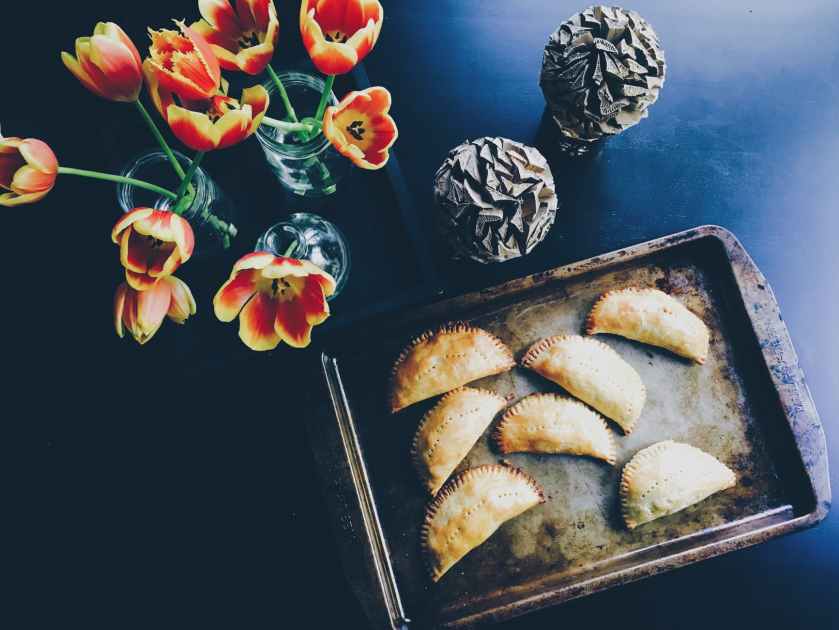
Similar to cut-up pies, empanadas are typically savoury often filled with cod fish or chicken. They are made by folding a disc of thinly rolled dough over the filling into a semicircle and then crimping the edges to seal it. The dough is often made with wheat flour, but can be substituted by corn flour, cornmenal, plantain or potato base, depending on the locally available ingredients. The content of the dough varies on whether the empanadas are to be baked or fried. The art of to make a perfect empanada is to hold the dough spread open, in one hand; while using the other hand to fill it and to crimp the edges. Homemade sweet varients of the empanadas are present in many local cuisines. For instance, the Gujiya is a traditional Indian crescent shaped dessert, similar like a sweet empanada.

There have been various variations similar to empanadas. Catibías, similar to empanadas are made with cassava flour dough with common fillings include ground beef, chicken, guava, and cheese. Pastelitos are similar to empanadas, too, but they’re made with a lighter pastry dough and they can be either baked or fried.

Travelling across the various countries, the ‘Mpanatigghi of Modica (half moon-shaped panzarotti filled with a mixture of almonds, walnuts, chocolate, sugar, cinnamon, cloves and minced beef), meat empanadas (“de pino”) of Chile , panades of Belize and so on, have been the varied presentations of the empanadas. Certain eateries in order to distinguish the varieties, develop a pattern on the pastry fold, crimping style of the edges or burn a letter(an abbreviated indication of the filling) into the dough.

Either way, one of the most easiest delights to be made for a novice cook, are empanadas which serve as quick bites, starters, breakfast, desserts or even for brunches to lunches.

“Don’t be afraid to adapt new ingredients into your own techniques, and traditional ingredients into new recipes.” Jose Garces

Posted in Family and Society, Life, Personal Musings, Quotes, Stories Around the World

To Just Stay

“Love recognizes no barriers. It jumps hurdles, leaps fences, penetrates walls to arrive at its destination full of hope.” Maya Angelou

One of the reasons’ why man needs his social surroundings be it family, friends or community is largely based on his ability to love and be loved. Here the aspect of love doesn’t focus solely on the relationship between two people, but between a network of people whose happiness are directly or indirectly influenced and dependent on the other. For “love” encompasses kindness, understanding, mutual respect, forgiveness and empathy.

“Love is a friendship set to music.” Joseph Campbell

One never realizes the intricate role that he or she may play in the life of the other. While it may seem trivial or a passing touch for one, it drastically change the life for the other. Learning to be gracious and kind is one of the facets of love. Love isn’t simply declared by showering of gifts, spending time with only those one knows or granting favours sometimes beyond one’s reach. Love also includes just being there and listening.

“The art of love is largely the art of persistence.” Albert Ellis

While doing the preparatory lessons on the aspect of biblical love, I had read an encounter based on events in the hospital room of a retired service man. What struck my mind on reading “Love Stays” was the fact that “human love” for the fellow being goes beyond boundaries, imagination and guidelines set by man. Even though for one it may be trivial and require very little effort and time on their part, for the other it would be a life changing moment. Choosing to spend our time with love, kindness and empathy would go a long way, especially when one knows that life has a boomerang effect, when we least expect it.

“And now these three abide: faith, hope, love; but love is more of them.”
(1 Corinthians 13:13)

Love Stays

A nurse took the tired, anxious serviceman to the bedside. “Your son is here,” she said to the old man. She had to repeat the words several times before the patient’s eyes opened. Heavily sedated because of the pain of his heart attack, he dimly saw the young uniformed marine standing outside the oxygen tent. He reached out his hand. The marine wrapped his toughened fingers around the old man’s limp ones, squeezing a message of love and encouragement. The nurse brought a chair so that the marine could sit beside the bed. All through the night, the young marine sat there in the poorly lighted ward, holding the old man’s hand and offering him words of love and strength. Occasionally, the nurse suggested that the Marine move away and rest awhile. He refused. Whenever the nurse came into the ward, the marine was oblivious of her and of the night noises of the hospital – the clanking of the oxygen tank, the laughter of the night staff members exchanging greetings, the cries and moans of the other patients.
Now and then, she heard him say a few gentle words. The dying man said nothing, only held tightly to his son all through the night. Along towards dawn, the old man died. The marine released the now lifeless hand he had been holding and went to tell the nurse. While she did what she had to do, he waited. Finally, she returned. She started to offer words of sympathy, but the Marine interrupted her. “Who was that man?” he asked. The nurse was startled, “He was your father,” she answered. “No, he wasn’t,” the marine replied. “I never saw him before in my life.”
“Then why didn’t you say something when I took you to him?”
“I knew right away there had been a mistake, but I also knew he needed his son, and his son just wasn’t here. When I realized that he was too sick to tell whether or not I was his son, knowing how much he needed me, I stayed.”
The next time someone needs you … just be there. Stay. 

Note: This is not a true story, but an incredible work of fiction written by Roy Popkin in 1964. It was published under the title “Night Watch” in the September 1965 edition of Reader’s Digest. Due to its highly emotional pull, the story has been re-circulated online since the 1990s under a variety of titles such as “Just Stay” and “He Needed a Son.”

“Everyone has a purpose in life and a unique talent to give to others. And when we blend this unique talent with service to others, we experience the ecstasy and exultation of own spirit, which is the ultimate goal of all goals.” Kallam Anji Reddy

Posted in Daily, Family and Society, Life, Personal Musings, Reflections, Stories Around the World

From One’s Perspective

The Minister travelled for days by train and car and boat to one of the furthest islands in the nation. As he surveyed the bleak but inspiring landscape, he turned to a local villager and said: “You’re very remote here, aren’t you?” She responded: “Remote from what?”

The scenario of the glass being half empty to half full, or the grass being green on the other side; have been faced by most of us at some point of time or the other. The common thread of thinking running through these moments is “our perception and the reality of what happens”.

“There are things known and there are things unknown, and in between are the doors of perception.” Aldous Huxley

Perspective has been one of the concepts, since the early days, which has been studied and attempts have been made to quantify or qualitatively assess it by mathematicians, philosophers, scientists as well as artists. Despite all the theories proposed, research as well as insight; till this day perception doesn’t exist by itself but leans heavily on our innate beliefs, opinion, experience and knowledge.

“No man has the right to dictate what other men should perceive, create or produce, but all should be encouraged to reveal themselves, their perceptions and emotions, and to build confidence in the creative spirit.” Ansel Adams

While one’s perspective may be right for some, it may be wrong for the other. Then the question arises, how do we draw the limits or the line? The practical aspect is possible as long as we ground ourselves in reality and lean on the principle of “to do unto others as one would want to be done unto oneself”. Simply put, as long as we learn to treat others with mutual respect, equality, freedom, justice, kindness and understanding; all the perspectives would reach the common target and purpose of doing good.

“What I need is perspective. The illusion of depth, created by a frame, the arrangement of shapes on a flat surface. Perspective is necessary. Otherwise there are only two dimensions. Otherwise you live with your face squashed up against a wall, everything a huge foreground, of details, close-ups, hairs, the weave of the bed-sheet, the molecules of the face. Your own skin like a map, a diagram of futility, crisscrossed with tiny roads that lead nowhere. Otherwise you live in the moment. Which is not where I want to be.” Margaret Atwood, The Handmaid’s Tale

Posted in Daily, Family and Society, Life, Personal Musings, Quotes, Reflections, Stories Around the World

Like A Child’s Love

“Just imagine becoming the way you used to be as a very young child, before you understood the meaning of any word, before opinions took over your mind. The real you is loving, joyful, and free. The real you is just like a flower, just like the wind, just like the ocean, just like the sun.” Don Miguel Ruiz

Children are simply beautiful. Interacting with children all day long, one is always fascinated by the numerous expressions, emotions they undergo, the innocent laughter and their mischief. A child’s love is always untainted at heart. Unfortunately as they grow from toddlers to adolescence, we adults and collectively society as well as media influences them, such that they lose their own selves and plunge into the niche that society carves for them. As parents, it is difficult to fight against this phenomenon as this has become the way of life and children will eventually grow, evolve and develop. Which is why, the growing years of a child are the most precious ones for parents and guardians.

“What it’s like to be a parent: It’s one of the hardest things you’ll ever do but in exchange it teaches you the meaning of unconditional love.” Nicholas Sparks

The concept of unconditional love is witnessed very often through parenting. A child’s love is never labelled nor constrained. In their very early years, their unblemished minds and hearts have no limits or barriers or categorization on their love, kindness and care. A child’s reasoning mayn’t be understood by adults. Yet as we wait to see the turn of events, one realizes that their acts of childhood are always based on their untainted guileless love and kindness. To be like a child, is a gift for the mind, body and spirit.

“Being deeply loved by someone gives you strength, while loving someone deeply gives you courage.” Lao Tzu

“Some time ago, a man punished his young daughter for wasting a roll of gold wrapping paper. Money was tight and he became angry when the child tried to decorate a box to put under the Christmas tree. Nevertheless, the girl brought the gift to her father on Christmas day and said, ‘This is for you, daddy.’
The man became embarrassed by his overreaction a few days before, but his rage continued when he saw that the box was empty. He yelled at her, ‘Don’t you know, when you give someone a gift, there’s supposed to be something inside?’
The little girl looked up at her dad with tears in her eyes and cried; ‘Oh, daddy, it’s not empty at all. I blew kisses into the box. They’re all for you, daddy.’The father was devastated. He put his arms around his daughter, and begged for her forgiveness.

A little while later, the girl died in an accident. Her father kept the gold box by his bed for many years and, whenever he was feeling down, he would take out an imaginary kiss and remember the love of the child who had put it there.”

“The greatest happiness of life is the conviction that we are loved; loved for ourselves, or rather, loved in spite of ourselves.” Victor Hugo

Posted in Daily, Random Thoughts, Stories Around the World, Work

To Believe It or Not !!

” “Coca-Cola is launching three flavours of its Zero Sugar brand featuring avocado, sourdough and charcoal.”

Imagine the consequences of the taste buds and the senses after an episode of experimentation with these flavours. And here’s how the flavours were described.
• Coca-Cola Zero Sugar Avocado – Forget smashed or blended, this new flavour infuses the subtle, creamy undertones of amazing avocado with that great Coca-Cola Zero Sugar taste. Both delicious and nutritious, this gorgeously green pick-me-up is guaranteed to make your socials grow.
• Coca-Cola Zero Sugar Charcoal – Cleanse, refresh and revitalise with a Zero Sugar supercharge. Loaded with activated charcoal, creating a smooth and rich flavour, this miracle in-a-can pairs-perfectly with your favourite Instagram filter.
• Coca-Cola Zero Sugar Sourdough – Crafted with care, superbly sour and bursting with fermented flavours. Packed with crumbly goodness – so you can start the day in the right way with a mouth-wateringly good snap of this wild-yeast infused Zero Sugar treat. “

For the readers of the above news on the Daily Mirror online version last year, had resulted in a frenzy of whether this was true or was it an “All Fools Day Prank”. Being mixed with the “true news” of the society, food, travel and living sections; it wasn’t easy to ascertain whether one was going to really taste avocado, sourdough or charcoal in their drink.

“The first of April, some do say
Is set apart for All Fool’s Day;
But why the people call it so
Nor I, nor they themselves, do know,
But on this day are people sent
On purpose for pure merriment.” (Poor Robin’s Almanac, 1790)

One of the days dreaded the most, especially at work, school or neighbourhood, is the first day of April, where the day is pretty confusing for each hour goes by the wait of “being pranked”. Each day this year, from social media to official meetings, one is always second guessing everything. As for pranksters, its’ a day of freedom, fun and revelry.

Yet when the prank is actually the truth, one may feel a bit razzed. For instance people who celebrate their birthdays on April First have always been questioned, even though they are speaking the truth. Remember the headlines that state “the African continent can split into two” after an enormous crack appears. Well, it’s actually true for a large crack, several miles long and growing accompanied with seismic activity had appeared in south-western Kenya causing the Nairobi-Narok highway to collapse. Researchers have attributed this to activity between the tectonic plates in Earth’s crust and upper mantle. Today the rift still continues to grow and an expert says it’s evidence that the continent is breaking apart.

Yet news like this, practical jokes and hoaxes especially on All Fools’ Day or April Fools’ Day spreads mass confusion (which was or wasn’t the purpose all along). Why this particular day ? The origin behind this day is quite interesting, with various versions and tales trending around the world.

As per Geoffrey’s Chaucer’s “The Cantebury Tales”, New Years’ Day used to be celebrated around April. With the Gregorian Calendar (1582, France) being introduced by Pope Gregory XIII with January 1st to be celebrated as “New Years’ Day.” For those who refused to support this,; they were mocked and sent on fools’ errands on April 1st.

Another disputed association between April 1st and foolishness also comes from Geoffrey Chaucer’s The Canterbury Tales (1392). In the “Nun’s Priest’s Tale”, a vain cock Chauntecleer is tricked by a fox on “Syn March bigan thritty dayes and two.” While readers apparently understood this line to mean “32 March”, i.e. April 1, it wasn’t clear if this was the correct inference. The scholars of today, believe that there is a copying error in the extant manuscripts and that Chaucer actually wrote, “Syn March was gon.” Then the passage would have originally meant 32 days after March ( i.e. May 2nd), the anniversary of the engagement of King Richard II of England to Anne of Bohemia (1381).

French poet Eloy d’Amerval (1508) had referred to “a poisson d’avril” (April fool, literally “Fish of April”), possibly the first reference to the celebration in France. In France, January 1st as New Year’s Day became common only by the mid-16th century and the date was adopted officially as per the Edict of Roussillon (1564). Likewise Flemish poet Eduard de Dene (1539) had written about a nobleman who sent his servants on foolish errands on April 1st.

The origin of April Fools’ Day is different in Netherlands, where it’s often attributed to the Dutch victory at Brielle in 1572, where the Spanish Duke Álvarez de Toledo was defeated (“Op 1 april verloor Alva zijn bril”). Another citation in history was on April 1, 1698 when several people were tricked into going to the Tower of London to “see the Lions washed”.

Few authors have expressed the belief that the origins of April Fool’s Day may go back to the Genesis flood narrative, although this hasn’t been verified by Biblical scholars or historians. As written by the Harper’s Weekly cartoonist Bertha R. McDonald (1908), ” Authorities gravely back with it to the time of Noah and the ark. The London Public Advertiser of March 13, 1769, printed: “The mistake of Noah sending the dove out of the ark before the water had abated, on the first day of April, and to perpetuate the memory of this deliverance it was thought proper, whoever forgot so remarkable a circumstance, to punish them by sending them upon some sleeveless errand similar to that ineffectual message upon which the bird was sent by the patriarch”.

Festivals celebrating a day for pranks has been there since the early Roman times, where “Hilaria” a Roman festival was celebrated. As the name suggests, it was a festival of laughter and hilarity where people would dress up in disguises to fool others and enjoy the spring season. Various countries have different ways to celebrate this day. While across Italy, France, Belgium, and French-speaking areas of Switzerland and Canada, people celebrate April Fools’ Day by trying to stick a paper fish on someone (without being noticed); in Iran jokes were played on each other on ‘Sizdah Be-dar'(the 13th day of the Persian New Year, falling on April 1st or 2nd). On the other hand Spanish speaking countries celebrate similar festivity on the ‘Day of the Holy Innocents’ (December 28 or 29) and in Denmark, this day is celebrated on’Maj-Kat’, which means ‘May-cat’ (May 1st).

Either way the chance to play practical jokes and hoaxes on this day has promoted this trend to continue. For there’s nothing more enriching than genuine innocent fun and laughter for the day.

“The maple syrup’s full of ants.
A mouse is creeping on the shelf.
Is that a spider on your back?
I ate the whole pie by myself.
The kitchen sink just overflowed.
A flash flood washed away the school.
I threw your blanket in the trash.
I never lie—I—
April Fool!” (Myra Cohn Livingstone)

Posted in Daily, Life, Personal Musings, Quotes, Stories Around the World, Work

Set the Glass Down

“Goodnight. Sleep tight.”

As we say these words to the young and dear ones, flashbacks of our younger days come to mind. If one remembers our childhood nights of bedtime stories and goodnight hugs; the nights today would have a feeling of uneasiness at times with night with “insomnia” or related like event, when the nights are spent in restlessness. Looking over the years, as we grow up sleepless nights became the trend. From blissful sleep of childhood, pulling an all-nighter with friends; then later on around the exams and finally in college to adult life; the trend of “staying up all night” transformed from being a trend to “the norm”. The thought that surfaces to mind is , “when was the last time we slept well?”

“The truth is that stress doesn’t come from your boss, your kids, your spouse, traffic jams, health challenges, or other circumstances. It comes from your thoughts about these circumstances.” Andrew J. Bernstein

Analyzing the nights where we toss and turn the bed covers, not sleeping a wink would be reasons ranging from a newborn to sick child or pending work, spouse’s absence, health issues and the list is endless. While some of these reasons are not in our hands to control or fathom; others’ can be controlled by containing our thoughts and putting our trust into our Faith.

“It’s not stress that kills us, it is our reaction to it.” Hans Selye

Life has given us whole causes for sleepless nights. Yet in the face of the hurdles, once we learn to lighten the burden with reason, immense Faith and Hope; the world tomorrow mayn’t be so bad. Whether we drive ourselves crazy with worry or not, what will happen will happen. Is it worth losing our sleep on these things ?

“Stress and worry, they solve nothing. What they do is block creativity. You are not even able to think about the solutions. Every problem has a solution.” Susan L. Taylor

“Once upon a time a psychology professor walked around on a stage while teaching stress management principles to an auditorium filled with students. As she raised a glass of water, everyone expected they’d be asked the typical ‘glass half empty or glass half full’ question. Instead, with a smile on her face, the professor asked, ‘How heavy is this glass of water I’m holding?’
Students shouted out answers ranging from eight ounces to a couple pounds. She replied, ‘From my perspective, the absolute weight of this glass doesn’t matter. It all depends on how long I hold it. If I hold it for a minute or two, it’s fairly light. If I hold it for an hour straight, its weight might make my arm ache a little. If I hold it for a day straight, my arm will likely cramp up and feel completely numb and paralyzed, forcing me to drop the glass to the floor. In each case, the weight of the glass doesn’t change, but the longer I hold it, the heavier it feels to me.’

As the class shook their heads in agreement, she continued, ‘Your stresses and worries in life are very much like this glass of water. Think about them for a while and nothing happens. Think about them a bit longer and you begin to ache a little. Think about them all day long, and you will feel completely numb and paralyzed – incapable of doing anything else until you drop them.’”

“‘Sunrise Sunset’ is about trying to get to a place where life is simple and not letting the stress and happenings in the world get in the way of your happiness.” Benny Cassette

Posted in Daily, Family and Society, Life, Quotes, Reflections, Stories Around the World, Work

Writing on the Stone

“Instead of focusing on that circumstances that you cannot change – focus strongly and powerfully on the circumstances that you can.” Joy Page

Bad days, we all have had our fair share of them. While we may envy others’ and wonder why do our days go wrong, what we have to think about instead is, why it went wrong. Sometimes the answer doesn’t lie with us, but in the circumstances that surround us. Either ways, when to know to let go is as important as when to learn to appreciate the good things that we are blessed with.

“Whatever good things we build end up building us.” Jim Rohn

Setbacks are no stranger to each one of us. Every person has their own share of struggles, stress and worries. At some point in our lives, we all have been deceived, struck down and lost relationships. Learning to survive and cope solely depends on how much we let go and how much we keep within ourselves. Being at the receiving end of the “wrongs” hurts a lot, but remembering the “good things done for us” makes those setbacks seem less painful. Carve the good done for us in solid rock to withstand the troubled waters and gales when they strike again. As for the “bad moments”, learn from them and write them on the sand so that over time, the winds will ease the sorrows and pain, rendering the forgiveness that each one of us are due to receive.

“You can live your life angry, bitter, mad at somebody or even guilty, not letting go of your own mistakes, but you won’t receive the good things God has in store.” Joel Osteen

“Two friends were walking through the desert. At one stage in their journey, they had an argument and one friend slapped the other one in the face. The one who got slapped was hurt, but without saying anything he wrote in the sand, ‘Today my best friend slapped me in the face.’
They kept on walking until they found an oasis, where they decided to have a wash. The one who had been slapped got stuck in a mire and started drowning, but his friend saved him. After he had recovered from his shock, he wrote on a stone, ‘Today my best friend saved my life.’
The friend who slapped and saved his best friend asked him, ‘After I hurt you, you wrote in the sand and now, you write in stone, why?’ The other friend replied, ‘When someone hurts us we should write it down in sand where winds of forgiveness can erase it away. But, when someone does something good for us, we must engrave it in stone where no wind can ever erase it.’”

“The more you talk about it, rehash it, rethink it, cross analyze it, debate it, respond to it, get paranoid about it, compete with it, complain about it, immortalize it, cry over it, kick it, defame it, stalk it, gossip about it, pray over it, put it down or dissect its motives it continues to rot in your brain. It is dead. It is over. It is gone. It is done. It is time to bury it because it is smelling up your life and no one wants to be near your rotted corpse of memories and decaying attitude. Be the funeral director of your life and bury that thing!” Shannon L. Alder