Posted in Daily, Family and Society, Personal Musings, Stories Around the World, Work

Share to Succeed

“People achieve more as a result of working with others than against them.” Dr. Allan Fromme

With clearing of the heavy rains, the town had needed a complete revamp of the municipal bock lawns, with tree limbs broken and scattered and muddy pools run all over the lawn. On the first look, clearing of the lawn seemed to be an impossible task. As the council meeting took place, every one of the attendees had pitched in, bringing more volunteers along the way. Slowly order was restored of what had looked like a seemingly impossible task.

“The power of one, if fearless and focused, is formidable, but the power of many working together is better.” Gloria Macapagal Arroyo

Above instances and many more similar ones, have always shown that the power of a team or set of people working in a synchronous mode can make the most drab, mundane or difficult task feasible. Each one has their own strengths and weakness. On pooling the efforts, the strengths add on, cancelling out the respective weakness amongst each other. Eventually together the task at hand is settles. While man is an social animal; each one has their own plate to handle. Learning when to combine the plates together for a splendid meal and when to have them independently at the right time, helps to balance the individual mind with the social order. Life needs both, individual as well as group effort. Too much of wither can result in proper gain of none or loss of all.

“Alone we can do so little; together we can do so much” Helen Keller

The Stone Soup Story
Many years ago three soldiers, hungry and weary of battle, came upon a small village. The villagers, suffering a meagre harvest and the many years of war, quickly hid what little they had to eat and met the three at the village square, wringing their hands and bemoaning the lack of anything to eat. The soldiers spoke quietly among themselves and the first soldier then turned to the village elders. Your tired fields have left you nothing to share, so we will share what little we have – the secret of how to make soup from stones.’

Naturally the villagers were intrigued and soon a fire was put to the town’s greatest kettle as the soldiers dropped in three smooth stones. ‘Now this will be a fine soup’, said the second soldier; ‘but a pinch of salt and some parsley would make it wonderful!’
Up jumped a villager, crying ‘What luck! I’ve just remembered where some’s been left!’
Then off she ran, returning with an apron full of parsley and a turnip. As the kettle boiled on, the memory of the village improved: soon barley, carrots, beef and cream had found their way into the great pot, and a cask of wine was rolled into the square as all sat down to feast. They ate and danced and sang well into the night, refreshed by the feast and their new-found friends.

In the morning the three soldiers awoke to find the entire village standing before them. At their feet lay a satchel of the village’s best breads and cheese. ‘You have given us the greatest of gifts – the secret of how to make soup from stones’, said an elder, ‘and we shall never forget.’ The third soldier turned to the crowd, and said: ‘There is no secret, but this is certain, it is only by sharing that we may make a feast’, then off the soldiers wandered, down the road.
Author Unknown

“Happiness quite unshared can scarcely be called happiness; it has no taste.” Charlotte Bronte

Posted in Daily, Food, Stories Around the World

Of “Petit Pots”

“Heat the milk and cream. Make it a bit bubbly. Add the flavours, mix it into the whisked eggs and egg yolks. Strain the mixture and pour into cups. Bake these cups in a water bath at low heat. Depending on taste, one can flavour this dessert with pieces of broken or melted choclate, rum, add a base of crunchy texture or garnish with almond slivers, sliced berries, cinnamon, colorful sugar or sprinkles; all leading to a piece of art as well as of delectable taste.”

The above simple dessert similar to a lightly set baked custard, known as “Pot de crème” or “petit pots” was believed to have originated from France during the 17th century. While the name means “pot of custard” or “pot of cream”,referring to the porcelain cups which were used to make and serve the dessert; the latter concept may have evolved from the from English Syllabub.

Usually looser than other custards, crème brulee, flans or crème caramel; it requires minimal preparatory time and can be made with the ingredients at hand. Such that it can be prepared without milk or had frozen. Hardly surprising that, this delight has got its’ own special place and day (August 27th) in the foodimentarian’s heart. For all the dessert connoisseurs, it would be time to experiment the taste buds with the varieties of preparations. While for the experimental chefs, let the steps to make an artful and palatable creation begin.

Posted in Daily, Food, Stories Around the World

Of Sponge Cake, Styles and Flavours

One of the very basic cakes, known to most kitchens and tea times; made of the very basic ingredients of flour, sugar, butter and eggs, mostly made as the non-yeasted cakes but leavened with beaten eggs are the “sponge cakes”.

With the roots tracing back to Spain of the early Renaissance period; the forerunner of sponge cake was initially believed to be have made more as a biscuit, flat and thin. The brainchild recipe was believed to be by the Italian pastry chef Giovan Battista Cabona (called Giobatta), at the court of Spain with his lord, the Genoese marquis Domenico Pallavicini, approximately around the middle of the 16th century. In fact the earliest original and attested sponge cake recipe was seen in English poet, Gervase Markham’s “The English Huswife, Containing the Inward and Outward Virtues Which Ought to Be in a Complete Woman (1615).” The thin crisp cookie like cake became it’s present form when bakers started using beaten eggs as the rising agent (mid 18th century). With baking powder (Victorian period, Alfred Bird, 1843), sponge cakes became higher and lighter.

The British sponge cake is produced using the batter method, with the layered Victorian sponge cake and the Madeira cake being popular in the high tea menu; these cakes made using the batter method are known as butter or pound cakes in US. The typical Victoria sponge filling consists of strawberry jam and whipped double cream sandwiched between two sponge cakes with the top of the cake layered with a dusting of icing sugar.

While sponge cakes are made using the batter method; cakes made using the trapped are known as “foam cakes”. Cakes made based on the technique of using trapped air to life the cake, partially or wholly, existed in most European patisseries. Like the Anglo-Jewish “plava”, pan di Spagna (Italy), génoise (Italian), pão-de-ló (Portugese) to mention a basic few.

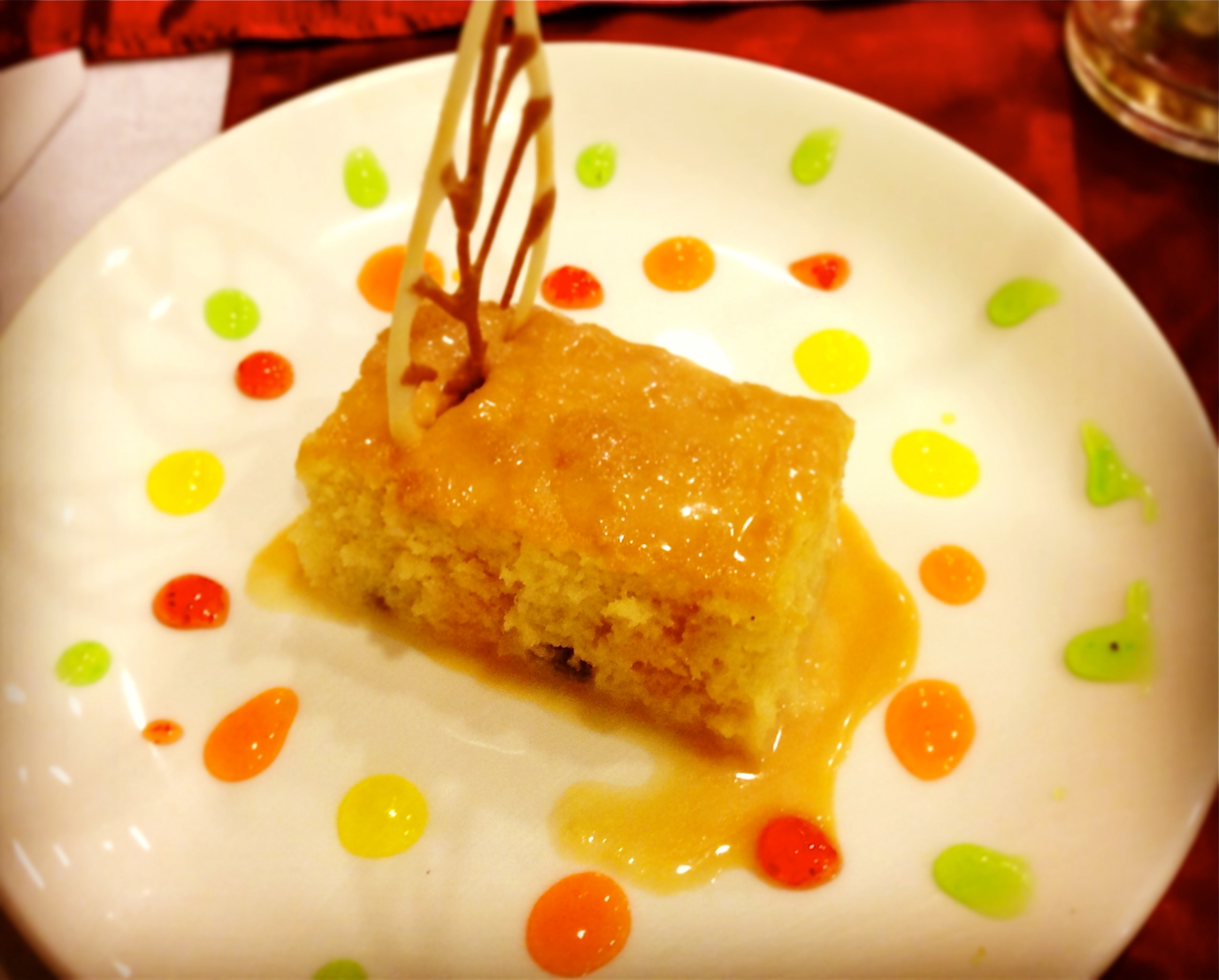
The derivatives of the basic sponge cake idea include the American chiffon cake, the Mawa cake (Indianized British sponge cake from Mumbai) and the Latin American tres leches cake. The latter is a sponge cake soaked in three kinds of milk: evaporated milk, condensed milk, and heavy cream. From the simple sponge cake, before it has cooled, the creation of rolled cakes as in the Swiss rolls, trifles, Madeleine and ladyfingers are possible. Little wonder then, this basic cake has been a part of the kitchens over the centuries. With the National Sponge Cake (August 23rd) being recognized by foodimentarians today; experimenting and indulging in the basic cakes of the childhood days would make way for a change fr the usual.

“Kai slices the cake, his version of the banana cake I have always talked about. He has made a vanilla sponge cake, soaked in vanilla simple syrup, and layered with sliced fresh bananas and custard. There is a central layer of dark chocolate ganache with bits of crispy pecans and toffee, and the whole thing is covered in chocolate buttercream, with extravagant curls of chocolate and chocolate-dipped banana slices piled in the middle. I accept a thin slice, savoring the flavors, both of the cake, and of simple joy.” Stacey Ballis (Good Enough to Eat)

Posted in Daily, Food

Sweet, Flavoured and Iced

“After scalding the teapot, put into it one quart of boiling water and two teaspoonfuls green tea. If wanted for supper, do this at breakfast. At dinner time, strain, without stirring, through a tea strainer into a pitcher. Let it stand till tea time and pour into decanters, leaving the sediment in the bottom of the pitcher. Fill the goblets with ice, put two teaspoonfuls granulated sugar in each, and pour the tea over the ice and sugar. A squeeze of lemon will make this delicious and healthful, as it will correct the astringent tendency.” (Marion’s recipe for “Ice Tea” (1879))
– The oldest sweet tea recipe (ice tea) in print from the community cookbook “Housekeeping in Old Virginia”, by Marion Cabell Tyree (1879 publication)

Although summer heat has given way to the rain, tea especially the iced and sweetened versions have almost a year round presence. Despite the rains, each week has it’s fair share of afternoon heat, best felt when one spends the muggy hours on foot. While iced or cool water has their benefits, there is the something about iced tea and sweet tea that prompts every cool drink enthusiast to indulge in them once a while.

With trade and colonial conquests, tea was introduced to Europe and then on to the Americas, where it had gained widespread popularity especially in the southern parts. By the 1900s, black tea became more accepted than green tea, especially when taken with ice. With scorching heat, the sweetened and iced version had more support than simply the iced version. Yet it was the World Fair (1904) that had made iced tea a popular summertime drink. This popularity had catapulted with the Prohibition ( 1920-1933) wherein beer, wine and alcohol was declared illegal then.

The technical difference between “sweet” and “iced tea” lies in the sugar. The former is taken as “sweetened and iced” whereas the latter i.e. iced tea, may be served unsweetened or black. Either way, learning to make sweet tea is a must for any afternoon social especially when the age of soft drinks may have been passed. With National Sweet Tea Day tomorrow (August 21st), it’s time to go recipe hunting and come with a flavoured and tacky sweet tea recipe.

Posted in Daily, Food, Stories Around the World

The “Meringue” Way

“To make white bisket bread.
Take a pound & a half of sugar, & an handfull of fine white flower, the whites of twelve eggs beaten verie finelie, and a little annisseed brused, temper all this together, till it be no thicker than pap, make coffins with paper, and put it into the oven, after the manchet is drawen.”
– Recipe for the “white biskit bread” in the book of recipes started (1604) by Lady Elinor Poole Fettiplace (c.1570 – c.1647) of Gloucestershire.
(Fettiplace, Eleanor Poole (1994). Hilary Spurling (ed.). Elinor Fettiplace’s Receipt Book. Translated by John Spurling. Bristol (U.K.): Stuart Press. Volume 1, page 23) noted by Muster (ref.)

Made from egg whites and sugar, whipped up to a finesse with a binding agent (salt, cornstarch or gelatin) and an occasional acidic ingredient (lemon, vinegar or cream of tartar) or flavorings of vanilla, coconut or almond; meringue had graced the dessert menu especially to highlight a special occasion or simply enjoy the pleasures of an exquisite delight. The origin till date, is a point of contention for food historians.

The name “meringue” had first appeared in cookbook by François Massialot (1692) (“XXVIII: Des Meringues & Macarons”. Nouvelle instruction pour les confitures, les liqueurs et les fruits (in French). Paris: Charles de Sercy. pp. 186–188). While the word “meringue” had first appeared in English in an English translation of Massialot’s book (1706); two considerably earlier seventeenth-century English manuscript books of recipes give instructions for confections known as “white bisket bread” and “pets” of what are today are recognizable as meringue. The other claim was that meringue was invented in the Swiss village of Meiringen and improved by an Italian chef named Gasparini between the end of the 17th century and the beginning of the 18th century.

“To make Pets
Take a pownd of Drye fine searsed [sifted] suger, & beat the whites very wel then take off froutgh [froth] & put your suger, bye litle & litle in to it — contineually stiring it & beating it with a spoone ore laydle, and when it is exceedingly well beaten, then have some pye plates ready buttred & wipe the buter of because the lesse buter it hath the beter, then drope them upon the plate & put in to every drope a carieway seede or coriander then let your oven be very temparate and watch them with a candle all the while & if they be right they will rise and looke very white, it is good at the first to set a scilet [skillet] of water, with them in to the oven,& when they be thowrow [thoroughly] drye then take them out, you must in the mixing of them put 12 graines of muske & 12 of Abergrisse [Ambergris] which you must bruse with suger before you stire it in to the egge & suger.”
– Recipe for a baked beaten-egg-white-and-sugar confection (1630) is given in a manuscript of collected recipes written, by Lady Rachel Fane (1612/13 – 1680) of Knole, Kent. (Barry, Michael (1995). Old English Recipes. Jarrod (archived at the Centre for Kentish Studies, Maidstone, Kent). p. 64f.)

The faster they are beaten, the better is the flavour. The key to the formation of a good meringue is the formation of stiff peaks by denaturing the protein of egg whites by pure mechanical shear force. Today these light, airy and sweet confections are made at home (more chewy and soft, and crisp exterior), though the commercial ones still thrive. Interestingly, meringues were traditionally shaped between two large spoons (still done so at the home kitchens) till Antonin Carême piped the “meringue through a pastry bag”.

Over the years, various techniques have been improvised to bring forth the French or basic meringue, Italian, Swiss and even the vegan meringue. From biscuits, desserts to embellishment, each meringue based recipe like the lemon meringue pie, baked Alaska, dacquoise, Esterházy torte to mention a few, all have a story and art of their own to tell. With meringue taking the form of whimsical shapes such as mushrooms; or piped into a crisp basket that is baked and filled with cake, fruit, or flowers are few of the many reasons why these delicacies are here to stay and transform the art and flavours of dessert.

Posted in Daily, Food

Of Panini, Origin and Evolution

Meaning small bread or bread rolls as derived from the Italian panini [paˈniːni] or panino; these sandwiches are made with Italian bread (such as ciabatta and michetta), usually served by grilling or toasting. While the modern panini may have baguette as the bread; the deli ingredients of the horizontally cut bread can be filled with one’s own choice. From salami, cheese, ham, vegetables sliced or pickled; the choices are aplenty.

“[Panini] are said to have originated in Lombardy, Italy, in response to the demand among Milanese office workers for a quick lunch without sacrifice in flavor and quality. In both Italy and the United States, panini are eaten for lunch and as snacks and appetizers. In Italy, sandwich shops traditionally wrap the bottom of the panino in a crisp white paper napkin, providing a practical solution to drips while enhancing aesthetics. Quality Italian bread is an absolute must for a killer panini, and most sandwich chefs will opt for a relatively thin artisan bread like grooved focaccia or ciabatta, slicing it in half horizontally. Panini are always grilled, so most restaurants and cafes have invested in professional grooved sandwich presses that flatten and heat the sandwich while creating a crunch, buttery outer crust.” -American Sandwich: Great Eats from all 50 States, Becky Mercuri [Gibbs Smith:Salt Lake City UT] 2004 (p. 81)

The earliest precursor of panini was believed to be in the 16th century Italian cookbook; food historians have traced these sandwiches to the trendy Milanese bars, called paninoteche (1960s). As their popularity had crossed the Atlantic in the mid-1970s, the first American reference to panini dates to 1956. With each city having their own distinctive version of panini, variation were developed in plenty. During the 1980s, “paninaro” had evolved which was the youngsters’ culture typical of teenagers to enjoy a meet and eat place like the sandwich bars, such as Milan’s Al Panino. These had later evolved to the initial style of fast food restaurants opened in Italy.

Over time, panini had evolved to more flavours and texture with the bread changing type along with the mix. As their popularity spread across the seas to the Asian continent and the Orient, the portability, easy preparatory, individual taste and choice have contributed to their fair share in the menus across the globe. Little wonder, why then August had been dedicated as the month of the panini  by experimental foodimentarians, for every kitchen of theirs would have made or had the “panini” at some point of time.

Posted in Daily, Food, Stories Around the World

Of Cheesecake, Origins, Style and Evolution

Pound the cheese until smooth and pasty. Mix the pounded cheese in a brass pan with honey and spring wheat flour. Heat the cheese cake “in one mass”, allow to cool and serve. ( Records from the oldest known Greek recipe, Athenaeus 230 A.D.)

One of the well loved desserts of “cheese cake” has its’ origins as early as the Greek civilizations of 6th century B.C. . Although it was believed that the first cheese cake may have been created on the Greek island of Samos, this mayn’t be exact. In fact, cheese and related products may have been there since the domestication of animals and use of milk by the primitive man. Th earliest evidence of cheese cake, was as per Greek records ( 5th century records of Greek physician Aegimus, Olympic records of 776 B.C. or Athenaeus writings of 230 A.D.) during sports and weddings (as the main wedding cake). Then the basic ingredients of flour, cheese, honey and wheat were taken in the right amounts and baked.

With the conquering of Greece by the Romans, the “cheesecake recipe” was modified to include crushed cheese and eggs. Either baked under a hot brick and served warm, or put into the pastry as a filling; the Roman cheesecake known as “libuma” was meant for special occasions. Cato the Elder’s De Agri Cultura accounts the earliest cheesecake recipes, which mentions three types; libum, savillum and placenta. The latter is almost like the modern cheesecake recipe with a crust that is separately prepared and baked.

“A dessert without cheese is like a beautiful woman with only one eye.” Anthelme Brillat

With the extension of Roman empire, later fall and rise of other civilization; cuisines and recipes were exchanged, experimented and evolved throughout Europe. From Great Britain to Eastern Europe, each region had their unique differences of ingredients, texture, method and presentation of cheesecake. The twelfth century had seen, a cheesecake recipe in the English cookbook, Forme of Curry (1390). Described as a flour based sweet food, various accounts also state cheesecake recipes as “cheese cut into very small pieces, soaked in milk for three hours; the mixture strained and eggs, butter and sugar being added (accounts of chef in employ of Henry VIII).”

Although the name “cheesecake” was used since the 15th century; the modern form of “cheesecake” had evolved around the 18th century. Then yeast was substituted with beaten eggs; thereby removing the overpowering yeast flavour and make it more “dessert-ish” and sweet. With immigration and migration to Americas, the recipes were further modified. The modern American cream cheese was developed in 1872 as an accidental discovery by William Lawrence (Chester, New York) as he tried to recreate the soft, French cheese Neufchâtel. Although he had made an “unripened cheese”, heavier and creamier than the regular; similar creations were made independently by other dairymen.

“New York means many different things to me. It certainly means cheesecake, more species of cheesecake than I ever knew existed: rum, orange, hazelnut, chocolate marble, Italian, Boston, and of course, New York.” David Frost

On a technical point, cheesecake today is more as a torte (based on number of eggs), tart or flan than being a “cake” as they have a separate crust, soft filling and the absence of flour in most recipes. In fact, modern cheesecake comes as two different types; of the baked cheesecake or cheesecakes made with uncooked cream-cheese on a crumbled-biscuit base.

With cheesecakes being broadly categorized as two basic types of baked or unbaked, each region or continent have their own versions or varieties. Like the most popular variety of South African made with whipped cream, cream cheese, gelatin filling, buttered digestive biscuit crust with Amarula liqueur, if not baked or the Asian style cheesecake of cornstarch and eggs (Japan) or cottage cheese, sugar and nuts ( Indian chhena poda, Odishan recipe) or the common unbaked Australian cheesecakes; one can modify the recipe for more fruit based or sweet (chocolate, vanilla or caramel) based flavouring.

“My favourite pudding is a toss-up between cheesecake – proper, New York cheesecake – and apple crumble and custard. Custard is very important, or dark chocolate mousse. Tea: probably Earl Grey, splash of milk.” Tom Hiddleston

For a more global cheesecake style, one can experiment and base recipes as per the French style (Neufchâtel cheese, gelatin), Italian-style (ricotta or mascarpone cheese, sugar, vanilla extract, small bits of candied fruit and sometimes barley flakes), Polish sernik, Russina vatrushka or like in the United Kingdom and Ireland.

The latter make their cheesecake typically with a base of crushed, buttered biscuits and often topped with a fruit compote. The usual filling is a mixture of cream cheese, sugar, cream and gelatin at times. Popular non fruit variations are banoffee, coffee, tea, chocolate, Irish cream, white chocolate, marshmallow flavors and even smoked salmon (Scotland). The New York style (heavy cream or sour cream based) and Chicago style (baked cream-cheese, fluffy with a shortbread based crust) cheesecakes are few of the popular American varieties.

The versatility, wide variety and variants, ease as well as simple ingredients of cheesecake are what makes them popular for quick occasions, simple desserts or more elaborate functions. To celebrate the National Cheesecake Day (July 30th), it would be fun to start a “cheesecake” tradition or recipe for family and friends. After all, cheese refines with age, in taste, flavours and texture. Intermixing recipes for new palatable combinations would be an interesting experimentation for the homemaker, artisan as well as the “chef’s eye”.