Posted in Daily, Food, Stories Around the World

Of Origin and Evolution…”Soufflé”

“You can’t make a souffle rise twice.” Alice Roosevelt Longworth

One of the main dishes that declares one’s success in the kitchen is the “souffle'”. Although records have traced its’ appearance to the early eighteenth century in France, soufflés may have been around ever since flour, milk, eggs and butter have been whipped up into different concoctions to please the palate. Essentially a soufflé is a baked egg-based dish made with egg yolks and beaten egg whites combined with various other ingredients and served as a savory main dish or sweetened as a dessert. “Soufflé” is the past participle of the French verb souffler which means “to blow”, “to breathe”, “to inflate” or “to puff”.


While, few food historians state that the first appearance is by the French master cook Vincent de la Chappelle in the early 1700s; the popularization of souffle perfected to an art was credited to the French chef, Marie-Antoine Carême, who was “a product of post-revolutionary Paris.” As per Antoine Beauvilliers, who is credited with the “first grand restaurant of Paris, had described the soufflé in “The Art of the Cook” (L’Art du Cuisinier, 1814) as,

“Put in the size of an egg of good butter, a little nutmeg and the yolks of four fresh eggs, the white of which must be whipped apart as for biscuit; mix them by little and little into the puree though hot, mix all well, and pour it into a silver dish or paper mould, put it in the oven. When the soufflé is well risen, touch it lightly, if it resist a little it is enough; it must be served immediately, as it is apt to fall.”

Baked in individual ramekins or typical dishes, soufflés are typically prepared from two basic components; the base as a flavored crème pâtissière, cream sauce (or béchamel) or a purée and the egg whites beaten to a soft peak. While the base provides the flavor, the egg whites provide the “lift” or puffiness to the dish. The base can be flavored with varied ingredients including herbs, cheese and vegetables for savory varieties or jam, fruits, berries,chocolate, banana or lemons and the like, for dessert soufflés. In fact, the savory soufflés can incorporate poultry, bacon, ham or seafood for a more substantial dish.

“The only thing that will make a souffle fall is if it knows you’re afraid of it.” James Beard


One of the main defaults while preparing a souffle’ is when it fails to rise. Yet as most chefs will say, one thing to keep in mind in soufflé preparation is that it really doesn’t matter how high the bubbly mixture poufs up while it bakes as long as the ingredients hidden inside should taste heavenly and cloud-like.

“If a dish doesn’t turn out right, change the name and don’t bat an eyelid. A fallen souffle is only a risen omelette. It depends on the self-confidence with which you present it.” Lionel Blue

For avid movie watchers as well as fans of the movies of the black and white era, one may have seen “Sabrina”, the 1954 film starring Audrey Hepburn. One of the scenes is where Hepburn is humiliated at the Parisian culinary school when the master chef humiliates her (and almost everyone) and critiqued their failed efforts at soufflé from “Too low; too high; too heavy; sloppy”. Hepburn sighs to her French baron friend (whose soufflé is perfect) “I don’t know what happened.”
He explains to her that she forgot to turn on her oven. “Your mind has not been on the cooking,” he says. “It has been elsewhere. A woman happy in love, she burns the soufflé. A woman unhappy in love she forgets to turn on the oven.”

While “the fallen soufflés” may be depicted in cartoons, comedies and children’s programs as a source of humor; the process of making it will be easy and fun if one learns to proportionate the ingredients and time the baking right. As they always say “Practice makes perfect”, trying a souffle’ for the National Cheese Souffle’ (May 18th) or Chocolate Souffle’ (February 28th) Day would be a first step towards mastering this art. If not to master, then at least experimenting to make one can result in some “kitchen fun” and good use of leftovers; or simple have and enjoy the “heavenly and light as air” experience.


Posted in Daily, Food

Hummus: From “Then” to “Now”

From parties to the routine meals or for the dieters as well as snack food for the cravings time after work or before the ” big meal”, this dip has been popular across the world. Little wonder then that with International Hummus Day ( May 13th) gone by, one mayn’t know enough about this dip.

Known as “Hummus” or “hummus bi tahini”, this Levantine dip or spread, is made from cooked or mashed chickpeas or other beans, blended with tahini, olive oil, lemon juice, salt and garlic. The word “Hummus” comes from the Arabic word meaning “chickpeas”. However likely from the Greek origins, hummus a part of the local cuisine in both Turkish Cypriot and Greek Cypriot communities, it is known as “humoi” . While originally placed in the Middle East and Mediterranean cuisine, today it has been featured in many local cuisine and recipes around the globe.

While there are a number of different theories and claims of origins in various parts of the Middle East and the Mediterranean, there is insufficient evidence to determine the exact or precise details. The basic ingredients of chickpeas, sesame, lemon, and garlic have been combined and eaten in their local cuisine over centuries. While some food historians believe that variations of this recipe were there during the ancient Egyptian civilizations where then chickpeas were widely eaten as cooked in stews and other hot dishes; they had also been a part of the Greek cuisine and cooking. However records of pureed chickpeas eaten cold with tahini do not appear before the Abbasid period in Egypt and the Levant.

Cookbooks of 13th century Cairo record recipes for dish resembling hummus bi tahina; like the recipe of a cold puree of chickpeas with vinegar and pickled lemons with herbs, spices, and oil, but no tahini or garlic.  Over the years variations exists in the amount of ingredients of the beans, chickpeas pureed as well as mixing of vinegar or olive oil, tahini as well as different spices, herbs or nuts, with or without garlic; made or served by rolling it out and letting it sit overnight. With trade playing a significant role in the spread and share of cuisines, hummus may be one among the numerous foods that had crossed over during the historical periods across the Middle East and the Mediterranean.

Being used as an appetizer or dip, or served with meals; hummus can be had in an numerous ways. It can be scooped with flatbread, such as pita or served as part of a meze (selection of appetizers) or as an accompaniment to falafel, grilled chicken, fish or eggplant as well as with tortilla chips or crackers. Hummus can be garnished with numerous available ingredients like chopped tomato, cucumber, coriander, parsley, caramelized onions, sautéed mushrooms, whole chickpeas, olive oil, hard-boiled eggs, paprika, sumac, olives, pickles and pine nuts. It can also be topped by a mixture of fava beans or can be made with yogurt, butter and topped with pieces of toasted bread ( Jordan and Palestine areas).

There are many variations to the preparation of “hummus” with the various changes of civilizations, culture mixing as well as immigration. Variations like hummus with fried eggplant and boiled eggs, as a chickpea soup or hummus with traditional skhug hot sauce to name a few, are popular in their locale areas. Of recent, African cuisine have brought specialties such as Sudanese Hummus Darfur with eggs, tomatoes, and grated cheese. Many restaurants offer varieties of warm hummus which may be served as chick peas softened with baking soda along with garlic, olive oil, cumin and tahini or as “msabbaha” made of whole chick peas garnishing the tahini (lemon spiked) with a drizzle of olive oil and sprinkling of paprika.

With hummus being gluten free, nut-free, dairy free as well as a perfect spread or dip for snacks, fresh fruits, bread, meat, pita chips and the like; it has gained widespread acceptance across many cultures and cuisines as well for the weight watchers, medical reasons or just for its’ own unique taste and blend. Making hummus isn’t just a work of ingredients but also of art and creativity. With its’ quick and easy preparation with locally available ingredients; “hummus” is something that everyone should try at least once in a lifetime.

Posted in Daily, Family and Society, Life, Quotes, Reflections

At a Child’s Pace

“Let the child be the scriptwriter, the director and the actor in his own play.” Magda Gerber

Every morning, before going off to work, my toddler sees me off before going to his day care. As his centre is close to my work place, the daily morning walk is all of ten minutes only. Yet some days we both take almost thirty minutes to get there by foot; for then we walk at his pace. Walking at his pace involves, stopping to watch the traffic, examine the caterpillar crawling across, collecting the smooth round pebbles near the stream and bringing along the sturdy sticks to his daycare and back to home as well.

“Children are not things to be molded, but are people to be unfolded.”  Jess Lair

At times, the mothers’ pace in me comes to full force, with loud “Hurry up’s”, holding his hand and flying ahead, not stopping to look at the “distractions or landscape”. These situations are later compensated when we go homeward bound in the evening. The memories of “walking at a child’s pace” are beautiful.The warring thoughts in their mind, while attaining their “collectible treasures” of “funny shaped rocks”, watching the pigeons drink the water, seeing the frogs leaping across with various emotions flitting across their faces offer refreshing joy and peace to the adult mind. Leave them in the garden alone, with child safe measures and behold, its’ like watch fountains of joy and laughter explode like hot springs. Watching them ponder and examine what they see, the wonder of seeing the “big cars, JCB’s, buses” on the road (for the miniature toy ones are in their control) and their joy in the simple things of life are treasured moments.

“Curiosity is the wick in the candle of learning.”  William Arthur Ward

Living with the speed of a child is never easy for us adults, but when we do, the joy of experiencing the little delights that life offers makes the “slowing down” all the more worth. Over the years, this valuable time is what helps not just our children to grow, but also help us adults to handle the bad days with these happy moments. For the “child’s‘ pace” teaches us to find time to notice the wonders’ of the skies, the smell of the earth and be surprised by the simple but beautiful things that life offers us.

“A child can teach an adult three things: to be happy for no reason, to always be busy with something, and to know how to demand with all his might that which he desires.” Paulo Coelho

Posted in Daily, Family and Society, Quotes, Reflections, Work

Language or Jargon

“It’s a strange world of language in which skating on thin ice can get you into hot water.” Franklin P. Jones

Living in a house with teenagers still in the family, one becomes an expert with short forms and abbreviations. In fact, one of the advantages (or disadvantages) of messaging and texting in the present day, is the use of less words, more of “emojis” and short forms that enable us to “save time”. Ironically what has happened is that we have forgotten how to spell correctly, speak in complete sentences or deliver a message without sounding garbled or hunting for the right words midway.

“When you lose a language and a language goes extinct, it’s like dropping a bomb on the Louvre.” Michael Krauss

Running through the official emails as well as personal ones’, the distinct difference in the style of writing, expression of words as well as use of “emoticons” highlight the official from the personal. Yet sometimes on rereading the mail, one has to very often guess the meaning behind the emoticons. Shifting between “smileys” and “dancing girls”, everything can be classified broadly into good or bad. In a way, words like adjectives, adverbs and similes have become almost extinct. Looking at the initial days of man, I guess we are back into the language of “expressions, hand signals, sounds, mono-, bi-or tri-syllables and garbles” just like the primitive ancestors.

“Losing the language means losing the culture. We need to know who we are because it makes a difference in who our children are.” Dottie LeBeau

Moving with the times is important. Hence striking a balance between the “cool” and “official language ” is a must, for us to convey complete and whole messages, before we lose out completely on our own sense of language, speech and words.

“At any one time language is a kaleidoscope of styles, genres and dialects.” David Crystal

“… once upon a time there were synonyms: “good, beautiful, valuable, positive, outstanding, excellent, wonderful, wonderful, wonderful, lovely, seductive, wonderful, cute, amazing, stunning, fantastic, magnificent, grandiose, irresistible attractive, fascinating, enticing, attractive, incomparable, unique, enticing, amazing, entrancing, divine “, and so on and so forth. And what? – left only “cool.” Less often – “cool” … ”  by T. Thick in “Hope and support”

Posted in Family and Society, Life, Personal Musings

Affinity, Soul and Time

“How will a person know, Selina, when the soul that has the affinity with hers is near it?” She answered, “She will know. Does she look for air, before she breathes it? This love will be guided to her; and when it comes, she will know. And she will do anything to keep that love about her, then. Because to lose it will be like a death to her.” Sarah Waters (… the author of Affinity)

Boy meets girl, by chance. Sparks fly but not much more after that. Fast forward years later. Lady meets a gentleman. Sparks fly and the fire is lit. If not, years on, an elderly man meets the woman of his dreams. Both old, yet sparks fly and the fire is lit. Forever or not, only time will know.

The above scenario may seem familiar. Our story or the story of someone we know or have heard of, may resonate with certain events as written above. What strikes one most on looking back, is the affinity between the two souls, no matter how far away. While “reel life” dramatizes the whole concept to “first look of pure love”; real life can range in varying degrees from mutual acceptance or comfort to instant attraction or the deep feeling of being complete. It varies from person to person.

For some “soul affinity” strikes instantly; while for others, it does not arise suddenly. Love with all its’ due respect, doesn’t arise from nothing. Where there is a fire, there are sparks. True love grows from a small sprout, of respect and admiration for a person, to love, affection and friendship comprising of pleasant moments through the attention given to each other. Love encompasses knowing the other; respecting the differences as well providing empathy, care and attention. Once experienced, its’ a feeling best described by emotions, memories and moments, more than the words that one can say.

“Love is the affinity which links and draws together the elements of the world… Love, in fact, is the agent of universal synthesis.” Pierre Teilhard de Chardin

Posted in Daily, Family and Society, Life, Personal Musings, Quotes, Stories Around the World, Work

Communication Fillers and Gaps

“The single biggest problem in communication is the illusion that it has taken place.” George Bernard Shaw

One of the recently circulated video on my social network pages, shows a social experiment in which four queues of employees are made to stand, with a message being conveyed as a sequence of actions likened to starting a motorbike. (https://www.youtube.com/watch?v=FH_7F3KI8yg)

Unfortunately as the message, in the form of sequence of actions, were passed on, minor alterations were being added on, which eventually resulted in the last person of the queue mimicking the actions that were no where close to the initial sequence or message that the first person had initiated. Although the video may seem hilarious at the end, on reflecting later, the lack of communication as well as the errors in the message being conveyed, understood and repeated are alarming.

“Communication – the human connection – is the key to personal and career success.” Paul J. Meyer

At every walk in life, communication is what brings man apart from other living species. Knowing how to convey ideas, bring about changes as well discuss and share various aspects makes human life meaningful, interesting and enriched. Yet when thoughts are shared wrong, with each one modifying the truth as per one’s short-lived understanding, thinking or viewpoint, the real sequence of events gets distorted, destroying the harmony and peaceful thinking.

“The most important thing in communication is hearing what isn’t said.” Peter Drucker

Each time we come across any information, words or actions, thinking about them before e repeat them elsewhere would go a long way in maintaining one’s own peace and harmony. The process of adding one’s own bit to the real sequence of events, when not understood the right way, can do significant harm than plausible.

Posted in Christian, Family and Society, Food, Life, poetry, Stories Around the World

Of Easter,Tradition and Trends

“I still believe in Santa, the Easter Bunny, the Tooth Fairy and true love. Don’t even try to tell me different.” Dolly Parton

With Easter Sunday being celebrated tomorrow, preparations are quietly underway which would make the day special tomorrow primarily keeping the children in mind. Easter Sunday is the day signifying the love of God for man, a time for hope, renewal and resurrection through His Son. With the season of Lent coming to a close and breaking the Lenten fast involves special significance, especially when one has abstained from something dear to them through this period. Sacrificing something that one is fond of is never easy, but a whole new meaning and character is acquired when we abstain from the “materialistic” pleasure that we being man, often crave every now and then. Which is why, every Easter Sunday meal is something that the entire family and friends look forward to. Besides being a time for togetherness, it also signifies the breaking of the Lenten Fast.

“The blessing of food for the Easter Sunday meal is especially popular among people of Eastern European descent, especially those from Poland. Families prepare baskets with the food they will eat on Easter morning – decorated eggs, sausage, ham, bacon, a loaf of bread with a cross cut into the crust, cheese, salt, horseradish, and butter carved in the shape of a lamb.” Ken Untener, The Little White Book for Easter

Around the world, various traditions are there on Easter. While initially they were modeled after the spring celebrations, later the trends were modified to give new relevance with the basis of the last supper or “Passover” or “Passove Sedar” in mind. Among the Easter Lunch, the fast is often broken by the “star of Easter”; painted, dyed, gilded in various hues, hidden or hung on trees, found on the treasure hunt, bough to church or given as gifts are the “Easter Eggs”. Most of the legends state them to be “symbol of life”.

“I agree. You don’t want it to look boring. It’s [the Easter egg] got to look good otherwise it’s just like every other chocolate. And size does matter when it comes to the egg, as that’s what Easter eggs are all about.” Liam Tomassi

Previously believed by the Egyptian and few Persian civilization of the early times, eggs were considered to be symbolic of after life. Few traditions believe that Mary Magdalene and the Virgin Mary held eggs during the crucifixion or that they were eaten at the first meal after the Resurrection. In the Eastern Orthodox churches, the hard shell of the egg represents the stone walls of Jesus’ tomb, with the egg itself representing the new life of the Resurrection. Eggs also were the easiest, most economical and available foods to eat while breaking the Lenten Fast. This popularity has lead in the presence of “the Easter Egg” predominate every Easter celebration.

“The Easter eggs symbolizes our ability to break out of the hardened, protective shell we’ve surrounded ourselves with that limits our thoughts and beliefs. As we break open our hearts and minds we discover a transformation to new, life enhancing thoughts and beliefs.” Siobhan Shaw

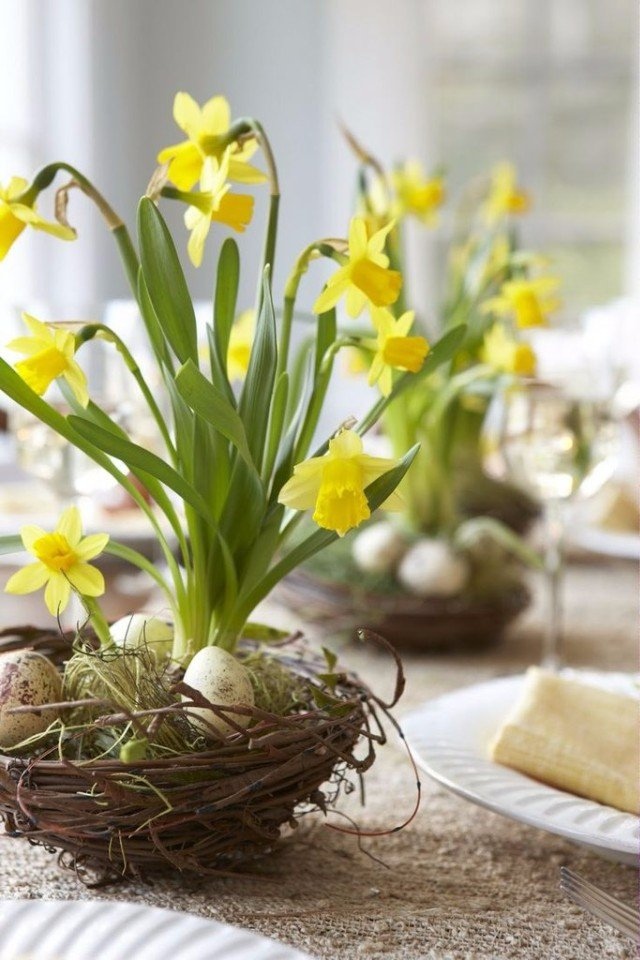
Another popular tradition was the Easter Basket, which was an “Easter Nest” originally. Arising from the concepts of fertility and springtime, Eastern basket was a German tradition which had gained mass popularity. Initially children would make “nests,” filled with grass, in hopes that Peter Cottontail would fill the nest with eggs. Later these nests evolved into baskets, which were bigger, less messier and easy to carry.

Amidst the Easter Eggs in the basket would be the “hollow chocolate bunnies”. While there is no historical or religious documentation on why the bunny represents Easter, the association would be more by the calendar. With Easter mostly during Spring, the month of April showered not only spring flowers but also signals the birth of baby rabbits. Thus spring time and bunnies symbolize birth and renewal. Coat the bunnies with chocolate and hollow them out to fill them with candies; voila the treat is irresistible for every kid in the block.

Other Easter traditions include eating ham or meat to the making of “Hot cross buns” and other breads marked with an X to symbolize the cross are a tradition on many Easter tables. From the “Choreg” of Armenia, Ukranian “Paska”, Polish “Babka” to Tsoureki of Greece, a wide varied variety of sweet breads are made around the world. With eggs being baked in most, these are conspicuously risen breads, quite different from the Passover tradition of unleavened bread.

As we get ready to break the Lenten Period and celebrate Easter, with all the food to be made ready, decorations to put up, church to be readied and tables to be set, the core message of renewal, togetherness and love shouldn’t be forgotten. One of the best ways to spread the message of love would be to share the delectable creations of Easter around.

The Easter Bunny came by today
and left surprises along his way.
Colorful eggs are all around.
With baskets in hand we search the ground.
Hiding in places here and there
Easter eggs are everywhere.
-Author Unknown