Posted in Daily, Food, Stories Around the World

Of Empanada, Origin and Evolution

“If you were a Colombian, you would have your version of an empanada. If you are an Argentinean, you might find a dough that’s baked and has a butter sheen on it. And then in Ecuador, you’ll find more crispy-fried empanadas. So, yeah, every culture has their own version of empanadas.” Jose Garces

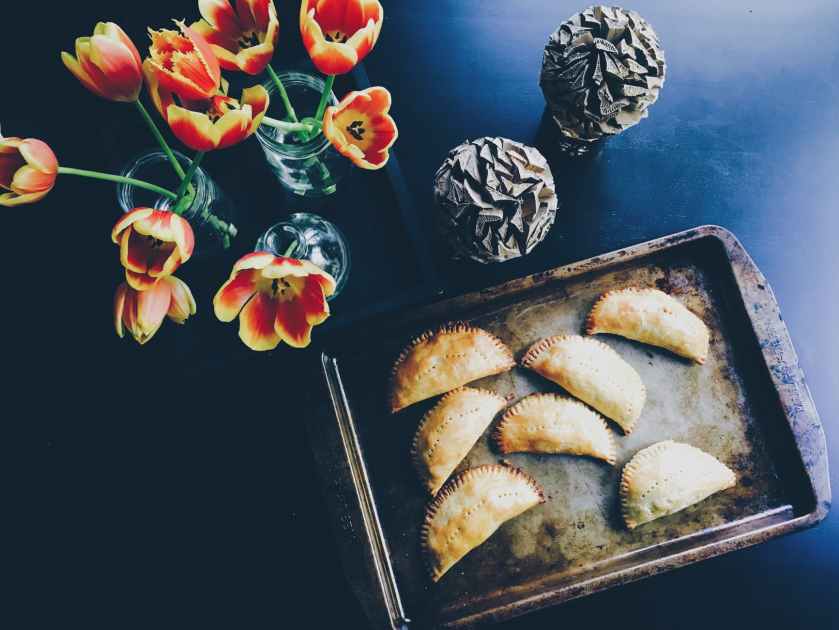
Derived from the Spanish verb “empanar” which translates to “wrap in bread”, these fried or baked pastries stuffed with sweet or savoury filling, known as empanadas have enjoyed widespread global popularity. Across the Caribbean, Latin America, Portugal, Spain, Italy to as far as Philippines; this dish has its’ own local blends that make it delectable and adaptable to every local cuisine.

“You are the olive in my empanada.” Brazilian Saying

Originally believed to be from Galicia, Spain; the empanadas of today may have been the brainchild of the Moors who had occupied Spain for hundreds of years. The idea of wrapping a hardy filling in pastry dough had led to this little delight. Fillings including seafood have been documented in a cookbook published in Catalan, Spain (1520). With the spread of civilization, trade as well as colonization, this savoury delight had travelled around the world. In fact the first empanadas in Western Hemisphere are credited to Argentina with the US celebrating the National Empanada Day on April 8th. While empanadas are a traditional Christmas treat in New Mexico, they’re known as creoles(southwest and south) or as fried pies (southeast) depending on the locality.

Similar to cut-up pies, empanadas are typically savoury often filled with cod fish or chicken. They are made by folding a disc of thinly rolled dough over the filling into a semicircle and then crimping the edges to seal it. The dough is often made with wheat flour, but can be substituted by corn flour, cornmenal, plantain or potato base, depending on the locally available ingredients. The content of the dough varies on whether the empanadas are to be baked or fried. The art of to make a perfect empanada is to hold the dough spread open, in one hand; while using the other hand to fill it and to crimp the edges. Homemade sweet varients of the empanadas are present in many local cuisines. For instance, the Gujiya is a traditional Indian crescent shaped dessert, similar like a sweet empanada.

There have been various variations similar to empanadas. Catibías, similar to empanadas are made with cassava flour dough with common fillings include ground beef, chicken, guava, and cheese. Pastelitos are similar to empanadas, too, but they’re made with a lighter pastry dough and they can be either baked or fried.

Travelling across the various countries, the ‘Mpanatigghi of Modica (half moon-shaped panzarotti filled with a mixture of almonds, walnuts, chocolate, sugar, cinnamon, cloves and minced beef), meat empanadas (“de pino”) of Chile , panades of Belize and so on, have been the varied presentations of the empanadas. Certain eateries in order to distinguish the varieties, develop a pattern on the pastry fold, crimping style of the edges or burn a letter(an abbreviated indication of the filling) into the dough.

Either way, one of the most easiest delights to be made for a novice cook, are empanadas which serve as quick bites, starters, breakfast, desserts or even for brunches to lunches.

“Don’t be afraid to adapt new ingredients into your own techniques, and traditional ingredients into new recipes.” Jose Garces

Posted in Daily, Random Thoughts, Stories Around the World, Work

To Believe It or Not !!

” “Coca-Cola is launching three flavours of its Zero Sugar brand featuring avocado, sourdough and charcoal.”

Imagine the consequences of the taste buds and the senses after an episode of experimentation with these flavours. And here’s how the flavours were described.
• Coca-Cola Zero Sugar Avocado – Forget smashed or blended, this new flavour infuses the subtle, creamy undertones of amazing avocado with that great Coca-Cola Zero Sugar taste. Both delicious and nutritious, this gorgeously green pick-me-up is guaranteed to make your socials grow.
• Coca-Cola Zero Sugar Charcoal – Cleanse, refresh and revitalise with a Zero Sugar supercharge. Loaded with activated charcoal, creating a smooth and rich flavour, this miracle in-a-can pairs-perfectly with your favourite Instagram filter.
• Coca-Cola Zero Sugar Sourdough – Crafted with care, superbly sour and bursting with fermented flavours. Packed with crumbly goodness – so you can start the day in the right way with a mouth-wateringly good snap of this wild-yeast infused Zero Sugar treat. “

For the readers of the above news on the Daily Mirror online version last year, had resulted in a frenzy of whether this was true or was it an “All Fools Day Prank”. Being mixed with the “true news” of the society, food, travel and living sections; it wasn’t easy to ascertain whether one was going to really taste avocado, sourdough or charcoal in their drink.

“The first of April, some do say
Is set apart for All Fool’s Day;
But why the people call it so
Nor I, nor they themselves, do know,
But on this day are people sent
On purpose for pure merriment.” (Poor Robin’s Almanac, 1790)

One of the days dreaded the most, especially at work, school or neighbourhood, is the first day of April, where the day is pretty confusing for each hour goes by the wait of “being pranked”. Each day this year, from social media to official meetings, one is always second guessing everything. As for pranksters, its’ a day of freedom, fun and revelry.

Yet when the prank is actually the truth, one may feel a bit razzed. For instance people who celebrate their birthdays on April First have always been questioned, even though they are speaking the truth. Remember the headlines that state “the African continent can split into two” after an enormous crack appears. Well, it’s actually true for a large crack, several miles long and growing accompanied with seismic activity had appeared in south-western Kenya causing the Nairobi-Narok highway to collapse. Researchers have attributed this to activity between the tectonic plates in Earth’s crust and upper mantle. Today the rift still continues to grow and an expert says it’s evidence that the continent is breaking apart.

Yet news like this, practical jokes and hoaxes especially on All Fools’ Day or April Fools’ Day spreads mass confusion (which was or wasn’t the purpose all along). Why this particular day ? The origin behind this day is quite interesting, with various versions and tales trending around the world.

As per Geoffrey’s Chaucer’s “The Cantebury Tales”, New Years’ Day used to be celebrated around April. With the Gregorian Calendar (1582, France) being introduced by Pope Gregory XIII with January 1st to be celebrated as “New Years’ Day.” For those who refused to support this,; they were mocked and sent on fools’ errands on April 1st.

Another disputed association between April 1st and foolishness also comes from Geoffrey Chaucer’s The Canterbury Tales (1392). In the “Nun’s Priest’s Tale”, a vain cock Chauntecleer is tricked by a fox on “Syn March bigan thritty dayes and two.” While readers apparently understood this line to mean “32 March”, i.e. April 1, it wasn’t clear if this was the correct inference. The scholars of today, believe that there is a copying error in the extant manuscripts and that Chaucer actually wrote, “Syn March was gon.” Then the passage would have originally meant 32 days after March ( i.e. May 2nd), the anniversary of the engagement of King Richard II of England to Anne of Bohemia (1381).

French poet Eloy d’Amerval (1508) had referred to “a poisson d’avril” (April fool, literally “Fish of April”), possibly the first reference to the celebration in France. In France, January 1st as New Year’s Day became common only by the mid-16th century and the date was adopted officially as per the Edict of Roussillon (1564). Likewise Flemish poet Eduard de Dene (1539) had written about a nobleman who sent his servants on foolish errands on April 1st.

The origin of April Fools’ Day is different in Netherlands, where it’s often attributed to the Dutch victory at Brielle in 1572, where the Spanish Duke Álvarez de Toledo was defeated (“Op 1 april verloor Alva zijn bril”). Another citation in history was on April 1, 1698 when several people were tricked into going to the Tower of London to “see the Lions washed”.

Few authors have expressed the belief that the origins of April Fool’s Day may go back to the Genesis flood narrative, although this hasn’t been verified by Biblical scholars or historians. As written by the Harper’s Weekly cartoonist Bertha R. McDonald (1908), ” Authorities gravely back with it to the time of Noah and the ark. The London Public Advertiser of March 13, 1769, printed: “The mistake of Noah sending the dove out of the ark before the water had abated, on the first day of April, and to perpetuate the memory of this deliverance it was thought proper, whoever forgot so remarkable a circumstance, to punish them by sending them upon some sleeveless errand similar to that ineffectual message upon which the bird was sent by the patriarch”.

Festivals celebrating a day for pranks has been there since the early Roman times, where “Hilaria” a Roman festival was celebrated. As the name suggests, it was a festival of laughter and hilarity where people would dress up in disguises to fool others and enjoy the spring season. Various countries have different ways to celebrate this day. While across Italy, France, Belgium, and French-speaking areas of Switzerland and Canada, people celebrate April Fools’ Day by trying to stick a paper fish on someone (without being noticed); in Iran jokes were played on each other on ‘Sizdah Be-dar'(the 13th day of the Persian New Year, falling on April 1st or 2nd). On the other hand Spanish speaking countries celebrate similar festivity on the ‘Day of the Holy Innocents’ (December 28 or 29) and in Denmark, this day is celebrated on’Maj-Kat’, which means ‘May-cat’ (May 1st).

Either way the chance to play practical jokes and hoaxes on this day has promoted this trend to continue. For there’s nothing more enriching than genuine innocent fun and laughter for the day.

“The maple syrup’s full of ants.
A mouse is creeping on the shelf.
Is that a spider on your back?
I ate the whole pie by myself.
The kitchen sink just overflowed.
A flash flood washed away the school.
I threw your blanket in the trash.
I never lie—I—
April Fool!” (Myra Cohn Livingstone)
Posted in Daily, Food, Stories Around the World

Of Green, Blue and Irish

“May your heart be light and happy, may your smile be big and wide, and may your pockets always have a coin or two inside!”- Irish Proverb

Although the Lá Fhéile Pádraig, “the Day of the Festival of Patrick”, or more commonly known as St. Patrick’s Day, an Irish cultural and religious celebration was observed worldwide on 17 March, (the traditional death date of Saint Patrick (c. AD 385–461)), celebrations are still afoot at most restaurants. One of the official Christian feast day, the day commemorates Saint Patrick, the arrival of Christianity in Ireland, celebrating the heritage and culture of the Irish in general. While going “green” coloured marks St. Patrick’s Day (although the Order of St. Patrick, an Anglo-Irish chivalric order (1783) adopted blue as its colour), indulging in Irish cuisine would be an added bonus, besides savouring the difference in flavours and style.

“Only Irish Coffee provides in a single glass all four essential food groups: alcohol, sugar, caffeine and fat.” Alex Levine

As a part of the celebrations, representative traditional Irish dishes like Irish stew, bacon and cabbage (with potatoes), boxty (potato pancake), coddle (sausage, bacon, and potato), colcannon, drisheen (a type of black pudding) or goody (A dessert dish made by boiling bread in milk with sugar and spices.) and gur cake have been on the menu in select restaurants and cafes. Yet the best of all, Irish Coffee, Irish Whiskey and Irish beer have been one of the favourite for many. For a weekend or weekday break from the routine cuisine, “going Irish” would be a welcome change.

“Bless us with good food, the gift of gab and hearty laughter. May the love and joy we share, be with us ever after!” Irish Kitchen Prayer

The Irish has evolved over the ancient times, largely based on the cereals and dairy products with meat cooked fresh, stewed (at times flavoured with honey) or used “purple berries” to colour the meal. Largely the cuisine has been modified by the English conquest in early 17th century followed by the migration of the Irish to the Americas. With the development of technology and media, Irish recipes gained its’ own level of global popularity. For the cuisine experimenter, trying out the barmbrack (leavened bread with sultanas and raisins) with colcannon (mashed potatoes with kale or cabbage) or the traditional Irish stew (of lamb or mutton with potatoes, carrots, parsnips, onions and seasoning) with gur cake (a confectionery made of a dark brown paste, containing a mixture of cake or bread crumbs, dried fruits (sultana raisins etc.) with a sweetener, put as a thick filling between two layers of thin pastry. Not to forget, the Irish Coffee or beer as a go along.

However basic and simple the Irish cuisine may sound, they never fail to please the taste buds with the different flavours. As the Irish often say, “Bíonn blas ar an mbeagán” (Bee-on bloss err on myah-gon) translated as “Though a small amount, it’s tasty.”

Sláinte (Pronounced Slawn-che, Health! (Cheers)) !!!

Posted in Daily, Food, Stories Around the World

Of Noodle, Origin, Evolution and Style

“Noodles are not only amusing but delicious.” ~ Julia Child

Derived from the German word “Nudel”, noodles has been one of the earliest staple food for many civilizations. Made from unleavened dough which is stretched, extruded or rolled flat and cut into a variety of shapes,as long thin strips or strings to waves, helices, tubes, strings or shells to mention a few.  Often pan fried or deep fried, they can be made from wheat, rice, buckwheat, acorn meal and even seaweed.

The oldest historical mention of noodles are in the Chinese records as per a book dated to the eastern Han dynasty (25 to 220 BC). Archaeological evidence unearthed an earthenware bowl that contained 4000-year-old noodles at the Lajia, China. These noodle were said to resemble “lamian”, which are a type of Chinese noodle that is made by repeatedly pulling and stretching the dough by hand. In fact records show that the earliest Chinese noodles, don’t appear as strands of dough but were shaped into little bits, formed from bread dough and thrown into a wok of boiling water. This type of noodles, known as “mian pian” is still eaten in modern day China.

The udon (wheat noodles) of Japan were adapted from the Chinese by Buddhist monks. Across Europe and Near East, records mention about fried sheets of dough called lagana ( first century BC). Greek and Latinized itrium refer to homogenous mixture of flour and water, boiled in the case of the latter. The Jerusalem Talmud (fifth century A.D.) mentions itrium. Arabs adapted the form to a string-like pasta, “itriyya” made of semolina and dried before cooking. Regional specializations of noodles and pasta began, with concrete information traced back to 13th and 14th century Italy. Since then on, pasta as well as noodles have been globalized.

Various varieties have been present globally, forming the staple diet of many local cuisines. While in China, chefs pull the thinnest of noodles, “la mian”, bathing them in a long-simmering beef soup with chili, coriander and crumbles of meat. Whereas, “Spätzle” egg noodles are the highlight in Germany and the Alps and Italy delicate thin sheets of spinach noodles are rolled out, baked with bolognese and bechemel sauce. The Indian cuisine has its’ own rice noodles, “idiyappam” and Thai cusine have their “Khanom chin”.

Bake it, chill or fry them, or toss them along with rice after boiling them, noodles can be simple and basic or artsy and innovative, the choice is ours. Little wonder why then march 11th has been celebrated as “Eat your Noodles” Day by foodimentarians globally.

“I wouldn’t exactly call it ‘cooking’ but I can make noodles. That means I can boil water, put the pasta in and wait until it’s done.” ~ Devon Werkheiser

Posted in Daily, Family and Society, Quotes, Work

Measure of Intelligence

Being innate hunters and gatherers for the purpose of survival, man doesn’t limit this action to his physical existence alone, but also to enhance his mental, emotional and spiritual thirst for life. From the very beginning, the questions of why, how, when, where and why has always fascinated man. To this purpose, the development of “intelligentia or intellectus” began from a purely scholarly view point to betterment of one’s existence. Fast forwarding to the present day, on the purpose of enhancing one’s intelligence; education, travel as well as acquiring information has been on the achievements list.

The test of a first-rate intelligence is the ability to hold two opposed ideas in the mind at the same time, and still retain the ability to function. F. Scott Fitzgerald

In fact, many consider an intelligent person is one who reads a lot, received a good education, travelled a lot, knows several languages and bears a lot of facts, data or information. While all this is partly correct, one can have all yet lose sight of humanity. In other words, we can have all the prerequisites of being intelligent and be unintelligent. On the contrary, we can’t have any of the requirements and still be an internally intelligent person.

Character is higher than intellect. A great soul will be strong to live as well as think. Ralph Waldo Emerson

For along the way we have lost sight of the real purpose of “intelligence”. The latter which in turn stems from the verb “intelligere” means to comprehend or perceive. Today both comprehension and perceptions are lost in the acquisition of intelligence.

Intelligence lies is not only in displaying knowledge, but also in the ability to understand others. It manifests itself in a thousand and a thousand trifles: in the ability to argue respectfully, behave modestly at the table, quietly (imperceptibly) help others, not to drop litter around themselves, not to utter hurtful or bad words or rude ideas.

Intelligence is the ability to understand, to perceive, it is a tolerant attitude towards the world and towards people. Dmitry Sergeevich Likhachev

So this begs the final question of whether we are intelligent enough to change for better and before things go from bad to worse. Or should we cling to what our beliefs and ideals were once formed on, even if they are humanely incorrect, egotistic and narrow minded to the point of stifling our relationships with fellow beings and curbing our growth, happiness and inner peace.

Intelligence is the ability to adapt to change. Stephen Hawking

Posted in Daily, Photography Art, Stories Around the World

Of Weddings, Cakes and Tradition

With the entire family gearing up for the wedding of the youngest, the days have turned into an organizational fiasco. Considering all the hectic preparations underway, the easier option would have been to elope and have a very quiet wedding. But then the entire family would miss out a chance to meet up, have loads of fun and enjoy great photographic moments or memories.

Although the event management team as well as the wedding planner were working on the arrangements, from gowns to venue settings to catering, last minute details were to be ironed out. As a part of my research into various ideas, I had chanced upon some fascinating historical facts and traditions that went along with wedding cakes in particular.

As early as the era of the Roman empire, a loaf of bread or biscuit made of meal (matzo cake), wheat or barley was crumbled over the bride’s head to provide good luck. After the newly married couple would eat a few crumbs together as one of their first unified acts, the leftover crumbs would be scooped by the wedding guests for good luck. With the Romans conquering Britain, the tradition was carried further by throwing the bread at the bride for good luck and fertility. Slowly the bread changed to more flatter cake like versions.

In England during the medieval era, instead of the plain wheat cakes; spiced buns, scones, and cookies were stacked as high as possible and the bride and groom would try to kiss over it. Legend said if they would have good fortune if they smooched successfully without knocking the whole thing down. From this the French tradition of Croquembouche was created. The myth tells of a Pastry chef while visiting Medieval England had witnessed such a wedding where sweet rolls were piled. Back in France, he had piled sweet rolls up into a tower to make the first Croquembouche. The modern croquembouche tower (usually built from profiteroles) is now placed on a bed of cake and make it a top tier, sometimes given a halo of spun sugar.

In some areas, especially mid 17th to 19th century, bride pies were made wherein a ring would. To symbolize the acceptance of the proposal, traditionally the bride would place a ring inside the couple’s portion of the cake. Alternatively a glass ring would be placed in the middle of the dessert and the maiden who found it would be the next to marry. Bride’s pie would evolve into the bride’s cake. As an oven was still a rarity, two pastry crusts would be baked on the hearth with currants between them like a sandwich and sugar sprinkled on top. At this point the dessert was sweeter than earlier versions. Over time, the ingredients progressed to include candied fruits, almonds, spices, raisins and even rum. In the Victorian era, white icing was also a symbol of money and social importance which has since then been carried on.

Interestingly, in the 17th century, two cakes were made, one for the bride and one for the groom as the bride cakes were too feminine for men. The groom’s cake was typically the darker colored, rich fruit cake and generally much smaller than the bride’s cake. Initially the bride’s cake was usually a simple pound cake with white icing with white as a symbol of purity. This is still carried over today at some weddings, although sometimes the groom’s cake is served at the rehearsal dinner.

Towards the late 18th century, tiered cakes had got their start when the apprentice of a London baker fell in love with his boss’s daughter. Inspired by by the tiered spire of St. Bride’s Church, legend has it the apprentice baker recreated the look in pastry form to impress her. Later on the traditional wedding cakes in England and early America were fruit cakes, often topped with marzipan and icing with tiers.

Symbolism and Superstitions. From bread to pies then cakes, the latter was originally intended to be distributed among the guests by only the bride for consuming the cake would ensure fertility. As weddings grew with increase in number of guests and tiered cakes with icing became popular, cutting the cake was a joint venture with the groom assisting the bride. As this tradition began the bride and groom would share a piece of cake before distributing it not only as a symbol of their union but also as their promise to take care of each other forever.

In the traditional American wedding, ribbons would be attached to the bottom layer of the wedding cake of which one would contain a charm or ring. Maidens would be invited to pull ribbons and whoever gets the charm will be the next person to marry. Some places, the wedding cake is broken over the bride’s head to ensure fertility and good fortune. Also bridesmaids would take a piece of cake home and place it under the pillow, or put it in their left stocking and sleep for dreams on their future husband and good luck as well.

Besides being celebratory, initially wedding cakes were a sign of social status. Over the centuries with the advent of wedding cake toppers, fondant, flower-paste, royal icing, glaceing, filling flavours ranging from chocolate, carrot, pistachio to Italian cream, lemon-thyme, passion fruit-lime, Mexican-hot chocolate to name a few; the options are endless as the wedding business grew to new and big proportions. Of recent the single or multiple tiered cake is for family and close friends at the wedding while little cupcakes and pastries have made their way into the reception. It’s little wonder that in all the wedding planning details, the cake takes its fair share faced by a great deal of choices, minor specifics, tastings, trepidation and artwork laced with innumerable amount of rethinking and decisions to be made.