Posted in Daily, Family and Society, Quotes, Work

Measure of Intelligence

Being innate hunters and gatherers for the purpose of survival, man doesn’t limit this action to his physical existence alone, but also to enhance his mental, emotional and spiritual thirst for life. From the very beginning, the questions of why, how, when, where and why has always fascinated man. To this purpose, the development of “intelligentia or intellectus” began from a purely scholarly view point to betterment of one’s existence. Fast forwarding to the present day, on the purpose of enhancing one’s intelligence; education, travel as well as acquiring information has been on the achievements list.

The test of a first-rate intelligence is the ability to hold two opposed ideas in the mind at the same time, and still retain the ability to function. F. Scott Fitzgerald

In fact, many consider an intelligent person is one who reads a lot, received a good education, travelled a lot, knows several languages and bears a lot of facts, data or information. While all this is partly correct, one can have all yet lose sight of humanity. In other words, we can have all the prerequisites of being intelligent and be unintelligent. On the contrary, we can’t have any of the requirements and still be an internally intelligent person.

Character is higher than intellect. A great soul will be strong to live as well as think. Ralph Waldo Emerson

For along the way we have lost sight of the real purpose of “intelligence”. The latter which in turn stems from the verb “intelligere” means to comprehend or perceive. Today both comprehension and perceptions are lost in the acquisition of intelligence.

Intelligence lies is not only in displaying knowledge, but also in the ability to understand others. It manifests itself in a thousand and a thousand trifles: in the ability to argue respectfully, behave modestly at the table, quietly (imperceptibly) help others, not to drop litter around themselves, not to utter hurtful or bad words or rude ideas.

Intelligence is the ability to understand, to perceive, it is a tolerant attitude towards the world and towards people. Dmitry Sergeevich Likhachev

So this begs the final question of whether we are intelligent enough to change for better and before things go from bad to worse. Or should we cling to what our beliefs and ideals were once formed on, even if they are humanely incorrect, egotistic and narrow minded to the point of stifling our relationships with fellow beings and curbing our growth, happiness and inner peace.

Intelligence is the ability to adapt to change. Stephen Hawking

Posted in Family and Society, Quotes, Stories Around the World

Our Civic Duty

Children need to get a high-quality education, avoid violence and the criminal-justice system, and gain jobs. But they deserve more. We want them to learn not only reading and math but fairness, caring, self-respect, family commitment, and civic duty. Colin Powell

During my school days, we used to have certain phrases painted on the walls. Among them, one was “cleanliness is next to godliness”. From the very early days of our foray into the world of learning, my school had taken the duty of educating us for society and the neighbourhood very seriously. While in smaller classes it was morning prayer followed by song and then the checking of our general appearance and neatness by our teachers as we sat down for our classes, it was more than that as we entered the higher grades. The early morning assembly which was marked by the prayer song, concise news headlines, thought for the day and school happenings in brief ended with a brief inspection by the prefects or senior class leaders as we headed to our classrooms.

“By its very definition, civic responsibility means taking a healthy role in the life of one’s community. That means that classroom lessons should be complemented by work outside the classroom. Service-learning does just that, tying community service to academic learning.” John Glenn

The message underlying all this entire proceedings was to be involved in our surroundings as well as that neatness and cleanliness should arise within us and spread over to our environment as well. One of the defaults of the present day is that we neglect to lay stress on the civic duty we all have being a part of community, society and country. By turning a blind eye to our civic responsibilities, the effect will impact not just the present but the future societies too.

“Ask not what your country can do for you; ask what you can do for your country.” John F. Kennedy

Contrary to common thinking, civic duty doesn’t need much effort if everything does their own bit. It can start from the grass-root levels of family, neighbourhood and schools. As history has proven time and again, the essence of strong civilizations and countries lies in their commitment of its’ people as well as their civic sense. When the fellow-feeling strengthened by kindness and mutual respect with sense of common duties and interests is strong, then the social life would be both healthy, comfortable and invigorating.

“Democracy is not simply a license to indulge individual whims and proclivities. It is also holding oneself accountable to some reasonable degree for the conditions of peace and chaos that impact the lives of those who inhabit one’s beloved extended community.” Aberjhani

This is one of the posts I had read through my social network pages, (translated to English) which prompted me to think that unless we start to educate our children about their civic duty and environment, we would pay a heavy price either now or later.

As I taught my son not to litter

When my son was about seven years old, and we all went to a small picnic place somewhere outside the city, stopped at a gas station and bought ice cream. As we were going in the car, we were enjoying the journey with my son having the ice cream. Then my son opens the window and throws the wrap. As the speed of the car was low, I was able to very quickly navigate and park the car on the side of the road. Silently I got out of the car, opened the trunk and freed one of the packages from the products. I took my son out of the car and asked to him collect all the garbage from the curb. My son’s pride was affected and my wife also tried to reason with me. Finally she went to the car and explained to her son that until he brought me a full package of garbage, we would not go any further, and accordingly all the fun we were supposed to have will not be there.

My son first with tears, and then with some kind of excitement in his eyes went to collect garbage. I took the second package and went with him. In less than half an hour, we cleared a small stretch of road of the traces of our people’s livelihoods and returned to the car. Then I explained to my son why he was sent to collect the garbage, because Russia is his homeland, and he must love his homeland. I spoke a lot, tedious (as my wife thinks) with examples, so that he understood why he was made to do so. In the end my son asked: Why did you go to collect for me?
“The fact that you threw the wrap out the window is, first of all, my mistake. I missed something in your upbringing, and therefore should have been punished along with you.”
Soon my son will be 13 years old, he has two little sisters, and yesterday I enjoyed watching how he tells them not to litter.

Posted in Family and Society, Life, Reflections, Stories Around the World

Aim of Schooling

“Intelligence plus character-that is the goal of true education.” Martin Luther King Jr.

As an infant grows up into a toddler entering childhood, one of the first things parents do, is to rush them into pre-school or centers for education to foster their growth of knowledge, skills and learning. Then the next stage is to ensure their admission into the best schools of the locality with high marks performance of marks and grades. Schooling is an extensive way of learning whereby understanding and ability of students are passed on from one initiation to the next by guidance and examinations. The primary purpose of schooling is not just to impart knowledge, but to enable the children of today to be productive for the distant tomorrow of society and to lead the future.

Education comes from within; you get it by struggle and effort and thought. Napoleon Hill

School doesn’t pave the way only to be literate, get jobs, vote or to be a professional. Instead it broadens the horizons, helps to find the inner talents and gifts, putting them to good use. School initiates children for the basics of life, finding self confidence and ability to stand on their own feet, rooting for the right ideals and strong principles. Unfortunately the current scenario of schools and education is to stereotype each child and mould them into a particular profession, whether it is by their choice is irrelevant. The fault lies not only with them alone, but also with parents and society who classify children based on their professional qualifications and job capacities.

“Do not train a child to learn by force or harshness; but direct them to it by what amuses their minds, so that you may be better able to discover with accuracy the peculiar bent of the genius of each.”  Plato

The catch to all the school based learning is whether it prepares our children for the realities of life. As they mature into young adults, children and adolescents get trapped in the social structure of thoughts, patterns and needs of the society foregoing their own likes, talents and gifts. Just like the eagles which soars the skies and cheetah the land, substitute their places or confine them in boxes, they lose their ability to fight, survive and appreciate life. This scenario could be metaphorically extended to children who are being moulded into the schools for grades and marks alone. Instead we, society as a whole, lose out on special talents, skills and art. There is more to life than jobs, grades, marks and examinations. Though they are indeed necessary, they are not what life is all about. For the most successful person that we know with the best grades making good money can be the unhappiest, dissatisfied or mentally disturbed on the inside. Let each child look beyond the exams and do what they love and excel in. The rest will follow.

This letter to the parents of students was written by the director of the Singapore school. But what do you want to be read by all parents in all schools in the world.
“Dear Parents. Your children will begin examinations soon. I know that you are all very worried that they should pass them well. But please remember: among the students in this exam there will be an artist who does not need to understand mathematics thoroughly. There will be an entrepreneur for whom history or English literature is not so important. A musician who does not need chemistry. An athlete for whom physical education is more important than physics. Great if your child gets good grades. But please do not deprive them of their self-confidence and dignity, if this does not happen. Tell them that this is normal, that this is just an exam. They are created for much more significant things in life. Tell them that whatever their assessment, you love them and you will not judge them. Please do it – and just watch how they will then conquer the world. One exam or a bad mark will not take away their dreams and talent. And please, do not consider doctors and engineers the only happy people on the planet. With best regards, the director of the school “

Posted in Life, Personal Musings, Stories Around the World

Aftermath of Ripples

Everybody talks about wanting to change things and help and fix, but ultimately all you can do is fix yourself. And that’s a lot. Because if you can fix yourself, it has a ripple effect. Rob Reiner

Two men were out on the water in a boat. One of them began drilling in the bottom of the boat, and the other, aghast said “What are you doing? Stop drilling!”. And the first man replied: “It’s all right. I’m only drilling on my side.”

Whether it’s your side or my side, the drilling of the hole affects all the travelers in the boat. This was a forward I had recently received from a friend. There are other versions similar to the above tale, although I believe this was adapted from the parable in the Jewish Midrash Rabbah. The message underlying is that the action of one person whether intentional or not, will affect those around him, either directly or indirectly.

Like the ripples caused by a stone in water, one leads to another till the action wears off. In real life, the ripples caused can have drastic impact, of the good kind and of the dangerous type. An accident, sudden death or harsh words can offset a chain of events that haven’t been predicted or foreseen. While some call it fate, not all events can be grouped under that umbrella. The consequence of our actions at time can be unfathomable. Drunk driving, hit-and-run, speeding, unsupervised work at construction sites are few instances that remind us that our actions impact everyone, not just us.

“Our personal ripple effect is the power of one generating hope and change in others for a better world. Like ripples radiating across the surface of a pond when a pebble is tossed in, kindness is powerful and has far-reaching, positive ramifications that bring about a tremendous sense of joy.” Laurie Buchanan

While we do good, others do benefit and same with the bad. When we try not to cause harm to others by keeping our selfish interests under check, it makes the world a better place to live. In case we forget this important fact, remember very often what goes around comes around as well. After all time doesn’t discriminate.

While it may seem small, the ripple effects of small things is extraordinary. Matt Bevin

Posted in Life, Reflections, Stories Around the World

Fill the Cup

Nan-in, a Japanese master during the Meiji era, received a university professor who came to inquire about Zen. Nan-in served tea. He poured his visitor’s cup full, and then kept on pouring. The professor watched the overflow until he no longer could restrain himself. “It is overfull. No more will go in!” Like this cup, Nan-in said, you are full of your own opinions and speculations. How can I show you Zen unless you first empty your cup?

Although there are many versions of the above story, the common thread running through all of them is that a full cup can’t hold anything more. While most of us may think it doesn’t apply to us, the reality may be the opposite. Do we hold any mental framework of how things should happen ? Do we use our knowledge to define guidelines for others without viewing the entire situation ? Many a time we dealt with situations and events based on what we already know or what we assume is right, without listening and learning to see what is actually happening.

To quote Nyogen Senzaki,”Like this cup, you are full of your own opinions and speculations. How can I show you wisdom unless you first empty your cup?” When we interact with people across the walks of our life, the reality of being educated arises. Illiteracy today is not just limited to the inability to read and write, but also encompasses the inability to keep a fresh mind in each situation.

In the beginner’s mind there are many possibilities, in the expert’s there are few. – Shunryu Suzuki-roshi

As we grow in life we improvise and learn a lot, always staying as beginners mayn’t be possible. Keeping a mind open to learning will help us improve our level of understanding of the various gifts of life. For keeping the same liquid or brew in a single place makes it stagnant and tasteless in the long run. The beauty lies when the liquid flows or when a cup is refilled with something refreshing, may it be new or old.

We are cups, constantly and quietly being filled. The trick is, knowing how to tip ourselves over and let the beautiful stuff out. Ray Bradbury

In the world of today, real progress is made when we learn when to unlearn what we thought we knew and when to learn anew about the things we didn’t know or assumed. While knowledge is to learn and fill our minds with something new, wisdom is what or when we know to learn, let go what we thought we knew or when to throw the light of what we have learnt to others.

Posted in Family and Society, Life, Quotes, Reflections

A Child of Today

To me there is no picture so beautiful as smiling, bright-eyed, happy children; no music so sweet as their clear and ringing laughter. P. T. Barnum

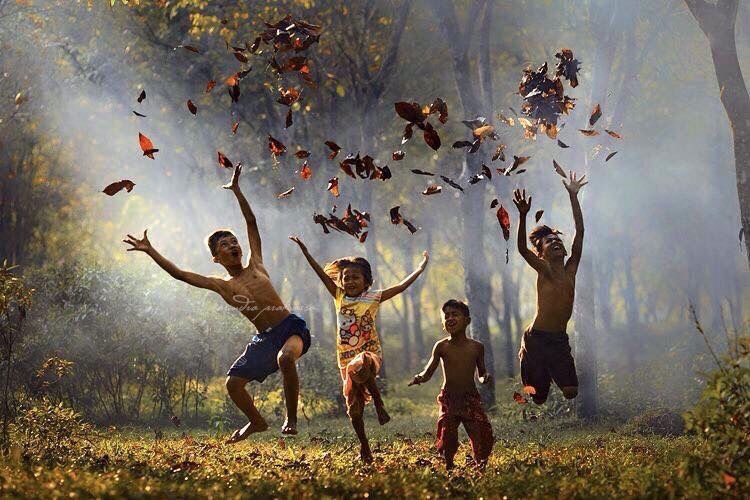
On the occasion of India celebrating every 14th of November as Children’s Day (celebrated on the day of birth of the first Prime Minister of Independent India and one of the great leaders who dearly loved children, Pt. Jawaharlal Nehru ); it would be meaningful if we reflect how our children are faring in the world of today. With the advent of technology, nuclear families, both parents working and the rise of the internet; one often wonders what has happened to the playgrounds, parks and neighbourhood lots where once we used to play in our childhood. Of course, this must be a moot point to ponder with the rise of “modernization, development and smart technology kids”. Though, it leaves room for thought on whether we have lost the genes of physical play (not just the hands or feet) and creative thinking with strategy as well as group interaction. Pretty difficult to decide on it, when all the modern gadgets claim the development of the very same genes.

Remember that children, marriages, and flower gardens reflect the kind of care they get. H. Jackson Brown, Jr.

These days, I often dread to read the entire newspaper in the mornings. With the rising rate of crime and delinquency against the children as well as by the children, it brings to shameful light of the neglect and selfishness that we as adults are engaged in. Besides not caring for the young, sometimes we ourselves indulge in acts causing danger to them. To quote the author Pam Leo,”Children are mirrors, they reflect back to us all we say and do.” Have you ever heard of a lioness killing its’ healthy young in their pride or healthy eaglets being killed by their own ? Are we better than the animals or worse ?

6 “If anyone causes one of these little ones—those who believe in me—to stumble, it would be better for them to have a large millstone hung around their neck and to be drowned in the depths of the sea. 10 “See that you do not despise one of these little ones. For I tell you that their angels in heaven always see the face of my Father in heaven. (Mathew 18:6 and 10, New International Version) One thing for sure, we have lost the sound of a child’s laugh as they are too caught up in the web of modernized theoretical learning, violence, fear and technology. If we become too late to change this, we are facing with the coming of the dark ages of carbon clones, monotonous, violence with production lines of robotic and mechanical output boxes instead of bright, creative or artistic minds with gentle hearts.

“There are only two lasting bequests we can hope to give our children. One is roots; the other, wings. Hodding Carter”

Practical learning starts in the family and community where children learn the basics of humaneness, love, respect, harmony and kindness. As they venture into the portals of education they learn the principles and mechanics of nature, science, art as well as history. While these aspects are important all the same, care should be taken that character is built with love, respect and mutual acceptance as well understanding of humanity. In the process of gaining an education, the ethos of life should not be lost or buried under purely selfish interests. Remember the era of the dinosaurs versus the mammals.

The greatest legacy one can pass on to one’s children and grandchildren is not money or other material things accumulated in one’s life, but rather a legacy of character and faith. Billy Graham

So while we watch the next generation growing up, whether we be foster or birth parents, guardians, educators, aunts, uncles, singles or couples; make the difference through families, neighbourhoods as well as communities. No matter how small the attention and care may be for us, for the child it is a big matter. For trees never become big, tall, provide shade or bear fruit unless we understand what they need and take due care of them. For the children learn from us, just by watching us, leave alone words and lectures. For, “Each day of our lives we make deposits in the memory banks of our children. Charles R. Swindoll” With that, lets hope we as adults change so that our children grow to leave a beautiful legacy for the distant years, though only time shall know.

Posted in Family and Society, Photography Art, Reflections, Stories Around the World

Simply Fruit

“Hello. Welcome to the Portokalos family and welcome the-the Miller family. I-I was thinking last night, um, the night before my-my daughter was gonna marry, uh, I-an Miller, that, um, you know, the root of the word Miller is a Greek word. Miller come from the Greek word “milo”, which is mean apple, there you go. As many of you know, our name Portokalos is come from the Greek word “portolakli”, which means orange. So, okay, here tonight we have, uh, apple and orange… we all different, but, in the end, we all fruit,” said Gus Portokalos at his daughter Toula’s wedding reception.

In case if the reader is wondering the context and origin of these lines, they are from the romantic comedy film of My Big Fat Greek Wedding (2002). The movie is centered on Fotoula “Toula” Portokalos, a Greek-American woman who in the middle of early mid-life crisis finally falls in love with Ian, an upper middle class White Anglo-Saxon Protestant American or simply put, a non-Greek American. Born into a an orthodox Greek family, Toula examines her relationship with family, with their cultural heritage and value system. Finally all ends well as the wedding takes with mutual appreciation of each others culture, tradition and customs.

Yet among the variety of funny dialogues, the words of Gus Portokalos resonate in the mind. Even though the speech is simple, the implicit message conveyed boils down to the fact that although we all are different, we eventually end up in the fruit basket. This truth is not confined to Greeks alone but is pertinent across all societies around the world. Similar situations have been encountered in different places not necessarily weddings, even the market places, work or on the daily commute. Fruit in whichever shape or size, chopped or as whole, garnished or plain or by whatever name or colour ultimately belongs to the big family of “fruit”.

Putting this subtle yet profound realization into practice in our day-to-day interactions would bridge the discriminatory attitude towards the people we meet across the different walks of our life. While we may not agree with some of them, absolute disdain and disrespect of others based on physical or traditional characteristics would narrow the rich exposure of the flavours of life.

In fact, unknowingly our words and actions mirror our personality as well as the traditions and culture that we belong to. By pointing one finger at others, we fail to grasp that at least three of the remaining three fingers are directed back towards us. And if anyone directs their hand at others, know that the same hand is attached to our body which throws back a picture about the culture and upbringing of the person. So instead of wasting away precious time and energy over irrelevant and minor details, isn’t it easier to keep matters simple and enjoy the basket of fruit ?