Posted in Christian, poetry, Stories Around the World

On Christmas Eve

“… and asked, “Where is the one who has been born king of the Jews? We saw his star when it rose and have come to worship him.” “(Mathew 2:2)

As written in the Gospel of Matthew, a mysterious star had appeared over the place where Christ was born in Bethlehem on the first Christmas, there by leading the wise men (the Magi) to find the baby Jesus and visit him. While many have debated about what the Star of Bethlehem really was; some believing it to be a fable or a North Star, planets, comets and the like. Also some astronomers believe that evidence proves it to be a “nova star” originating at that time and at that point. Either way, the star proves as a guiding light not only to find the baby Christ but also as a reminder that His Birth will bring us light in the gloomy depths of the World. As said in the scriptures, “I am the light of the world. Whoever follows me will never walk in darkness, but will have the light of life.” (John 8:12).

On Christmas Eve as we remember, narrate and read about the birth of the Lord, knowing that God’s gift has to be lived and shared will help us live the gift of Life as well as the blessings He has bestowed on us.

“God’s Gift” by Fyodor Dostoevsky

An angel-child on Christmas Eve
Did God send to the world.
“As you walk among the pines,”
He said and then he smiled,
“Do cut a tree and, in my name,
Do give it to the kindest
And the sweetest child on earth.”
The angel-child was puzzled deep:
“Whom shall I give it to?
How shall I know which of the babes
Has earned the prize of our Lord’s grace?”
“You’ll know,” was all God said,
And the Heavenly Host did part.
The moon stood high and lit the road
That led into the city.
The air was full of happy song,
Joy awaited every child…
So with the tree upon his back
The cheerful angel boldly strode.
Now, take a look in every window:
What cheer in every room!
Christmas trees all burning bright
As they do on Yuletide night.
The angel now began to rush
And made his way from home to home,
So as to find that special one
Who would receive God’s gift.
And everywhere he looked, he saw
Such fine and mindful girls and boys.
But each, on seeing the Christmas tree,
Forgot their manners and their poise.
Some said, “That tree’s for me!”
Some answered, shameless as could be:
“You aren’t worth half a tree,
I’m better than you, you see!”
“Oh, no, I say, that is my tree
You are not half as good as me!”
The angel listened quietly
And looked upon them sadly.
Every one was full of boasts
And each did praise himself the most.
Their eyes did squint with envy,
Their gazes — black with fear.
The angel ran onto the street,
And heaved a sigh, “Oh, Lord, my dear!
Do tell me which of them deserves
Your kind and precious gift!”
Then on the street our angel met
A tiny boy, at best knee-high.
He stared right at that green pine tree
His face did glow and shine.
“A tree, a tree!” he clapped his hands,
“Oh, what a shame I don’t deserve
This gift — it’s not for me…
But won’t you take it to my sis,
Who lies at home in bed so sick?
It would make her happy! Yes!
No one deserves it more than she!
She earned it with the tears she shed!”
The boy then poked the angel-child
And the angel-child did smile
And gave the boy that Christmas tree.
And then, as if by miracle,
The stars fell from the sky,
And sparkling like green emeralds
They encircled that Christmas pine.
It shimmered, twinkled, winked and gleamed,
For it wore the mark of grace Divine
That little boy stood struck amazed
And trembled in his rapture…
The angel witnessed that boy’s love
And tears streamed down his face.
And the angel brought to God that news
That was the greatest grace.

(Translated/adapted by John Freedman)

Posted in Christian, Family and Society, Stories Around the World

Countdown to Christmas

“It’s beginning to look a lot like Christmas;
Soon the bells will start,
And the thing that will make them ring
Is the carol that you sing
Right within your heart.” ~ Meredith Willson, “It’s Beginning To Look A Lot Like Christmas”

With carols in the air and knitted stockings labelled and hung up, the countdown to Christmas begins. Tuning to the “Nine Lessons and Carols” which tells of the birth of Christ and the carol stories; carols have been an early accepted part of Christmas celebrations.


Derived from Old French “carole”, the word Carol actually means dance or a song of praise and joy. Although carols used to be written and sung during yer round, only the tradition of singing them at Christmas has really survived. During the early years of Christianity, the songs of the pagan solstice celebrations for Christmas were reworded with songs from the Bible. As time progressed and vernacular language of carols along with plays had set, carols gained wide popularity during the Christmas season. These days carols have become an essential part and parcel of Christmastime and a major time for meeting, singing, rejoicing, praising and celebrating.

While we busy ourselves with the songs and plays, decorating homes and trees, shopping spree, sending the express parcels and orders and wrapping presents; bringing everyone including family, friends, colleagues, acquaintances and communities together is what gives the season its’ real meaning. To quote Harlan Miller, “I wish we could put up some of the Christmas spirit in jars and open a jar of it every month.”


Posted in Christian, Daily, Stories Around the World

Colours to White Christmas

“I’m dreaming of a white Christmas,
Just like the ones I used to know,
Where the tree tops glisten
And children listen
To hear sleigh bells in the snow.” ~ Irving Berlin

Christmas brings forth its’ own hue of colours with each colour bringing its own significance. Ranging from prosperity and year round presence of “green” to “red” which depicts the fall of Adam, blood of Christ or Santa’s coming; these two form the predominant hues of the season. Other major colours include blue denoting the sky and heaven, purple for the altar and the coming of the light and presence of sun in cold months of winter as denoted by the colour “gold”. Yet the most evasive of all is the pristine colour of white, which represents purity, spotless, goodness and peace; akin to the birth of the Lord.

Trending through the Christmas cards, pictures, stories and carols is the scene of “White Christmas”. While this is the case of the wintry lands, the rest of the world may see a little to hardly any snow. Yet the dream of White Christmas lurks for many reasons ranging from beauty, artistry to the pristine pureness of Christmas. For those of us who can’t experience the snow; the closest we can get to “White Christmas” is by engaging in the spirit of love, sharing, kindness and generosity. Whichever colour it may be, Christmas season is here for all.


Posted in Christian, Daily, Stories Around the World

Christmas and Oranges

For those of us who are involved in Christmas-time festive, the link between oranges and Christmas will perplex unless we have heard the story connecting them. In fact for “Christmas historians”, oranges originated with St. Nicholas, stockings and gold.

The legend is traced to (and the most popular explanation) St. Nicholas, an early Christian bishop of the ancient Greek city of Myra during the time of the Roman Empire who was a wealthy man and spent his life helping others. According to the legend, he had learnt of a poor shopkeeper who couldn’t afford wedding dowries for his three daughters. As the father was reluctant to accept any gifts, in order to help the family, St. Nicholas went to the town at night and tossed three sacks of gold through the window (or down the chimney as some narrate). The gold had landed in the girls’ stockings, which were drying by the fire. In the morning by the time the family had woken up, the gold had condensed into balls in the toes of the stockings.

Following St. Nicholas’ example, oranges were given and shared at Christmas time, as representations of gold and a way to celebrate generosity and caring for those in need.

Others reasons for handing oranges at Christmas can be traced to the fact there were once considered as luxurious items and scarce commodities; hence considered as rare treats when received. During the Great Depression and the wars, oranges were rarity in the markets and homes.

Another theory behind the tradition is that orange segments signify the ability to share what one has with others, symbolizing “the season of giving” of December. Reminding us of the taste of summer, oranges are indeed a “must” gift in the stockings.

“I pretended like all the oranges rolling everywhere were her happy memories and they were looking for a new person to stick to so they didn’t get wasted.” Stephen Kelman

Posted in Christian, Daily, Stories Around the World

Setting Up the Tree

“Freshly cut Christmas trees smelling of stars and snow and pine resin – inhale deeply and fill your soul with wintry night.” John J. Geddes

Interestingly the concept of the using trees to celebrate festivals or major events have been there since the early days of civilization. Before the emergence of Christianity, trees and plants that stood the drought and force of winter, remaining green against the white canvas held a special meaning for the people in the cold winter. Believing that evergreen boughs hung over the doors and windows would keep away evil, ghosts and illness as well as remind one of the spring around the corner, Pagans used branches of it to decorate their homes during the winter solstice. Fir Trees were decorated in the Roman temples at the festival of Saturnalia. Similar practices were followed by Ancient Egyptians and Druids during their pagan festivals.

Although for Christians, the fir tree symbolizes as a sign of everlasting life with God; the initial origins are still doubtful. One of the earliest related stories is traced to Germany based on Saint Boniface. In the year 722 AD, he had encountered some pagans who were about to sacrifice a child at the base of a huge oak tree. To prevent the sacrifice, he had cut down the tree and a Fir tree grew up at the base of the oak. He then spread the message that this lovely evergreen, with its branches pointing to heaven, was a holy tree, the tree of the Christ child, and a symbol of His promise of eternal life.

Another legend from Germany of how the Christmas Tree came into being goes as a reminder of care and love for fellow beings. On a cold Christmas Eve night, a forester and his family were gathered gathered round the fire in their cottage to keep warm. Suddenly there was a knock on the door. When the forester opened the door, he found a ragged poor little boy standing on the door step, lost and alone. The forester welcomed him into his home and the boy was fed, washed and put to bed in the youngest son’s own bed. The next day which was Christmas Morning, the family were woken up by a choir of angels and the poor little boy had turned into Jesus, the Christ Child. The Christ Child went into the front garden of the cottage and broke off a branch of a Fir tree and gave it to the family as a present to say thank you for looking after him. Since then, people have remembered that night by bringing a Christmas Tree into their homes.

The Christmas tree tradition as we now know it in the 16th century when devout Christians brought decorated trees into their homes can be credited to Germans. They had built Christmas pyramids of wood and when wood was scarce, decorated them with evergreens and candles. Yet the popular belief is that Martin Luther, the 16th-century Protestant reformer, had first added lighted candles to a tree. In order to recapture the brilliant view of the twinkling stars amidst the evergreens, for his family; he erected a tree in his main family room and wired its branches with lighted candles. In 1846, the sketch of the then popular royals Queen Victoria and Prince Albert standing with their children around a Christmas tree; had resulted in widened popularity of the Christmas tree and its’ acceptance and appearance in many households. Since then the trend has caught on and stayed.

From Christmas lights to handmade ornaments, apples , nuts, marzipan cookies, Gingerbread men and so on, Christmas trees have been adorned in homes, neighbourhoods and communities. While the traditional fir tree has been replicated where ever possible; Christmas trees range from pine trees, spruce trees or even tall trees in their garden especially in tropical climates. Although the Christmas tree has been vastly popularized commercially or artistically; the true origin and concept still stands the same; adorning our homes, being the evergreen surviving the winter ice and snow.

Posted in Christian, Family and Society, Stories Around the World

String the Holly

Very gay they were with snow and sleigh-bells, holly-boughs, and garlands, below, and Christmas sunshine in the winter sky above. All faces shone, all voices had a cheery ring, and everybody stepped briskly on errands of good-will. ~Louisa May Alcott, “Seamstress,” Work: A Story of Experience, 1873

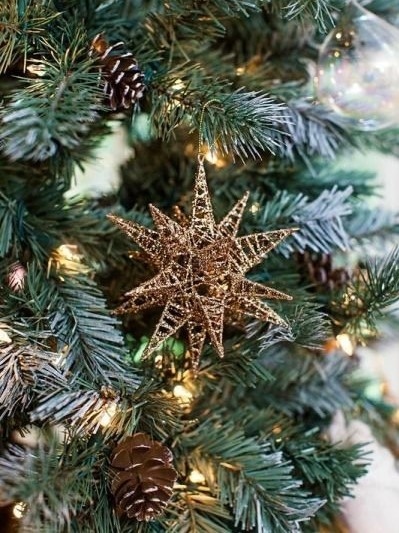
Although December signifies the beginning of Christmas festive; the setting of the holly boughs or wreaths on the door and the Christmas star on the porch signals the start of the season of love, joy and hope. The word ‘wreath’ is derived from the Old English word ‘writhen’ meaning to writhe or twist. The Romans used to hang them on their doors as sign of status or victory, or awarded during events like the Original Olympics held in Greece or worn by women at special occasions like weddings as headdresses. However the Christmas Wreaths of today may have started life as Kissing Boughs.

Before Christmas trees became popular, a more common mode of decoration at homes was “the kissing bough”. Made of five wooden hoops that made the shape like a ball ( four vertical hoops for the ball with one horizontal round the middle) were covered with holly, ivy, rosemary, bay, fir or other evergreen plants. Red apples from strings or red ribbons were hung from inside the hoop, with a candle inside the ball and a large bunch of mistletoe from the bottom of the ball.

Interestingly holly, ivy, mistletoe and the like were used in the pre-Christian era to celebrate the Winter Solstice Festival as well as ward off evil spirits. As Christianity came into Western Europe, Christian meanings were given to the “greenery”.

The prickly leaves of holly represent the crown of thorns f Christ with the red berries symbolized as drops of blood. The clinging nature of ivy to something in order to support itself signifies our need to lean on God for support at all times. In fact, sometimes a piece of ivy tied outside the church is supposed to protect the church from lightening.

Laurel worn as a wreath on the head symbolizes success and victory of God over the Devil. The evergreen of fir as well yew trees symbolize everlasting life . Rosemary also known as remembrance herb was connected with the Virgin Mary and believed to protect one from evil spirits.

Traditionally, the greenery is taken down after the Twelfth Night on Epiphany, to be packed and stored safely for the next year. Yet some homes keep it up till Candle-mas. While these traditions may not be significant for some, putting up these decorations bring a lot of cheer as well as welcoming Christmas time with a warm feeling.

“When the holly’s in the red
And the pine is in the green,
When the mornings all are frosty,
In a brilliant silver sheen
Then I love to go a’ walking
Rambling here and there, quite slow,
Plucking greenery and berries;
Wishing for a Christmas snow”
Rachel Heffington

Posted in Family and Society, Reflections

Gearing for the Holiday Season

Holidays – any holiday – are such a great opportunity to focus on bringing the family together. Lidia Bastianich

Come December, across many countries families come together, friends meet up, work schedules get hectic and team up so as to bring together the close of the year. In some places while the financial year may be of a different time frame, the last month of the year still holds a special place with schools closing for Christmas, offices, workplaces and even hospitals gearing up for some holiday cheer as well as couples, friends and families going to new places to celebrate the end of the year and welcome the next one.

I like to compare the holiday season with the way a child listens to a favorite story. The pleasure is in the familiar way the story begins, the anticipation of familiar turns it takes, the familiar moments of suspense, and the familiar climax and ending.Fred Rogers

One of the challenges of the holiday season is not to get completely lost within the web of pure commercialization with shopping sprees, parties around the clock and the whole gala of the year end. No doubt we need them too, but with the whole family and friends getting free time for the season, submerging ourselves into the consumer aspect alone is a dimming outlook. One of the essential things that we can give others is time. Take out some time this holiday season and spend it with our family and friends. Spend some time with those who we are in irregular contact with. Share your precious time with children, extended family and community so that we create good memories as well as foster our relationships for better.

Thoughts turn to other’s just a little more this time of year. Days grow shorter and memories grow longer. Families and friends gather in celebration or hope. Giving is a reflection of our love and caring for each other and those less fortunate. May your thoughts turn to gratitude this holiday season and carry on throughout the next year. James A. Murphy

For those of us who are always short of time especially during holidays, one of the best ways to free up some time is not to simply organize but prioritize as well as delegate the work. Toddlers running underfoot would love spending some time with the baking batter, cutting up dough for cookies or having fun with glitter art and paints in their play pen. Even teenagers when they opt to stay at home would help especially to make edible art and designs, put their interior designer experimentation into good use or can start on the music lists for the season, provided we encourage them to help and give them an outlet to express their creativity and energy. Getting the whole family involved is no easy feat yet the memories made would light the dark moments in our life. This holiday season, the most precious and priceless thing to spend on would be time and striving to do so would make the holidays worth the store of treasured moments.

“The best and most beautiful things in the world cannot be seen or even touched. They must be felt with the heart. Wishing you happiness.” Helen Keller