Posted in Daily, Food, Stories Around the World

Madeleine for holidays

Entering into the last month of the year, the delight of enjoying the twilight mornings with the warm cup of tea in the bitter chill of the air, would be better with a little of the small crunchy or tiny delights to add to the tea. In fact with holidays round the corner, a regular stock of the ready homemade sweet dry desserts especially cakes, cookies and biscuits would come in handy.

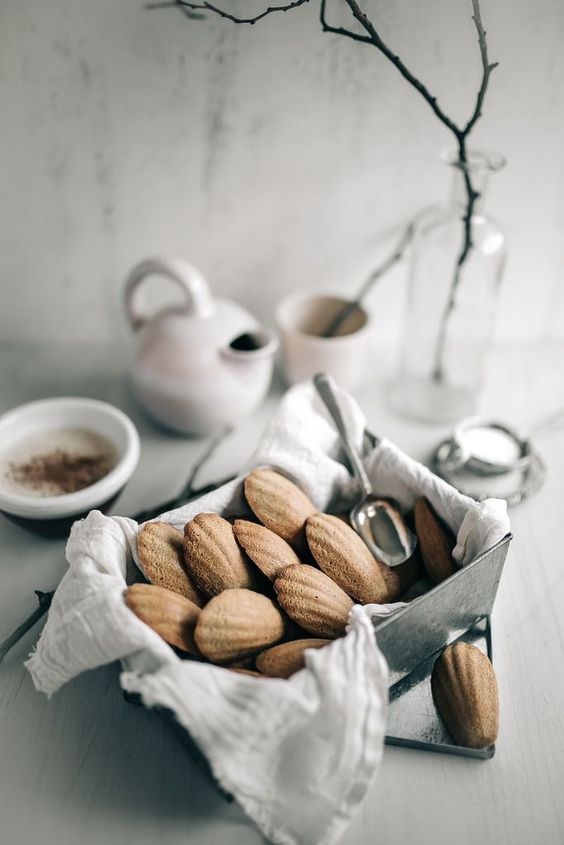
Among them are the treats of small sponge cakes with their distinctive shell-like shape, baked in pans and can be made with the basic ingredients. Known as the madeleine or petite madeleine, these traditional small cakes trace their origins to the Lorraine region in northeastern France. By legend these cakes have been there in the 17th century French cusine, although the increased use of metal moulds (18th century) had led to their increased use. By the end of the 19th century, the madeleine is considered a staple of the diet of the French bourgeoisie.

By etymology, the term madeleine describes “a small cake”. Made from génoise cake batter (with the suspended air in the mixed batter giving the volume to the cake) with traditional recipes adding on finely ground almonds, nuts or lemon zest for their special lemony flavour. In Britain, similar cakes are baked in dariole molds, they are coated in jam, desiccated coconut and topped with glacé cherry.

“On a pound of flour, you need a pound of butter, eight egg whites & yolks, three fourths of a pound of fine sugar, a half glass of water, a little grated lime, or preserved lemon rind minced very finely, orange blossom praliné; knead the whole together, & make little cakes, that you will serve iced with sugar.”
“Cakes à la Madeleine”. Menon, Les soupers de la Cour ou L’art de travailler toutes sortes d’aliments, p.282 (1755)

The madeleine has been mentioned by the culinary writers during the Napoleonic era, especially in the recipe books of Antonin Carême and Grimod de la Reynière. One record of the first recipe traces to the “cakes à la Madeleine and other small desserts” (1758) of a French retainer of an Irish Jacobite refugee, Lord Southwell. Tracing the roots of “Madeleine”, there are several interesting legends pertaining to the origin of the cake. While one considers the name centered from a female character of Lorraine, probably a chef with the patron being Paul de Gondi (17th century cardinal), owner of a castle in Commercy. Another legend consider the inventor to be Madeleine Paulmier, cook for Stanislaus I, duke of Lorraine and exiled King of Poland (18th century). As the legend goes, Louis XV (son-in-law of the duke) charmed by the little cakes prepared by Madeleine Paulmier (1755), named them after her and Maria Leszczyńska, his wife had introduced them soon afterward to the court in Versailles which soon became a favoured French recipe. Two legends link the cake with the pilgrimage to Compostela (Spain) where Madeleine, a pilgrim is said to have brought back the recipe from her voyage or a cook named Madeleine is said to have offered little cakes in the shape of a shell to the pilgrims passing through Lorraine. While another legend states that Madeleine was the creation from the kitchens of Prince Talleyrand by the pastry chef Jean Avice (19th century) who is said to have baked little cakes in Aspice moulds.

Not just in the kitchen, but Madeleine have made their significant impact in literature with Proust’s “episode of the madeleine” as an instance of involuntary memory in his book In Search of the Lost Time. Similar to the madeleine are the “financiers” or the Malaysian Bahulu. One of the benefits of getting down to making Madeleine for the holidays is the ease in its’ preparation, variability of ingredients as well as the versatility of it being a part of the small and the large holiday get-togethers. As for the simplicity in style, a little of “food art” will make the difference. Adding to the festive spirit, madeleine can indeed spice up the holiday season this year.

Posted in Food, Stories Around the World

Of Milk, Flour and Flavours

With the sweet tooth running pretty strong in the family genes, the question “what’s for dessert?” comes first, even before the table is laid. When the baking comes to a lull, the ever ready alternative comes as long as milk is plenty and available. From the Spanish Arroz Con Leche to the Muhalabieh of the Middle East or malabi (Israeli milk pudding), French Teurgoule, British Blancmange to the Indian Kheer or Persian Firni, there are countless variations and possibilities to the regular recipes of milk based puddings and desserts. Interestingly each dish in this vast list has their own history and legend behind them.

Milk. Rice flour ( of recent cornstarch). Sugar. Rosewater. Vanilla extract. Chopped nuts.

With legendary origins dating to Sassanid Persia (224-651), the milk based pudding Mhallabiyeh ( or Muhalabieh in Middle East, Israeli malabi) has been often made with the basic ingredients of rice, sugar, rice flour and milk. Although in the Middle Ages, muhallebi and blancmange (European counterpart) were made with shredded chicken.

As the legend goes, Muhallebi was first served by a Persian cook (late seventh century) to an Arab general, Al-Muhallab ibn Abi Sufra who had liked the dish and named it after him. Thereby this dish had entered the Arab cuisine. The initial recipes (10th century) were based on three versions of the basic dish: milk thickened with ground rice, milk with rice grains and chicken and an egg custard (without rice). Records from two 13th-century Arab cookbooks (one by al-Baghdadi, another from Andalusia) have recipes of a spiced pudding variation made with mutton instead of chicken. The Ottoman Empire has written records of two versions of muhallebi: a version with shredded chicken (tavuk gögsü) served during the reign of Mehmed the Conqueror and a later recipe(1530) for a meatless version flavored with rose water. Later records give a recipe for muhallebi named as “Ramazan cakes” (19th century English cookbook). This recipe records of boiling milk together with rice flour and sugar until the mixture reduces followed by which the pudding is then flavored with rose or jasmine extract and allowed to cool before it is sprinkled with powdered sugar.

Modern variations of the initial recipe has been seen in the substitution of the rice flour (or addition at times) by cornstarch or wheat starch depending on the thickness, consistency and creaminess required. The Israeli “malabi” is made from cream and milk cooked with corn starch and rose syrup, the latter being used primarily for flavouring. It is often topped with chopped pistachios, desiccated coconut, almond slivers as well as orange water flavorings. On the other hand, the Cyprian mahalebi (or mahalepi or muhallebi) is devoid of milk. Instead it is made from water, sugar, nisete flour ( or cornstarch/corn flour), rose water and when it is set, they add. When the muhallebi is set the Cypriots add rose called triantafyllo (rose squash /cordia/syrup) on top of it.

While making Muhallebi at home, various alternatives and add-ons to the classical recipe may be tried. More elaborate concoctions can be tried, like layering this pudding on a biscuit base for a chewy feel to balance out the sweet milky taste; or modify it as a drink based dessert. No matter what, with the sweetness of the milk (cream added as per preference) to balance out the taste of cereal and additional flavourings with various toppings and garnishes, this dessert will be a well loved addition to the list of no bake desserts.

Posted in Daily, Food, Stories Around the World

Splash of White

“I had some dreams, they were clouds in my coffee.” Carly Simon

For coffee connoisseurs around the globe, knowing the exact coffee-lingo is a must. Following the dictum of “When in Rome, do as the Romans do”, coffee lingo too changes as per place. Be it the espresso macchiato or the Caffè macchiato (not the latte macchiato) or the “café pingado”, all routes lead to another coffee concoction.

Known as espresso macchiato or Caffè macchiato (latter in Italy), it is essentially an espresso coffee drink with a small amount of milk (usually foamed) in it. The origin of this drink could be possibly attributed to the baristas which needed to show their serving waiters the difference between an espresso and the effect to it after a little bit of milk was added to it. The purpose was to just mark or stain the espresso. In Italian, macchiato means “stained” or “spotted” so the literal translation of caffè macchiato is “stained” or “marked coffee.” Moving over to the Portuguese version of this drink where it is renamed as “café pingado” literally translated to coffee with a drop. Although in Mexico, it is called a cortada, the latter terminology mayn’t be used in other countries as it meant for another coffee beverage with a higher amount of milk in it as compared to the macchinato.

“Black as the devil, hot as hell, pure as an angel, sweet as love.” Charles Maurice de Talleyrand

As compared with any other similar coffee drink with milk, the caffè macchiato has the highest ratio of espresso to milk. The key to a perfect macchiato lies in getting the quantities right. As the name suggests, this coffee should contain just a splash of milk, which is added to pure espresso. The traditional macchiato is about one and a quarter ounce that is one ounce of espresso with a small amount (around one to two teaspoons) of milk, the latter is mostly steamed with slight foam so there is a visible mark. The purpose of the milk is to enhance in moderation (rather than being overwhelming), preserving the bold flavour and the taste of the coffee while adding a delicate touch of sweetness (as an alternative to added sugar).

For coffee cognoscente attention to details are required for the preferred coffee. While an average cappuccino has an 1:2 ratio and latte has a 1:3 ratio of espresso to milk, the average size espresso macchiato has a 2:1 ratio. To prepare the drink at home or in a semi-professional barista set-up, a single shot of espresso is poured into a demitasse (a small espresso cup) and then a splash of hot milk is added. Few recipes suggest adding 1–2 teaspoons (approx. 5 to 10 grams) of milk heated to 140 to 150°F (60–66°C). Heating the milk so, would introduce steam into the milk causing the fats to expand and develop a layer of little bubbles like a “micro-foam.” This is most often done using an espresso machine and a steam wand.

For a change, as the autumn showers run by and the cold wintry winds approaching soon, the scent and flavours of coffee maybe enjoyed the “macchiato” way. As any javaphile would agree, those little beans can liven up the day at any hour or moment of time.

“To espresso or to latte, that is the question…whether ’tis tastier on the palate to choose white mocha over plain…or to take a cup to go. Or a mug to stay, or extra cream, or have nothing, and by opposing the endless choice, end one’s heartache.” Jasper Fforde


Posted in Food, Stories Around the World

Of Kladdkaka and Chocolate

Butter. Eggs. Sugar. Cocoa or chopped dark chocolate. Vanilla sugar. Flour. Pinch of Salt.
Minimum Baking Time.

While prepping a sudden luncheon meet for old friends, the dessert dish had to be something different, for we three ladies were all dessert connoisseurs. Hunting down for quick cake recipes, had led to the Swedish Kladdkaka, a gooey choclate cake that requires the very basic ingredients and minimum preparatory as well as baking time. This venture had led to the revelation of interesting tidbits and details of this favoured Swedish delight.

Kladdkaka, literally translated as gooey or messy cake (more commonly known as “chocolate mud cake” is a dense sticky chocolate cake with a soft and gooey center, often served with whipped cream or vanilla ice cream and raspberries. Widely believed to be one of the best cakes for chocoholics, there are many variations to the standard recipe for this delight. One of the major reason for it’s gooey nature (quite different from brownies and other regular sugar cookies) is the absence of baking soda in this preparation. With just mild whisking, the absence of air bubble results in the stickiness.

While tracing the exact origin of this cake didn’t lead to any specific occasion or person, it is believed to have been inspired by the brownie or the French chocolate cake recipe; with its’ origin being at a time when baking soda wasn’t routinely available (probably around World War II). Another theory was that Kladdkaka came from Örebro where Gudrun Isaksson (1938) baked brownies from a recipe she received from the USA. As baking powder was difficult to get hold of then, the dough became liquid resulting in the chocolate mud cake. Alternatively it was believed that this cake came to Sweden via the editor-in-chief of the Veckojournalen (1968), Margareta Wickbom who had visited a cafe in Paris where she tasted chocolate cake and brought home the recipe. It was known as “Elake old man’s muffins” then, believed to be made first in muffin form.

Regardless of the roots, with the simplicity of the recipe, ingredients and quick baking time, it makes for a welcome change for the quick but elaborate dessert. Variations are there with coffee added to the regular flavour or making the cake on block chocolate to give a whitish texture to it, adding fruits or nuts as well as making the batter more lighter or luxurious or give it a flour-less twist. So for the kitchen experimenters or home chefs, dessertarian and chocoholics, here is another recipe and delight to add to the ever growing list.

“This cake is one of those cakes I take for granted somehow. I love it so much but I rarely bake it. Before I started baking like crazy, about 5 years ago, I used to bake two times a year, tops. Two times a year, that’s it. And when I did, it was always “kladdkaka” (roughly translated “sticky cake” or “gooey cake” but I’ll just call it Swedish chocolate cake). Why kladdkaka then? Well, first of all, it was the only recipe I knew how to make. Second, it’s probably the easiest thing you could possibly make, and it’s just so darn delicious. You simply have to make this one! And don’t forget to serve it with whipped cream (vanilla ice cream is ok as well)!”
Linda Lomelino, Call Me Cupcake

(Sources: http://kladdkakerecept.blogspot.com/, https://culturedarm.com/a-swedish-kladdkaka-recipe/)

Posted in Daily, Food, Stories Around the World

Yorkshire, Pudding and a Twist

Flour. Eggs. Milk.

On one quiet Sunday afternoon, these four staple ingredients in the pantry brought out the urge to try something different for the Sunday dinner. As the option of sweet or savoury were being considered, the experimentation ran into attempts at making Yorkshire pudding.

One of the most favoured English dishes, Yorkshire pudding is a baked pudding which can be served in numerous ways. From being a main course dish served with meat and gravy or filled with banger and mash or made into dessert with fillings of chocolate, the options keep on changing depending on the choice of ingredients, the size of the pudding, and the accompanying components of the dish.

“Make a good batter as for pancakes; put in a hot toss-pan over the fire with a bit of butter to fry the bottom a little then put the pan and butter under a shoulder of mutton, instead of a dripping pan, keeping frequently shaking it by the handle and it will be light and savoury, and fit to take up when your mutton is enough; then turn it in a dish and serve it hot.
– A recipe for “a dripping pudding” as published in the book “The Whole Duty of a Woman” by Lady A; Kenrick, William (1737).

While the exact origins of this dish aren’t traced to any particular era, the recipe in records was seen in the sixteenth century. Originally this dish was believed to be served as first course to dull the appetite for the main meat and vegetables served as the second course. In poorer households, the pudding was often served as the only course. As to the name “Yorkshire”, the probability lies in the crispier batter of the pudding in this region, made so by the higher temperatures produced by the coal.

One of the reasons of its’ popularity lies in the ease of cooking. By pouring the batter made from milk (or water), flour and eggs ( basic ratio of 1/3rd cup flour and 1/3rd liquid per egg), into preheated, oiled, baking pans, ramekins or muffin tins (in the case of miniature puddings), they can be made steamed, in the pan or ovens. A steamed recipe involves covering the pudding with grease proof paper to steam it and then serve with jam and butter (1926).

“It is an exceeding good pudding, the gravy of the meat eats well with it,” states Glasse. “…. To set your stew-pan on it under your meat, and let the dripping drop on the pudding and the heat of the fire come to it, to make it of a fine brown.” (recipe as recorded in The Art of Cookery Made Plain and Easy by Hannah Glasse (1747)).

The versatility of the Yorkshire pudding can be felt across the various cuisines. With Laplanders (also known as popovers) of the American cuisine, these are light rolls made from an egg batter similar to that of Yorkshire pudding, typically baked in muffin tins or dedicated popover pans (straight-walled sides rather than angled). Similar dishes ( batter based savoury dishes) include the French gougère (a savoury choux pastry mixed with cheese), Bismarck or Dutch baby pancakes, takoyaki (a Japanese puff batter dumpling with octopus) or the more elaborate dish of “Toad in the Hole”. Traditional variants with local flours like sago, split gram flour, gluten free or palaeo based Yorkshire puddings and the like have been tried. The beauty of experimentation of the different recipes lies in simple adaptation, palatability and above all, bringing a bit of another culture to the table.

Half a pound of flour
1 ounce of butter
2 eggs
Milk to mix
Put the half-pound of flour into a basin and rub in the butter. Make a hollow in the centre of the mixture and break in the egg, beat well adding the milk gradually until all is mixed. Then beat for a further fifteen minutes, when the mixture coats a spoon it is ready. Grease a pudding basin and pour in the mixture, cover with greaseproof paper and steam for one and a half hours. Serve with jam, butter and sugar. [Note, for cooking the water should only come half way up the dish.
Source: Recipes Past and Present. A Wootton Bridge Historical website

Posted in Daily, Food

Of Colours and Flavours, Simple and Sweet

One of the necessities of having a good meal family, besides sitting down together and enjoying home cooking is to close the meal with the “sweet finish”. Preparing the big family luncheon, even though it may be a pot luck dinner at times; getting the final finish right is what makes the meal complete. With a big joint family, dessert includes something sweet for the children, sweet and healthy for the adults, balanced dessert for the diabetics, health conscious and the ultimate dish for the professed dessertarian.

“Dessert is probably the most important stage of the meal, since it will be the last thing your guests remember before they pass out all over the table.” William Powell

Originating from the French word “desservir” ( means to clear the table), dessert as a term was in known use in the 1660s. Although this term may have been in use from the 14th century, the present meaning may have arose around the beginning of the 20th century as the setting a variety of dishes on the table at the same time (service à la françaisee) was replaced with the serving of a meal in courses (service à la russe). As described in A History of Dessert (2013), Krodnl states that dessert was served after the table had been cleared of other dishes. While sweet were a part of the Mesopotamian era, Persian Empire, the Greeks, ancient India and other civilizations; dried fruits and honey were perhaps the first sweeteners used. With the spread of sugar and trade, the modern dessert dishes slowly began taking shape.

“I am starting to think that maybe memories are like this dessert. I eat it, and it becomes a part of me, whether I remember it later or not.” Erica Bauermeister

Contrary to expectations, desserts doesn’t necessary have to be of very high standards or made of expensive ingredients. Neither does it always need to indulged in with the sense of guilt and foreboding. Desserts can be had not just to statisfy the sweet cravings or close a meal, but also to enjoy the right mix of sugar, nutrients and taste at the end of the meal. From cheese board, parfait of berries, nuts and yogurt, cinnamon on ice cream and biscuits or bananas slices and covered in dark chocolate and crushed nuts to the elaborate fairy cakes or mousse; desserts can be had elaborate or whipped out of thin air with basic ingredients, creativity and an artistic eye. At times, desserts need to sticky sweet and loaded with calories for that little bit of sugar high or as basic as fruits with a sprinkling of the sweet stuff. Either way, there is always plenty of variety to choose from.

“There is no better way to bring people together than with desserts.” Gail Simmons

With the colours of autumn slowly setting in, what better way to ring in October than to get the sweet tooth going in a healthy manner. With the National Dessert Month setting in and the fall harvest closing in, it would be easy to stock on the fruit preserves, enlist creative ideas and set a traditional family dessert trend.

Posted in Daily, Food

Add the “Cheese”

Being the lone one in the house, as a result of over time and off hours being allotted accordingly, enough and more time was spent on the ads section and advertisements were marked. Imagine when the leaflet advertising the discounted cheeseburger rates for the whole week ( in lieu of the national cheeseburger day, Sept 18th) were seen. As the hunger cravings rose to a peak by noon, the big lunch was foregone with the craving for cheeseburger. With a sparsely stocked larder and takeaway not an option in the downpour (besides being miles away from the town roads), creative cooking was the only option. Considering the leftovers and the supplies in the fridge, it was time to make something light. What happens when one places two mince meat patties with sliced tomatoes, crisp onion rings with a nice helping of cheese between two bread slices (out of buns). Voila, the homemade version of cheese burger is ready.

“Man who invented the hamburger was smart; man who invented the cheeseburger was a genius.” Matthew McConaughey

Essentially, a cheeseburger is a hamburger topped with cheese. Although the slice of cheese is added to the cooking hamburger patty shortly before serving, which allows the cheese to melt; variations exist depending on choice of having it melted solid or double extra. As for the cheese, from processed to melt-able cheese, options range from cheddar, Swiss, mozzarella, blue Cheese or pepper jack being the popular ones.

With the rise of cattle ranching, fast food chains, commercialization of food industry and rise of fast food; hamburgers had risen in popularity. The late 1920s saw the adding of cheese to hamburgers. Though several competing claims exist as to who created the first cheeseburger. Records repute that Lionel Sternberger (1926) had introduced the cheeseburger at the age of 16 when he was working as a fry cook at his father’s sandwich shop (Pasadena, California) “The Rite Spot” and “experimentally dropped a slab of American cheese on a sizzling hamburger.” Another similar mention of a cheeseburger smothered with chili for 25 cents was listed on the menu of O’ Dell’s restaurant (Los Angeles, 1928). However the trademark for the name “cheeseburger” was awarded to Louis Ballast of the Humpty Dumpty Drive-In in Denver, Colorado.

“You dont have to eat a whole cheeseburger, just take a piece of the cheeseburger.” Guy Fieri

Variations like steamed cheeseburger, soy cheese and vegan versions have been seen across the globe, with the ingredients adapting to the local cuisine and customs. All said and done, the cheese part has stayed on. There’s something fun about indulging in the occasional cheese burger ( homemade, fast food franchise made or deli made) once in a while. No matter how old or busy one is, the delights of the cheeseburger do stay strong.

“I take pleasure in the little things. Double cheeseburgers, those are good, the sky ten minutes before it rains,the moment your laugh turns into a cackle. And I sit here, and smoke my Camel straights, and I ride my own melt.” Ethan Hawke