Posted in Food, Stories Around the World

Biscuits, Crumbs and Milk

With plenty of biscuits left over from the holiday baking safely enclosed in their tins, it was their crumbs which had to be called to an order. After all the holiday cakes and ice-cream, evening desserts had to be something light, easy on the sugar and simple to make. What would be an easier solution for all the crumbs than the good old “biscuit pudding”.

Interestingly biscuit pudding is something that has evolved over time. With the British cuisine evolving the pudding from dumplings, the former had to be either in the meals or dessert category. More steamed than bakes, they were the savoury ones like steak and kidney pudding, haggis, pease pudding and the dessert ones (steamed in a basin and for afters) like the Christmas pudding, sticky toffee pudding and so on. Though essentially centuries on, pudding is more of a dessert than savoury. Dessert puddings like bread and butter pudding, biscuit pudding or simply with fruit.

“The proof of the pudding is in the eating.” Miguel de Cervantes, Spanish author. (1547-1616) ‘Don Quixote de la Mancha’

One of the very basic biscuit pudding recipes that resulted in the first stained smock of preschooler was the Chocolate biscuit pudding. Though claimed to be a Sri-Lankan dessert pudding introduced by the British during the colonial era; it may have been in the kitchens of the west long before then. To make it requires layers of a prepared chocolate pudding or icing mixture alternated in a serving dish with layers of biscuits (plain ones preferred) dipped in warm milk. Served cold (not baking or steaming) with chopped nuts as garnish, cutting through would see five to seven layers of biscuit and chocolate. An easy dish to keep bored children busy on cold days.

The old-fashioned biscuit pudding, usually handed over in the set of family recipes, the basic ingredients would be vanilla, eggs, milk and plenty of leftover biscuits. This moist pudding is usually had cold, garnished with ground cinnamon, raisins, candied fruit and with maple syrup. With fond memories, it puts the cracked biscuits and their crumbs to good use.

Posted in Food, Stories Around the World

From Spaghetti-o-iei’s

The noon drive from work during the last week day entitles picking up the kids from school. Once they are in the car, the ride then on is interspersed with narratives ranging from the classes, to “mom did you know that she/he” to playground falls, teacher praises, peer comments and the like. Among the narratives was their home science classes wherein the primary classes as well as kindergarten were taught about basic stuff like hand-washing, making cookies, tending the garden and sorting the recyclables. With detailed descriptions of how spaghetti was made in class, the three of us had trooped into the ice-cream parlour for the weekend scoop. Imagine to my surprise when the “today’s special” held the title “spaghettieis”. On clarification, the waitress told me that we serve ice cream only and spaghettieies was just noodle ice-cream.

Spaghettieis (German pronunciation: [ʃpaˈɡɛtiˌaɪs]) is a German ice cream dish made to look like a plate of spaghetti.

Created by Dario Fontanella, “spaghettieis” was a dish of vanilla ice cream extruded through a modified Spätzle press or potato ricer, giving it the appearance of spaghetti( late 1960s, Mannheim, Germany). The entire ice-cream spaghetti is then placed over whipped cream and topped with strawberry sauce (to simulate tomato sauce) with coconut flakes, grated almonds, or white chocolate shavings added over it (similar to the Parmesan cheese). Fontanella had served this innovative creation to tearful children and had received the Bloomaulorden, a medal bestowed by the city of Mannheim (2014).

As this innovation makes it’s rounds in popular gelaterias, ice cream parlours as well as special events; various variations have been experimented with. Popular among these simulations include the different flavours of the “ice-cream shaped like spaghetti” with dark chocolate ice cream, nuts, sprinkles, icing sugar and the like. To be a “spaghettiei” dessert, the simulation has to be one of the varied spaghetti versions like Spaghetti Carbonara, Spaghetti Bolognese, Spaghetti cacio e pepe (cheese and pepper) or the Spaghetti alle vongole appearance. With simple “mini-variations” a simple bowl of vanilla ice-cream can be turned into something decadent and delightfully elaborate but exquisite and simple.

Posted in Daily, Family and Society, Personal Musings, Quotes, Reflections

Trails to Track

With the schools staying closed for the first week of the year, holiday mood was still going strong at the home front. As a consequence the family homestead was filled with occasional bouts of uproarious running feet. The holiday favourite of “Hide and Seek” was on, with a twist of the “I Dare” to the caught to avoid being the next seeker. As the seeker was rooting out the “hidden”, the constant lookout for any traces or clues to their whereabouts was on. This game of “Hide and Seek” reminds one a lot of the different trails and marks that each one of us leave behind.

“No memory is ever alone; it’s at the end of a trail of memories, a dozen trails that each have their own associations.” Louis L’Amour

For each one of us, we have our own hidden cache of trails, some pleasant some not so, of memories and instances where one event lead to the next making way for a pleasant change; and then again may a series of unpredictable or nerve-wrecking series of changes which may be still going on. All of us leave traces behind, but whether one chooses to leave those to be of the good kind, or the negative type, is of own choosing. The state of affairs may never be of own choice many a time. The difference always lies in how we respond to them. At the end of the day, the traces we leave behind will always reflect a part of ourselves, maybe in an overt way or a silent subtle manner. Yet whether the feeling of negativism or positivism from those vibes, that feel from the traces we leave behind are ours alone.

“Every person has the power to make others happy.
Some do it simply by entering a room
others by leaving the room.
Some individuals leave trails of gloom;
others, trails of joy.
Some leave trails of hate and bitterness;
others, trails of love and harmony.
Some leave trails of cynicism and pessimism;
others trails of faith and optimism.
Some leave trails of criticism and resignation;
others trails of gratitude and hope.
What kind of trails do you leave?”
— William Arthur Ward

Posted in Family and Society, Life, Random Thoughts, Stories Around the World

Au revoir to Hello

Bidding adieu to the last few hours of the year brings back fond memories as well as interesting traditions followed to welcome the new year. While the last day may be a holiday, for some it is the last few hours of another work day. Yet battling the traffic and rushing to make it to home base for the last few hours is done so as to usher in the next year with family and friends. While some are on a rampage while setting up the traditional new year watch night, attend the night service, host the family gathering, get the first few traditional customs of the new year ready and the like, the option lies in joining the fray or sitting on the sidelines and enjoying the celebrations.

As we usher in the next year, customs both family and country wise may be followed. From the Siberian tradition of diving into a frozen lake while holding a tree trunk to be placed underneath the ice or the Singaporean tradition of releasing wishing spheres into the river, painting front doors red (Chinese), sprinkling salt on the doorstep (Turkey) are just few of the countless traditional new year customs. Each home and family can make their won set of traditions. Be it enjoying a glass of champagne or ice-cream for the children after the night watch service to having fireside games, each of us can make our own tradition to usher in the new year.

“In our perfect ways. In the ways we are beautiful. In the ways we are human. We are here. Happy New Year’s. Let’s make it ours.” Beyoncé

Through all the celebrations, one mustn’t fail to remember that each day is a new year, a chance to do something new, for the better and an opportunity for new chances and attempts. Each new day is an opportunity to make our closest dreams come true. Life always holds a myriad of new beginnings, it is taking them on and changing the circumstances for making oneself better that makes all the difference.

Posted in Food, Stories Around the World

Cookies, Spices and Holidays

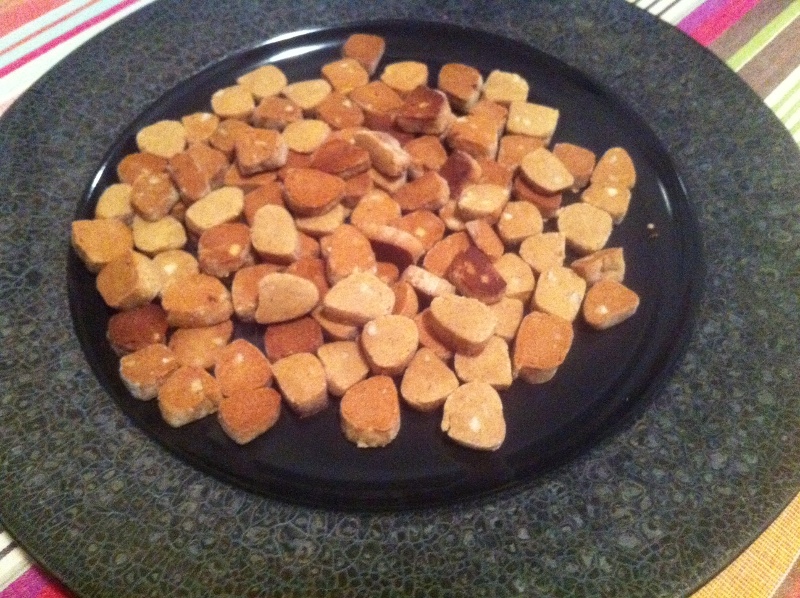
No Christmas or winter holidays would be complete without the tiny peppernuts, cookies baked and stored in tins, kept for the cold nights or after hours of carolling. Made with plenty of assistance, these holiday cookies come by many different names, varying from region to region, with their own legends behind them. These tiny spice cookies are quite popular as holiday treats, known as pepernoten (Dutch), pfeffernuesse or peppernuts (English) or pebernødder in Danish. While the exact origin maybe uncertain, traditional beliefs links these cookies to the Dutch feast of Sinterklaas, where children receive gifts from St. Nicholas. Since 1850, these cookies have been a part and parcel of the European yuletide celebrations.

Flour, brown sugar, sugar, cloves, cinnamon.

Unlike the name “peppernut”, these cookies don’t always contain nuts in its ingredients. The size of the cookie, roughly similar to nuts and can be eaten as a handful, which probably accounts for the name. The ease of making these pfeffernüsse has resulted in a varied range of recipes, with variations made in the used of the amounts of aromatic spices like cinnamon, cloves, mace, nutmeg, cardamom or anise as well as the sweeteners used, ranging from options of powdered sugar, brown sugar, molasses, honey or a fine dusting of icing sugar. To make the dough similar to the early century versions, leavening agents like potassium or ammonium carbonate are used to get the sticky and dense consistency.

Accounting for the regional variations pepernoots are similar Dutch cookie-like confectionery. Certain recipes are similar to the Pfeffernüsse although they look completely different when baked. Other recipes vary in the adding of cardamom, pepper, butter, vinegar, eggs, brown syrup to the usual holiday cookie ingredients of flour (wheat or rye), cinnamon and cloves. Light brown and square shaped, they are fairly chewy and harden gradually when exposed to the air.

“Best of all are the decorations the grandchildren have made ~ fat little stars and rather crooked Santas, shaped out of dough and baked in the oven.” Gladys Taber

In addition to the baking, the customs with these pepernoten (or pepernoots) stay on. From hiding handfuls of them through the room so that children can look for them or hiding pocketfuls of them while caroling or for ice skating breaks. In earlier days, new parents would place one or two carrots underneath the infant’s pillow so that Sinterklaas would then come and bless the child by showering the infant with “pepernoten”.

Modifying these recipes by choice, making them gluten-free or adding the favourite ingredients and toppings gives these holiday cookies a personal touch and flavour. In the midst of all, getting the ingredients kneaded with help of many tiny hands gives these holiday spice cookies a pleasant feel and memories full of warmth and laughter worth treasuring for life.

“Peacekeeper Christmas Spice Cookies 225g butter, softened 200g sugar 235ml molasses 1 egg 2 tbsp. sour cream 750g all-purpose flour 2 tbsp. baking powder 5g baking soda 1 tsp. ground cinnamon 1 tsp. ground ginger pinch salt 145g chopped walnuts 145g golden raisins 145g chopped dates In a large mixing bowl, cream the butter and sugar together. Add the molasses, egg and sour cream; mix well. Combine the flour, baking powder, baking soda, cinnamon, ginger and salt; gradually add to creamed mixture. Stir in walnuts, raisins and dates. Chill for 2 hours or until easy to handle. On a floured surface, roll out dough finely. Cut with a 21/2-inch round cookie cutter. Place on greased baking sheets. Bake at 325°F for 12–15 minutes. Cool completely.”
Jenny Colgan (Christmas at the Cupcake Cafe)

Posted in Food, Photography Art, Stories Around the World

Flavoured, Festive and Wine

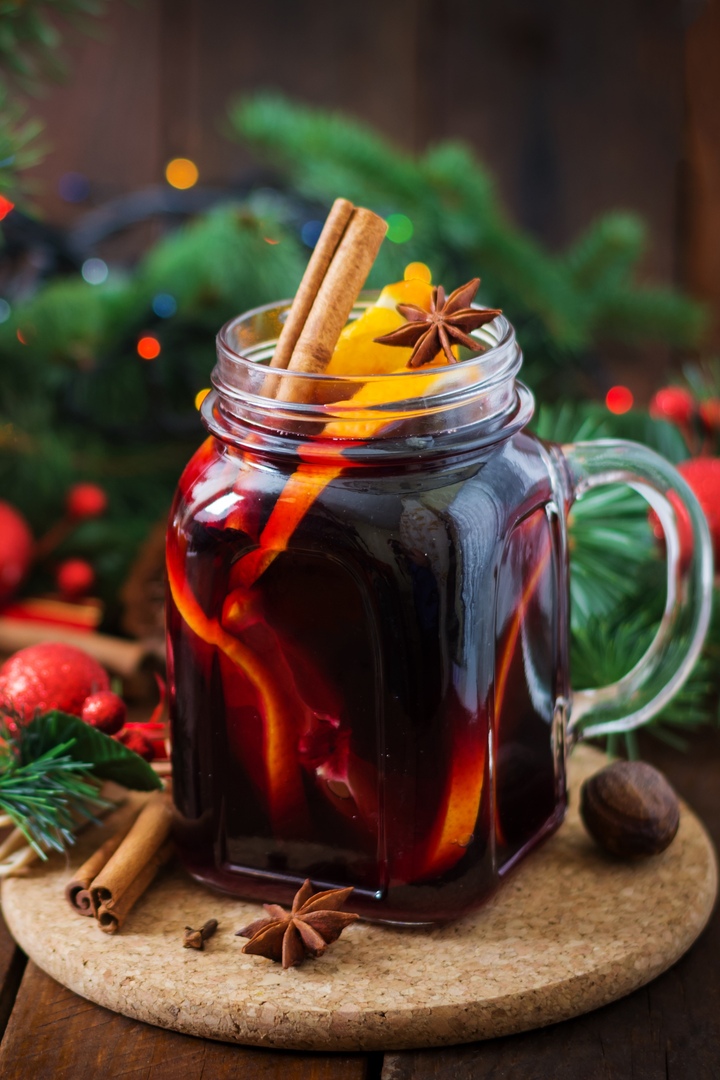
No festive season is complete without the traditional accompaniment of wine. For winter, the entire holidays and Christmas centers around the mulled wine. Traditionally mulled wine, also known as spiced wine, is usually made with red wine along with various mulling spices and sometimes raisins which may be served warm. While most versions are alcoholic, there are many non-alcoholic variations especially for children during Christmas.

Tracing the origins of mulled wine, the second century Roman cuisine saw records of wine being spiced and heated in some areas. Although their era came to an end, certain aspects of the Roman cuisine had been merged with the local cuisine. As wine and viticulture spread along the rest of Europe and till the Scottish border, various variations and traditions with mulled wine entered into the local cuisine and culture. As recorded in the Medieval English cookbook “The forme of Curry” (1390) mentions “Pur fait Ypocras …” (mulled wine) to grind together cinnamon, ginger, galangal, cloves, long pepper, nutmeg, marjoram, cardamom, and grains of paradise (“spykenard de Spayn”, rosemary may be substituted), mix them with red wine and sugar (form and quantity unstated).

Early variations include the concept of mulled wine being transferred to mulled ale, mulled cider or mulled apple juice. Though today recipes for mulled wine include the combination of orange, lemon, cinnamon, nutmeg, fennel seed (or star anise), cloves, cardamom, and ginger. Usually the spices are combined and boiled in a sugar syrup, then red wine is added, heated and served usually in small porcelain glass mugs.

A quick way to make it would be to add a tea bag of spices to red wine, which is heated along slices of orange or lemon. Common variations include the addition of brandy or ginger wine.Served with an orange or lemon slice garnish studded with cloves, cinnamon or star anise; this brings winter Christmas in a mug. Not just confined to wine; mulling spices can be added to beer and cider, as in the preparation of Wassail punch, a recipe since the Victorian Era.

While known as mulled wine in English based cuisine, other varieties are indigenous to the different cuisines with the difference ranging from the type of wine used, method of preparation as well as the spice mix. For instance Glühwein popular in German-speaking countries and Alsace (France) is made from red wine with the addition of vanilla pods to the spices. Glögg, gløgg or glögi, which is mulled wine in the Nordic countries (sometimes spelled as glog or glug) are made wiht stronger spirits like rum, vodka, brandy or just plain fruit juices. Vinho quente served in the Brazil is typically made with red wine, cinnamon sticks and cloves. On the other hand, greyano vino served in Bulgaria is made of red wine, homey and peppercorn.

With the festive and holiday season in full swing, mulled wine essentially brings the warmth of the season in a cup. In fact, it is one of the best seasons to start the traditional family recipe of own. More than the experimentation, it is the memories that get passed on over the years.

TO MULL WINE.
INGREDIENTS.- To every pint of wine allow 1 large cupful of water, sugar and spice to taste.
Mode.-In making preparations like the above, it is very difficult to give the exact proportions of ingredients like sugar and spice, as what quantity might suit one person would be to another quite distasteful. Boil the spice in the water until the flavour is extracted, then add the wine and sugar, and bring the whole to the boiling-point, then serve with strips of crisp dry toast, or with biscuits. The spices usually used for mulled wine are cloves, grated nutmeg, and cinnamon or mace. Any kind of wine may be mulled, but port and claret are those usually selected for the purpose; and the latter requires a very large proportion of sugar. The vessel that the wine is boiled in must be delicately cleaned, and should be kept exclusively for the purpose. Small tin warmers may be purchased for a trifle, which are more suitable than saucepans, as, if the latter are not scrupulously clean; they spoil the wine, by imparting to it a very disagreeable flavour. These warmers should be used for no other purpose.
(Traditional recipe for Mulled Wine. Mrs Beeton’s Book of Household Management. 1869. Revised edition. Pg.929-930 (Paragraph 1961))
Posted in Daily, Life, Quotes, Reflections, Work

The “Nailing” Point

Diz ſagent uns die wîſen, ein nagel behalt ein îſen, ein îſen ein ros, ein ros ein man, ein man ein burc, der ſtrîten kan.
– (c. 1230 Freidank Bescheidenheit)
(Middle High German (positively formulated):”The wise tell us that a nail keeps a shoe, a shoe a horse, a horse a man, a man a castle, that can fight.”)

With a hoard of activities being planned for Christmas, little wonder then that unless prioritization is done, no task will reach their finish point. In hindsight, one realizes that despite the prioritization, necessary things are left undone. Which highlights, what may be necessary mayn’t be important then but pays a heavy price later on.

The trip to the family roots, attending the recital, cheering at the junior league match, quick rush to the doctors’ for the routine physical checks, following the prescribed or set medication, servicing the four wheeler on time, drawing the building plans with an eye on the future possibilities are all just few of the many instances wherein “what is necessary to be done” is foregone for “the mood of that time”, botched up planning or deeming the “necessary as trivial”.

Over time, one goes through many situations wherein the failure to contemplate the various possibilities or correct the then perceived as minor defects, may eventually lead to a more grave sequence of events with appalling outcome. The root problems lies in the indifference to what is the necessity than what is simply the other important task at that point of time. True that availability and possibility for the necessary task may seem slight then, but that balance of scales is always a relative concept. At times, when the fingers are burnt, the consequence will then be felt as terrible and priceless.

“Neglect breeds mischief…” Benjamin Franklin

Hindsight is indeed unsettling, for once these chains of defaults and causalities are tended to, going back to the normal way may be difficult. But as they always say turning to the right path at some point may be better than going on the same, reparative steps have to be taken as soon as the errors have been realized. For a stitch in time o save nine, knowing that the “stitch” is necessary isn’t just enough but getting down and doing it is more important. No matter how small they may seem, it is the simple things that matter quite a bit. And these are the few, but pertinent facts that one discerns as the years mature.

For want of a nail, the shoe was lost,
For want of a shoe, the horse was lost,
For want of a horse, the rider was lost,
For want of a rider, the message was lost,
For want of a message, the battle was lost,
For want of a battle, the war was lost,
For want of a war, the kingdom was lost,
For want of a nail, the world was lost
‘The Want of a Nail”
– T. Rundgren
Warner Chappell N.A., Ltd., 1989
(“Rundgren” Variation)