Posted in Family and Society, Life, Quotes, Reflections

A Child of Today

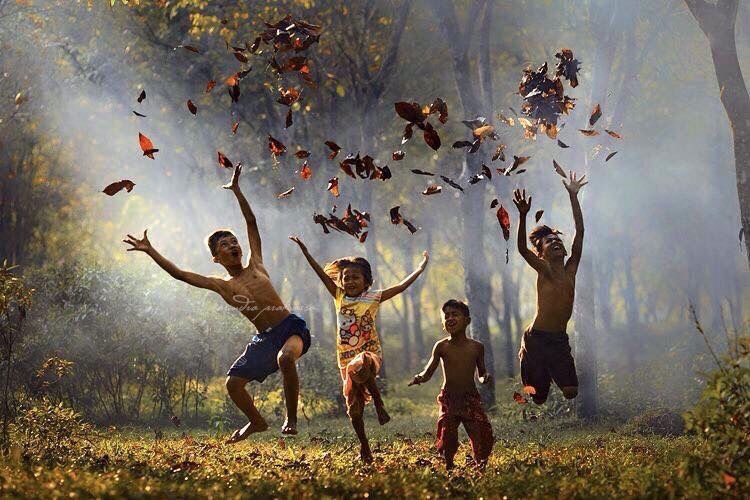
To me there is no picture so beautiful as smiling, bright-eyed, happy children; no music so sweet as their clear and ringing laughter. P. T. Barnum

On the occasion of India celebrating every 14th of November as Children’s Day (celebrated on the day of birth of the first Prime Minister of Independent India and one of the great leaders who dearly loved children, Pt. Jawaharlal Nehru ); it would be meaningful if we reflect how our children are faring in the world of today. With the advent of technology, nuclear families, both parents working and the rise of the internet; one often wonders what has happened to the playgrounds, parks and neighbourhood lots where once we used to play in our childhood. Of course, this must be a moot point to ponder with the rise of “modernization, development and smart technology kids”. Though, it leaves room for thought on whether we have lost the genes of physical play (not just the hands or feet) and creative thinking with strategy as well as group interaction. Pretty difficult to decide on it, when all the modern gadgets claim the development of the very same genes.

Remember that children, marriages, and flower gardens reflect the kind of care they get. H. Jackson Brown, Jr.

These days, I often dread to read the entire newspaper in the mornings. With the rising rate of crime and delinquency against the children as well as by the children, it brings to shameful light of the neglect and selfishness that we as adults are engaged in. Besides not caring for the young, sometimes we ourselves indulge in acts causing danger to them. To quote the author Pam Leo,”Children are mirrors, they reflect back to us all we say and do.” Have you ever heard of a lioness killing its’ healthy young in their pride or healthy eaglets being killed by their own ? Are we better than the animals or worse ?

6 “If anyone causes one of these little ones—those who believe in me—to stumble, it would be better for them to have a large millstone hung around their neck and to be drowned in the depths of the sea. 10 “See that you do not despise one of these little ones. For I tell you that their angels in heaven always see the face of my Father in heaven. (Mathew 18:6 and 10, New International Version) One thing for sure, we have lost the sound of a child’s laugh as they are too caught up in the web of modernized theoretical learning, violence, fear and technology. If we become too late to change this, we are facing with the coming of the dark ages of carbon clones, monotonous, violence with production lines of robotic and mechanical output boxes instead of bright, creative or artistic minds with gentle hearts.

“There are only two lasting bequests we can hope to give our children. One is roots; the other, wings. Hodding Carter”

Practical learning starts in the family and community where children learn the basics of humaneness, love, respect, harmony and kindness. As they venture into the portals of education they learn the principles and mechanics of nature, science, art as well as history. While these aspects are important all the same, care should be taken that character is built with love, respect and mutual acceptance as well understanding of humanity. In the process of gaining an education, the ethos of life should not be lost or buried under purely selfish interests. Remember the era of the dinosaurs versus the mammals.

The greatest legacy one can pass on to one’s children and grandchildren is not money or other material things accumulated in one’s life, but rather a legacy of character and faith. Billy Graham

So while we watch the next generation growing up, whether we be foster or birth parents, guardians, educators, aunts, uncles, singles or couples; make the difference through families, neighbourhoods as well as communities. No matter how small the attention and care may be for us, for the child it is a big matter. For trees never become big, tall, provide shade or bear fruit unless we understand what they need and take due care of them. For the children learn from us, just by watching us, leave alone words and lectures. For, “Each day of our lives we make deposits in the memory banks of our children. Charles R. Swindoll” With that, lets hope we as adults change so that our children grow to leave a beautiful legacy for the distant years, though only time shall know.

Posted in Family and Society, Life, Reflections, Stories Around the World

Trace the Bridges

In forensic sciences there is a principle known as Locard’s exchange principle which states that the perpetrator of a crime will bring something into the crime scene and leave with something from it, and that both can be used as forensic evidence. Although these words written by Locard was, “It is impossible for a criminal to act, especially considering the intensity of a crime, without leaving traces of this presence.”

Nevertheless setting aside crime scenes, what was dwelling in my mind were two words “exchange” and “traces”. Although the principle above may sound simple, what one fails to realize is that our every human interaction and relationship works on exchange and traces. There is an exchange of human emotions, ideas, behaviour, words and actions leaving behind imprints or traces in the near or distant future behaviour or interactions. Along the exchanges, sometimes we end up in having misconceptions, misunderstandings and mistrust, finally leading to innumerable issues. While some issues may be genuine and easily resolvable by a little give and take, others may either be irrevocably knotty or may be there as courtesy of making a mountain out of a molehill. Yet the catch is that we will never know unless we try.

Human relationships are of a very fragile nature. They need a lot of care and fostering to maintain and grow. Even the ones that seem rock solid might falter if the small pebbles strewn in the path aren’t cleared. On the other hand walls and fences are rock solid and never crumble, but they are meant for walling in or isolation. Until we learn to build bridges to keep the flow of exchange of ideas, emotions and interactions, we wouldn’t be able to leave behind traces either. After all life without meaning is purposeless, for what everyone wants among the deepest desire buried in their hearts is to be wanted and loved.  Then on, the rest will follow.

As the story between the two brothers go, everyday we have the choice of building fences or bridges. One leads to isolation and the other to openness. Yet the final decision is ours to make. While we need to know which bridges to cross or which to burn, sometimes we need more than one chance to decide the outcome of whether to cross the bridge or not. Either way the course of action is ours to decide and the sequelae that follows, we ourselves will have to face.

The two brothers

Once upon a time, two brothers who lived on adjoining farms fell into conflict. It was the first serious rift in 40 years of farming side by side, sharing machinery, and trading labour and goods as needed without a hitch. Then the long collaboration fell apart. It began with a small misunderstanding and it grew into a major difference, and finally it exploded into an exchange of bitter words followed by weeks of silence. One morning there was a knock on John’s door. He opened it to find a man with a carpenter’s toolbox. “I’m looking for a few days work,” he said. “Perhaps you would have a few small jobs here and there. Could I help you?” “Yes,” said the older brother. “I do have a job for you. Look across the creek at that farm. That’s my neighbour. In fact, it’s my younger brother. Last week there was a meadow between us and he took his bulldozer to the river levee and now there is a creek between us. Well, he may have done this to spite me, but I’ll go him one better. See that pile of lumber curing by the barn? I want you to build me a fence – an 8-foot fence – so I won’t need to see his place anymore. Cool him down anyhow.” The carpenter said, “I think I understand the situation. Show me the nails and the post hole digger and I’ll be able to do a job that pleases you.”

The older brother had to go to town for supplies, so he helped the carpenter get the materials ready and then he was off for the day.
The carpenter worked hard all that day measuring, sawing, and nailing. About sunset when the farmer returned, the carpenter had just finished his job. The farmer’s eyes opened wide, his jaw dropped. There was no fence there at all. It was a bridge – a bridge stretching from one side of the creek to the other! A fine piece of work – handrails and all – and the neighbour, his younger brother, was coming across, his hand outstretched. “You are quite a fellow to build this bridge after all I’ve said and done.” The two brothers stood at each end of the bridge, and then they met in the middle, taking each other’s hand. They turned to see the carpenter hoist his toolbox on his shoulder. “No, wait! Stay a few days. I’ve a lot of other projects for you,” said the older brother. “I’d love to stay on,” the carpenter said, ” but I have many more bridges to build.”

Everyday we have the choice of building fences or bridges. One leads to isolation and the other to openness.

Posted in Family and Society, Life, Reflections, Stories Around the World

Choose the Shades

With the advent of technology, there is a whole world of information out there. Along with it comes a slew of ideas, thoughts and opinions for the various events we find ourselves surrounded by. Consequently there is always a tussle between what is true or correct and what is wrong or falsified. Unfortunately not everything is in black or white, there are shades of gray that are far too many to differentiate. It becomes quite difficult to decide on the final course of action or words to reach an outcome.

Many claim on bringing the truth to light. Yet the truth can be tinged by the shades of relativity, haziness to opaqueness, lack or inaccessibility of information, communication deficits and sometimes varies as per one’s perspective. So how to discern the right and the wrong ? That’s when we remove the filters in our mind and look at the bare bones of basic facts.

Then we can imagine a blank page and then try drawing on it. With our senses finely attuned and instincts honed in, we can get the picture as long as all preconceived notions and perceptions are thrown out of mind. For besides misinterpretation, the latter clouds our individual thinking and judgement. Instead we lean on our strong sense of morality, honour and humanness to highlight the right colours to blend in as we draw the lines or curves. In such a scenario, the picture we draw would make us feel satisfied.

As an old Indian folklore goes, every blind man had felt the elephant but in parts, for none of them could step back and see the bigger picture. In real life, there may be situations where we have to decide an outcome or relay information, which would consequently lead to a chain of events which can be disastrous for some while positive for others. Then instead of clouding our minds with what we know, it’s easier to take a fresh page, write in the lines and then put in all the facts and knowledge that we have gleaned through our travels of life. For then even though perspectives may vary, the decisions will be based in a complete context on hard facts, certainty and true events not on speculation, hearsay or filtered imaginations. What’s good for one may be bad for others, but in the long run if both benefit then it is worth the change.

The Blind Men and The Elephant

A long time ago in the valley of the Brahmaputra River in India there lived six men who were much inclined to boast of their wit and lore. Though they were no longer young and had all been blind since birth, they would compete with each other to see who could tell the tallest story. One day, however, they fell to arguing. The object of their dispute was the elephant. Now, since each was blind, none had ever seen that mighty beast of whom so many tales are told. So, to satisfy their minds and settle the dispute, they decided to go and seek out an elephant. Having hired a young guide, Dookiram by name, they set out early one morning in single file along the forest track, each placing his hands on the back of the man in front. It was not long before they came to a forest clearing where a huge bull elephant, quite tame, was standing contemplating his menu for the day.
The six blind men became quite excited; at last they would satisfy their minds. Thus it was that the men took turns to investigate the elephant’s shape and form.

As all six men were blind, neither of them could see the whole elephant and approached the elephant from different directions. After encountering the elephant, each man proclaimed in turn:
“O my brothers,” the first man at once cried out, “it is as sure as I am wise that this elephant is like a great mud wall baked hard in the sun.”
“Now, my brothers,” the second man exclaimed with a cry of dawning recognition, “I can tell you what shape this elephant is – he is exactly like a spear.”
The others smiled in disbelief.
“Why, dear brothers, do you not see,” said the third man, “this elephant is very much like a rope,” he shouted.
“Ha, I thought as much,” the fourth man declared excitedly, “this elephant much resembles a serpent.”
The others snorted their contempt.
“Good gracious, brothers,” the fifth man called out, “even a blind man can see what shape the elephant resembles most. Why he’s mightily like a fan.”
At last, it was the turn of the sixth old fellow and he proclaimed, “This sturdy pillar, brothers, mine, feels exactly like the trunk of a great areca palm tree.”
Of course, no one believed him.

Their curiosity satisfied, they all linked hands and followed the guide, Dookiram, back to the village. Once there, seated beneath a waving palm, the six blind men began disputing loud and long. Each now had his own opinion, firmly based on his own experience, of what an elephant is really like. For after all, each had felt the elephant for himself and knew that he was right!And so indeed he was. For depending on how the elephant is seen, each blind man was partly right, though all were in the wrong.

Posted in Family and Society, Photography Art, Reflections, Stories Around the World

Simply Fruit

“Hello. Welcome to the Portokalos family and welcome the-the Miller family. I-I was thinking last night, um, the night before my-my daughter was gonna marry, uh, I-an Miller, that, um, you know, the root of the word Miller is a Greek word. Miller come from the Greek word “milo”, which is mean apple, there you go. As many of you know, our name Portokalos is come from the Greek word “portolakli”, which means orange. So, okay, here tonight we have, uh, apple and orange… we all different, but, in the end, we all fruit,” said Gus Portokalos at his daughter Toula’s wedding reception.

In case if the reader is wondering the context and origin of these lines, they are from the romantic comedy film of My Big Fat Greek Wedding (2002). The movie is centered on Fotoula “Toula” Portokalos, a Greek-American woman who in the middle of early mid-life crisis finally falls in love with Ian, an upper middle class White Anglo-Saxon Protestant American or simply put, a non-Greek American. Born into a an orthodox Greek family, Toula examines her relationship with family, with their cultural heritage and value system. Finally all ends well as the wedding takes with mutual appreciation of each others culture, tradition and customs.

Yet among the variety of funny dialogues, the words of Gus Portokalos resonate in the mind. Even though the speech is simple, the implicit message conveyed boils down to the fact that although we all are different, we eventually end up in the fruit basket. This truth is not confined to Greeks alone but is pertinent across all societies around the world. Similar situations have been encountered in different places not necessarily weddings, even the market places, work or on the daily commute. Fruit in whichever shape or size, chopped or as whole, garnished or plain or by whatever name or colour ultimately belongs to the big family of “fruit”.

Putting this subtle yet profound realization into practice in our day-to-day interactions would bridge the discriminatory attitude towards the people we meet across the different walks of our life. While we may not agree with some of them, absolute disdain and disrespect of others based on physical or traditional characteristics would narrow the rich exposure of the flavours of life.

In fact, unknowingly our words and actions mirror our personality as well as the traditions and culture that we belong to. By pointing one finger at others, we fail to grasp that at least three of the remaining three fingers are directed back towards us. And if anyone directs their hand at others, know that the same hand is attached to our body which throws back a picture about the culture and upbringing of the person. So instead of wasting away precious time and energy over irrelevant and minor details, isn’t it easier to keep matters simple and enjoy the basket of fruit ?

Posted in Daily, Family and Society, Photography Art, poetry

Who You Are

As I was watching the preschoolers laugh and joyously enter the gates of their daycare, what passed through my mind was how much will change for them through the years. On a retrospective view, we had started off the years of toddler-hood with all innocence and a joyous outlook. As the years go by, we learn of names, colours, sizes and preferences. When the teenage years come, it becomes to more of a personal struggle to find ourselves. Sometimes we get lucky and find our settings and tuning by youth. Yet there are days when we still lose our bearings and need a little soul searching to get back on track. Whereas, some of us will need more years to wander to get the right track. When we heed to too many directions, we get confused and discover that we have lost ourselves on the way. Instead of running in circles and loops, to break free is the only way out. The truth is deep inside we know who we are, we only need to listen to it more to find and define ourselves back. Else the eternal doubt of “Who are you…” will always linger in mind, heart and soul.

Not by Erin Hanson

You are not your age,
Nor the size of clothes you wear,
You are not a weight,
Or the colour of your hair.
You are not your name,
Or the dimples in your cheeks,
You are all the books you read,
And all the words you speak,
You are your croaky morning voice,
And the smiles you try to hide,
You’re the sweetness in your laughter,
And every tear you’ve cried,
You’re the songs you sing so loudly,
When you know you’re all alone,
You’re the places that you’ve been to,
And the one that you call home,
You’re the things that you believe in,
And the people that you love,
You’re the photos in your bedroom,
And the future you dream of,
You’re made of so much beauty,
But it seems that you forgot,
When you decided that you were defined,
By all the things you’re not.

Posted in Family and Society, Personal Musings, Photography Art, Stories Around the World

Being Humane

Empathy not simply sympathy. Insight not being obtuse. Warmth not just words.

I truly believe that everything that we do and everyone that we meet is put in our path for a purpose. There are no accidents; we’re all teachers – if we’re willing to pay attention to the lessons we learn, trust our positive instincts and not be afraid to take risks or wait for some miracle to come knocking at our door. Marla Gibbs

Some of the greatest lessons that we can learn is by observing human interaction. In such a scenario, childhood is where we can be keen witnesses where the innocence, kindness and attitude of children haven’t yet been gate-crashed by the chaos of the world that we as adults have created. Although now in the present world, even their guilelessness has not been spared. Yet there are instances where children have shown us the resilience of the human nature especially when when they meet their own peers who are not to their same level. One real life evidence of this is in “Perfection at the Plate” where “everyone can play” , written by Rabbi Paysach Krohn, a popular lecturer and best-selling author of the ArtScroll Maggid series of short stories. Do read on.


Perfection at the Plate

In Brooklyn, New York, Chush is a school that caters to learning-disabled children. Some children remain in Chush for their entire school careers, while others can be mainstreamed into conventional yeshivos and Bais Yaakovs. There are a few children who attend Chush for most of the week and go to a regular school on Sundays. At a Chush fund-raising dinner, the father of a Chush child delivered a speech that would never be forgotten by all who attended. After extolling the school and its dedicated staff, he cried out, “Where is the perfection in my son Shaya? Everything that Hashem does is done with perfection. But my child cannot understand things as other children do. My child cannot remember facts and figures as other children do. Where is Hashem’s perfection?” The audience was shocked by the question, pained by the father’s anguish and stilled by his piercing query. “I believe,” the father answered, “that when Hashem brings a child like this into the world, the perfection that He seeks is in the way people react to this child.” He then told the following story about his son Shaya.

Shaya attends Chush throughout the week and Yeshivah Darchei Torah in Far Rockaway on Sundays. One Sunday afternoon, Shaya and his father came to Darchei Torah as his classmates were playing baseball. The game was in progress and as Shaya and his father made their way towards the ball field, Shaya said, “Do you think you could get me into the game?”

Shaya’s father knew his son was not at all athletic, and that most boys would not want him on their team. But Shaya’s father understood that if his son was chosen in, it would give him a comfortable sense of belonging. Shaya’s father approached one of the boys in the field and asked, “Do you think my Shaya could get into the game?” The boy looked around for guidance from his teammates. Getting none, he took matters into his own hands and said, “We are losing by six runs and the game is already in the eighth inning. I guess he can be on our team and we’ll try to put him up to bat in the ninth inning.” Shaya’s father was ecstatic as Shaya smiled broadly. Shaya was told to put on a glove and go out to play short center field, a position that exists only in softball. There were no protests from the opposing team, which would now be hitting with an extra man in the outfield.

In the bottom of the eighth inning, Shaya’s team scored a few runs but was still behind by three. In the bottom of the ninth inning, Shaya’s team scored again and now with two outs and the bases loaded and the potential winning runs on base, Shaya was scheduled to be up. Would the team actually let Shaya bat at this juncture and give away their chance to win the game? Surprisingly, Shaya was told to take a bat and try to get a hit. Everyone knew that it was all but impossible, for Shaya didn’t even know how to hold the bat properly, let alone hit with it. However as Shaya stepped up to the plate, the pitcher moved in a few steps to lob the ball in softly so that Shaya should at least be able to make contact.

The first pitch came in and Shaya swung clumsily and missed. One of Shaya’s teammates came up to Shaya and together they held the bat and faced the pitcher waiting for the next pitch. The pitcher again took a few steps forward to toss the ball softly towards Shaya. As the next pitch came in, Shaya and his teammate swung the bat and together they hit a slow ground ball to the pitcher. The pitcher picked up the soft grounder and could easily have thrown the ball to the first baseman. Shaya would have been out and that would have ended the game. Instead, the pitcher took the ball and threw it on a high arc to right field, far and wide beyond the first baseman’s reach. Everyone started yelling, “Shaya, run to first! Shaya, run to first!” Never in his life had Shaya run to first.

He scampered down the baseline wide eyed and startled. By the time he reached first base, the right fielder had the ball. He could have thrown the ball to the second baseman who would tag out Shaya, who was still running. But the right fielder understood what the pitcher’s intentions were, so he threw the ball high and far over the third baseman’s head, as everyone yelled, “Shaya, run to second! Shaya, run to second.” Shaya ran towards second base as the runners ahead of him deliriously circled the bases towards home. As Shaya reached second base, the opposing shortstop ran towards him, turned him towards the direction of third base and shouted “Shaya, run to third!” As Shaya rounded third, the boys from both teams ran behind him screaming, “Shaya, run home! Shaya, run home!”

Shaya ran home, stepped on home plate and all 18 boys lifted him on their shoulders and made him the hero, as he had just hit the “grand slam” and won the game for his team. “That day,” said the father who now had tears rolling down his face, “those 18 boys reached their level of perfection. They showed that it is not only those who are talented that should be recognized, but also those who have less talent. They too are human beings, they too have feelings and emotions, they too are people, they too want to feel important.”

Origins: The story given above is Perfection at the Plate, a work of Rabbi Paysach Krohn. It appeared in his 1999 book, Echoes of the MaggidEchoes is a collection of  “heartwarming stories and parables of wisdom and inspiration.” It is the fifth such tome in the “Maggid” series. Rabbi Krohn says that the story is true and that he was told it by Shaya’s father, who is a friend of his. (The “Chush” school mentioned in the piece is the Jewish Center for Special Education on Kent Street in Brooklyn, a school that caters to Yiddish-speaking children of Orthodox Hasidic Jews. ) Note: In Judaism, HaShem (lit. “the Name”) is used to refer to God, when avoiding God’s more formal title, Adonai (lit. “My Master”).

Posted in Daily, Family and Society, Reflections

Caught by the Web

“Sorry, network out of coverage area.”
“Free Wi-Fi available”
“Is there network coverage in this area?”
“Is there internet facility available in this cafe ?”

The above sentiments have been either echoed by us or we have heard them on a daily basis. Most malls, stores, cafes and even public waiting areas advertise the availability of internet and free Wi-Fi. While for them it is a means to attract more customers, sometimes we do require internet facility in these areas. Yet the right balance has to be struck between the need and the time spent using the internet. Wi-Fi is needed depending on our professional as well as social requirements. Yet besides the eight working hours, how many of the remaining hours do we spent on the net ? Are we in the era where we are more anxious about the availability of internet at home or at social gatherings instead of spending quality time with our family or strengthening our social relationships? How many of us neglect direct interactions in favour of compulsive checking of our social media accounts? The answers will reflect on the extent to which the internet dominates our life.

Like all modern technology, the internet does open up a vast chasm of information, which can turn out to be quite useful or just distractions. The knowledge that we glean from the net is like a two edged sword, it has to be accurate factually and also add on to our enlightenment in a positive manner. For such a use, the internet is indeed instrumental to add to our daily time. Yet at the same, the web is indeed a trap with lots of data where the reliability is questionable as well as having an adverse effect on our daily life.

The scales of usage have to be precariously balanced. Introspectively, it all comes down to what we use it for; materialistic impulses or sensible living. If we engage in imbibing on trash like gossip, slander, impure or wicked thoughts; besides wasting our time, we feed ourselves on junk that causes more harm than good.
As Proverbs 15:14 says,”A wise person is hungry for knowledge, while the fool feeds on trash.”(NLT version)

Putting in the wisdom of His Word to practice, proper choices have to made regarding the use of the net. For the internet is indeed a treasure trove but if it comes at the expense of family time, loss of relationships or excessive usage to the point of anxiousness, then it’s time to reconsider whether we are indeed a victim of the trappings of the spider’s web.